4,068 posters, 219 videos, 101 topics, 69 sessions, 14,365 authors, 6,128 institutions
ePostersLive by SciGen Technologies S.A. All rights reserved.
Alzheimer's Association International Conference 2026
July 12-15, 2026 | London, United Kingdom, and Online

871
Explainable Artificial Intelligence For Automated Amyloid-PET Positivity Classification
Poster Presenter
Authors
Sophie A. Martin, Lyduine Collij, Leonard Pieperhoff, Ariane Bollack, Alle Meije Wink, David Vállez-García, Frederik Barkhof, James H. Cole
Affiliations
UCL, UK, Lund University, Sweden, Amsterdam UMC, Netherlands, GE Healthcare; UCL, UK, Barcelona-β Research Centre, Spain; CIBER-BBN, Spain, UCL, UK; Amsterdam UMC, Netherlands
Part of Topic
Motivation:
•Positron emission tomography (PET) imaging can be used to detect amyloid plaques and support early diagnosis of Alzheimer’s disease (AD).
•Artificial intelligence (AI)-based PET classification or quantification [1],[2] can address inter-rater subjectivity and facilitate rapid screening.
•Existing AI models lack interpretability.
•Explainable artificial intelligence (XAI) methods can help to interpret model outputs but produce variable results [3].
•Validating methods is challenging without a 'ground truth’ reference and is often limited group-wise, structural imaging analyses [4].
•There remains a need for assessing the relevance of salient regions on a subject-level.
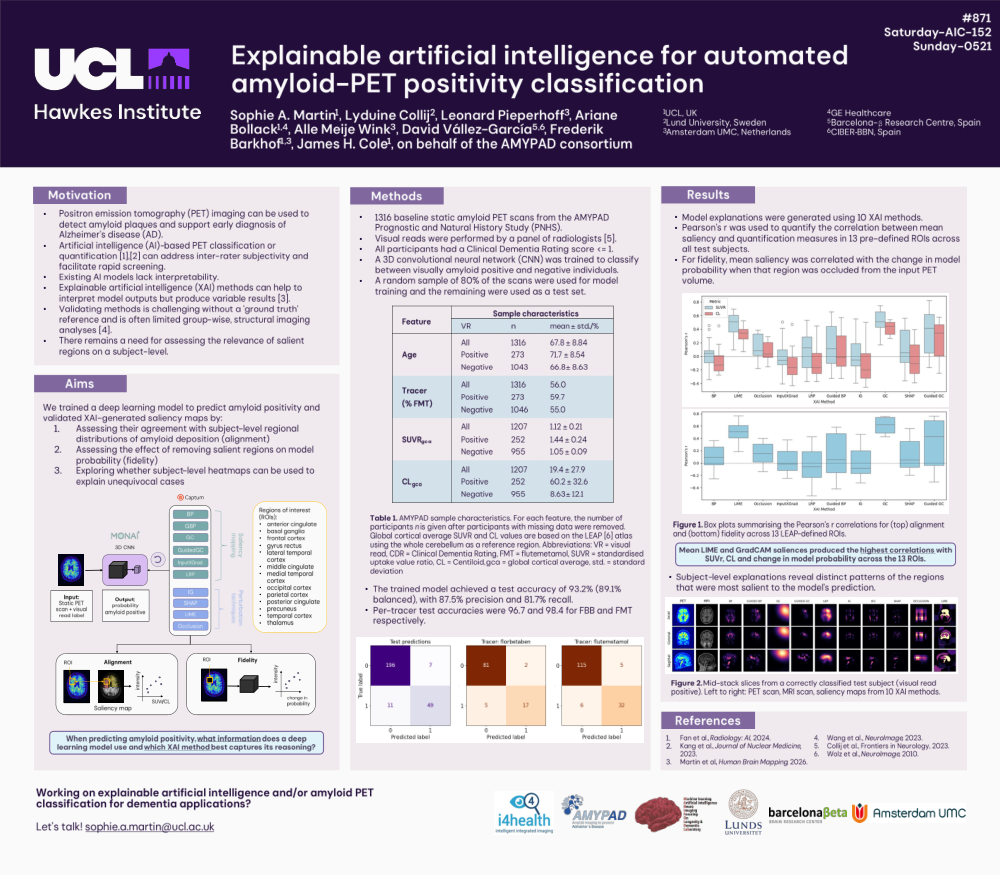
When predicting amyloid positivity, what information does a deep learning model use and which XAI method best captures its reasoning?
Mean LIME and GradCAM saliences produced the highest correlations with SUVr, CL and change in model probability across the 13 ROIs.
Comments
Email is required but is not shown publicly.
Loading comments...