4,068 posters, 219 videos, 101 topics, 69 sessions, 14,365 authors, 6,128 institutions
ePostersLive by SciGen Technologies S.A. All rights reserved.
Alzheimer's Association International Conference 2026
July 12-15, 2026 | London, United Kingdom, and Online

3000
Astroglial Reactivity Is Associated With Early Cortical Microstructural Changes In Preclinical Alzheimer’s Disease
Poster Presenter
Authors
Wiesje Pelkmans, Michalis Kassinopoulos, Jordi Huguet, Ferran Lugo, Gwendlyn Kollmorgen, Clara Quijano-Rubio, Kaj Blennow, Henrik Zetterberg, Juan Domingo Gispert, David Vállez, Marc Suárez-Calvet, Gemma Salvadó
Affiliations
Roche Diagnostics International Ltd, Rotkreuz, Switzerland, Roche Diagnostics GmbH, Penzberg, Germany, Barcelonaβeta Brain Research Center (BBRC), Pasqual Maragall Foundation, Barcelona, Spain; Hospital del Mar Research Institute, Barcelona, Spain, Barcelonaβeta Brain Research Center (BBRC), Pasqual Maragall Foundation, Barcelona, Spain;Hospital del Mar Research Institute, Barcelona, Spain, Department of Psychiatry and Neurochemistry, Institute of Neuroscience and Physiology, The Sahlgrenska Academy, University of Gothenburg, Mölndal, Sweden; Clinical Neurochemistry Laboratory, Sahlgrenska University Hospital, Mölndal, Sweden; Paris Brain Institute, ICM, Pitié-Salpêtrière Hospital, Sorbonne University, Paris, France; Neurodegenerative Disorder Research Center, Institute on Aging and Brain Disorders, University of Science and Technology of China and First Affiliated Hospital of USTC, Heifei, China, Department of Psychiatry and Neurochemistry, Institute of Neuroscience and Physiology, The Sahlgrenska Academy, University of Gothenburg, Mölndal, Sweden; Clinical Neurochemistry Laboratory, Sahlgrenska University Hospital, Mölndal, Sweden; Wisconsin Alzheimer's Disease Research Center, University of Wisconsin School of Medicine and Public Health, Madison, WI, USA, Hong Kong Center for Neurodegenerative Diseases, Hong Kong, China; Department of Neurodegenerative Disease, UCL Institute of Neurology, London, United Kingdom, Barcelonaβeta Brain Research Center (BBRC), Pasqual Maragall Foundation, Barcelona, Spain; Hospital del Mar Research Institute, Barcelona, Spain; Universitat Pompeu Fabra, Barcelona, Spain; Spanish National Center for Cardiovascular Research (CNIC), Madrid, Spain, Barcelonaβeta Brain Research Center (BBRC), Pasqual Maragall Foundation, Barcelona, Spain; Hospital del Mar Research Institute, Barcelona, Spain; Centro de Investigación Biomédica en Red Bioingeniería, Biomateriales y Nanomedicina (CIBER-BBN), Instituto de Salud Carlos III, Madrid, Spain, Barcelonaβeta Brain Research Center (BBRC), Pasqual Maragall Foundation, Barcelona, Spain; Hospital del Mar Research Institute, Barcelona, Spain; Servei de Neurologia, Hospital del Mar, Barcelona, Spain, Barcelonaβeta Brain Research Center (BBRC), Pasqual Maragall Foundation, Barcelona, Spain; Hospital del Mar Research Institute, Barcelona, Spain; Clinical Memory Research Unit, Department of Clinical Sciences, Lund University, Malmö, Sweden
Part of Topic
Background:
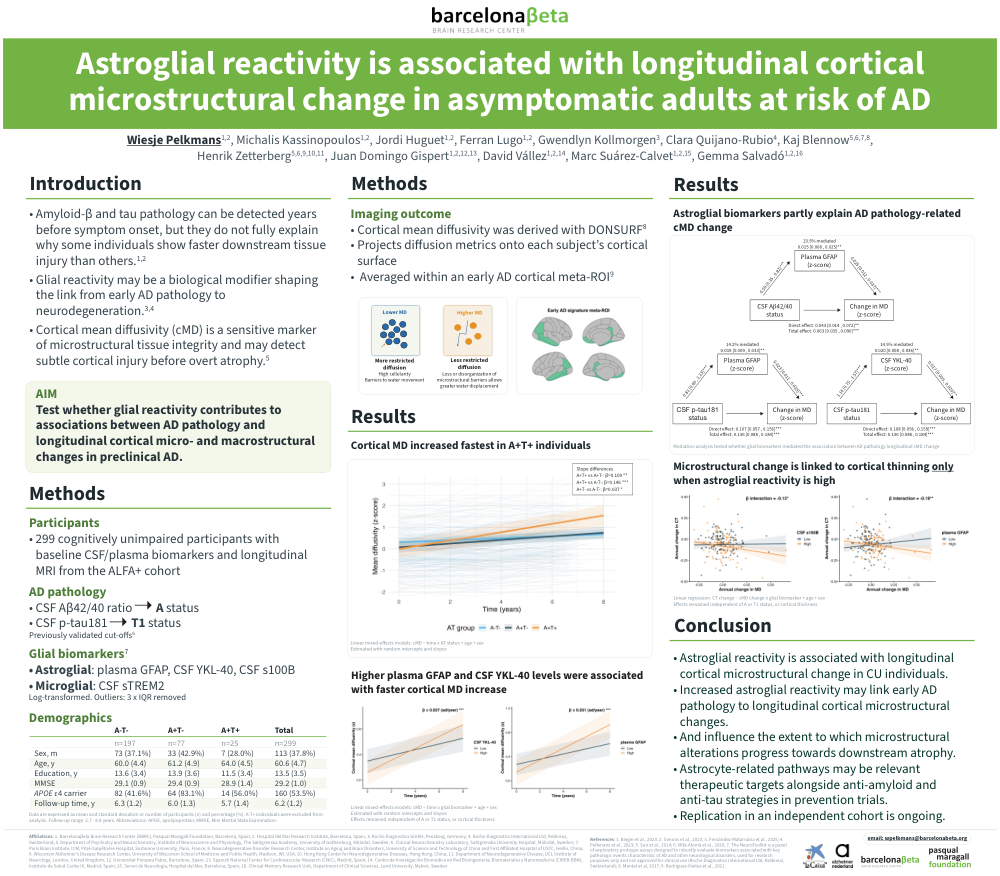
Current biomarkers enable accurate detection of amyloid-β and tau pathology years before symptoms; however, it remains unclear which individuals will subsequently develop downstream neurodegenerative changes, and how early such changes can be detected. Cortical diffusion measures may capture microstructural tissue alterations prior to overt atrophy, but their relationship to other pathophysiological events in Alzheimer’s disease (AD) is not fully understood. Here, we investigated how longitudinal change in cortical mean diffusivity (MD), a marker of cortical microstructural integrity, relates to AD pathology and biomarkers of glial reactivity.
Methods: We included 299 cognitively unimpaired participants from the ALFA+ study with baseline biomarkers of astrocytic (CSF YKL-40, CSF s100B, plasma GFAP) and microglial reactivity (CSF sTREM2), and longitudinal diffusion MRI (n=77 with two scans; n=222 with three scans; mean follow-up: 6.2 years, range: 2.7-8.8). Cortical MD was estimated using DONSURF and summarised within a previously validated early AD signature meta-ROI. AT1 status was defined using CSF Aβ42/40 and CSF p-tau181. Linear mixed-effects models tested whether AT1 stage and glial biomarkers were associated with longitudinal MD change. Mediation analyses assessed whether glial biomarkers mediated associations between AD pathology and MD change.
Results: A+T1+ participants showed steeper annual MD increases compared to both A+T1- (β=0.099, SE=0.025, p<0.001) and A-T1- (β=0.133, SE=0.023, p<0.0001); A+T1- also differed from A-T1- (β=0.034, SE=0.014, p<0.05). Higher baseline CSF YKL-40 and plasma GFAP, but not CSF s100B or CSF sTREM2, were associated with faster MD increases (both p<0.0001), independent of A and T1 status and cortical thickness. Plasma GFAP partially mediated the association of Aβ (24.3%) and p-tau (14.2%) with MD change, while CSF YKL-40 partially mediated the association of p-tau with MD change (14.5%) (all p<0.01).
Conclusions: Different aspects of astroglial reactivity, measured by GFAP and YKL-40, are differentially associated with longitudinal cortical microstructural alterations in preclinical AD. Their partial mediation of the effects of Aβ and tau pathology on increased cortical MD, i.e. less restricted diffusion, suggests a pathway linking core AD pathology and astroglial reactivity to early downstream tissue changes. These findings support exploring astrocyte-related interventions alongside anti-amyloid and anti-tau strategies in prevention trials.
Comments
Email is required but is not shown publicly.
Loading comments...