4,068 posters, 219 videos, 101 topics, 69 sessions, 14,365 authors, 6,128 institutions
ePostersLive by SciGen Technologies S.A. All rights reserved.
Alzheimer's Association International Conference 2026
July 12-15, 2026 | London, United Kingdom, and Online

10906
Advances In Neuroimmunology In The Treatment Of Progressive Supranuclear Palsy: A Systematic Review Of Monoclonal Antibodies
Poster Presenter
Authors
Vitório Serafim, Gabriela Bezerra Sorato, Henrique Werner Balbinot, Ítalo Santos Vieira, Guilherme da Rosa Raya, Ana Júlia Rodrigues Ribeiro, Ana Carolina Gomes Petry, Jessica Vargas Lopes, Tábata Smagala, Liana Lisboa Fernandez
Affiliations
Universidade Federal de Ciências da Saúde de Porto Alegre, Porto Alegre, Brazil, Department of Basic Health Sciences, Universidade Federal de Ciências da Saúde de Porto Alegre, Porto Alegre, Brazil
Part of Topic
Background: Progressive Supranuclear Palsy (PSP) is a rare, fatal neurodegenerative tauopathy with no approved disease-modifying therapies. The spread of tau pathology, potentially mediated by extracellular N-terminal (N-t) tau, is a key therapeutic target. Monoclonal antibodies emerge as a treatment option for this disease.
Methods: A systematic review was conducted using the PubMed, Embase, and Cochrane databases, with the terms “progressive supranuclear palsy,” “monoclonal antibody,” and their variations, connected by the Boolean operator AND. The inclusion criteria were cohort studies or randomized trials, while the exclusion criteria involved studies with patients presenting associated psychiatric or neurological comorbidities, interventions other than monoclonal antibody therapy, and abstracts without full-text articles. The Rayyan platform was used for blinded screening by two reviewers. Among the 713 articles identified, after removing duplicates, only 3 met the inclusion and exclusion criteria.
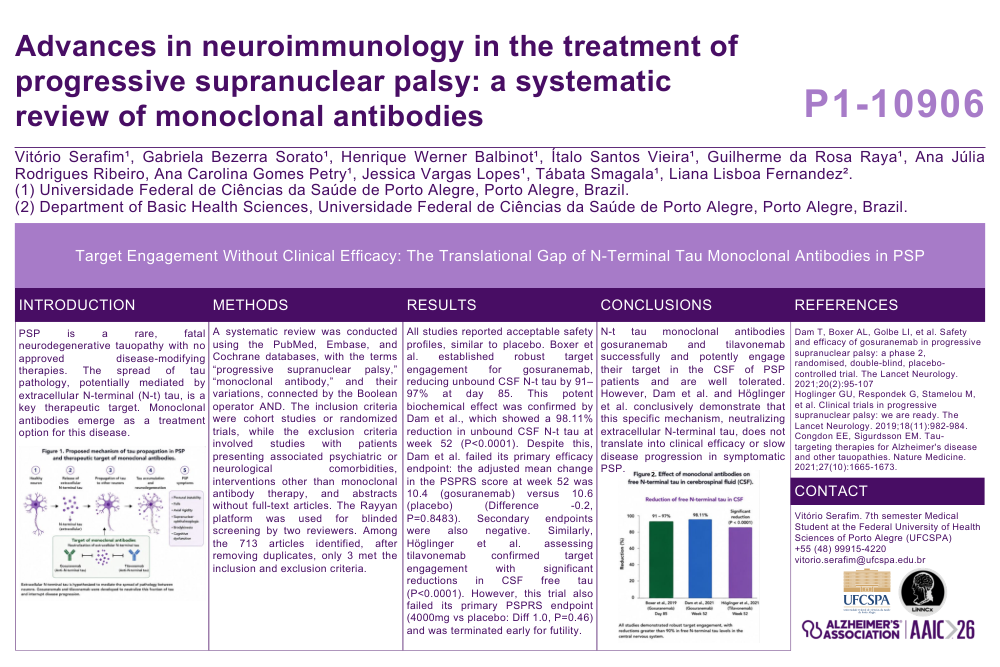
Results: All studies reported acceptable safety profiles, similar to placebo. Boxer et al. established robust target engagement for gosuranemab, reducing unbound CSF N-t tau by 91–97% at day 85. This potent biochemical effect was confirmed by Dam et al., which showed a 98.11% reduction in unbound CSF N-t tau at week 52 (P<0.0001). Despite this, Dam et al. failed its primary efficacy endpoint: the adjusted mean change in the PSPRS score at week 52 was 10.4 (gosuranemab) versus 10.6 (placebo) (Difference -0.2, P=0.8483). Secondary endpoints were also negative. Similarly, Höglinger et al. assessing tilavonemab confirmed target engagement with significant reductions in CSF free tau (P<0.0001). However, this trial also failed its primary PSPRS endpoint (4000mg vs placebo: Diff 1.0, P=0.46) and was terminated early for futility.
Conclusions: N-t tau monoclonal antibodies gosuranemab and tilavonemab successfully and potently engage their target in the CSF of PSP patients and are well tolerated. However, Dam et al. and Höglinger et al. conclusively demonstrate that this specific mechanism, neutralizing extracellular N-terminal tau, does not translate into clinical efficacy or slow disease progression in symptomatic PSP.
Comments
Email is required but is not shown publicly.
Loading comments...