4,068 posters, 219 videos, 101 topics, 69 sessions, 14,365 authors, 6,128 institutions
ePostersLive by SciGen Technologies S.A. All rights reserved.
Alzheimer's Association International Conference 2026
July 12-15, 2026 | London, United Kingdom, and Online

6776
Network-specific Patterns Of Functional Connectivity And Amyloid-ί PET Align With Tau PET In Atypical Alzheimer Disease Subtypes
Poster Presenter
Authors
Peter Millar, Stephanie Doering, Babatunde Adeyemo, Saurabh Jindal, Nicole McKay, Jeremy Strain, Julie Wisch, Gordon An, Pete Canfield, Shaney Flores, Nicholas Metcalf, June Roman, Carlos Cruchaga, Jason Hassenstab, David Holtzman, John Morris, Brian Gordon, Beau Ances, Tammie Benzinger
Affiliations
Part of Topic
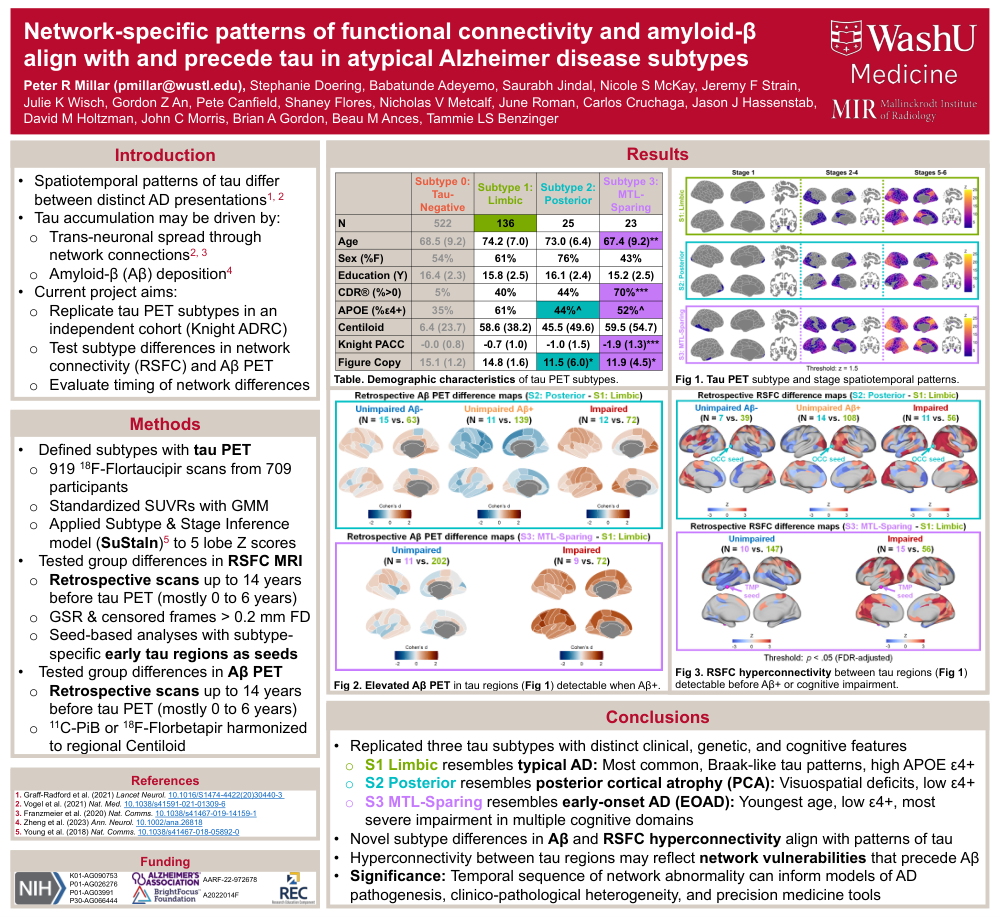
Network-specific patterns of functional connectivity and amyloid-β align with and precede tau in atypical Alzheimer disease subtypes
Peter R Millar (pmillar@wustl.edu), Stephanie Doering, Babatunde Adeyemo, Saurabh Jindal, Nicole S McKay, Jeremy F Strain, Julie K Wisch, Gordon Z An, Pete Canfield, Shaney Flores, Nicholas V Metcalf, June Roman, Carlos Cruchaga, Jason J Hassenstab, David M Holtzman, John C Morris, Brian A Gordon, Beau M Ances, Tammie LS Benzinger
Washington University in St. Louis School of Medicine
Introduction
Methods
Table. Demographic characteristics of tau PET subtypes.
Fig 1. Tau PET subtype and stage spatiotemporal patterns.
Fig 2. Elevated Aβ PET in tau regions (Fig 1) detectable when Aβ+.
Fig 3. RSFC hyperconnectivity between tau regions (Fig 1) detectable before Aβ+ or cognitive impairment.
Conclusions
References
1. Graff-Radford et al. (2021) Lancet Neurol. 10.1016/S1474-4422(20)30440-3
2. Vogel et al. (2021) Nat. Med. 10.1038/s41591-021-01309-6
3. Franzmeier et al. (2020) Nat. Comms. 10.1038/s41467-019-14159-1
4. Zheng et al. (2023) Ann. Neurol. 10.1002/ana.26818
5. Young et al. (2018) Nat. Comms. 10.1038/s41467-018-05892-0
Funding
NIH K01-AG090753, P01-AG026276, P01-AG03991, P30-AG066444
Alzheimer's Association AARF-22-972678
BrightFocus Foundation A2022014F
Research Education Component (REC)
Comments
Email is required but is not shown publicly.
Loading comments...