4,068 posters, 219 videos, 101 topics, 69 sessions, 14,365 authors, 6,128 institutions
ePostersLive by SciGen Technologies S.A. All rights reserved.
Alzheimer's Association International Conference 2026
July 12-15, 2026 | London, United Kingdom, and Online

4355
Ai-based aί Quantification Improves Concordance With Visual Reads
Poster Presenter
Authors
Pierrick Bourgeat, Jurgen Fripp, Ying Xia, Azadeh Feizpour, Reisa Sperling, Sid E. O’Bryant, Frederik Barkhof, Gill Farrar, Ariane Bollack, Lyduine E. Collij, Susan Landau, Robert Koeppe, Renaud La Joie, Michael W. Weiner, Colin L. Masters, Victor L. Villemagne, Christopher C. Rowe, Vincent Dore
Affiliations
UCL, University of Michigan, University of Pittsburgh, UCSF, Austin Health, Amsterdam UMC, CSIRO, Harvard, University of North Texas, GE, Berkeley, San Francisco Veterans Affairs Medical Center, UWA
Part of Topic
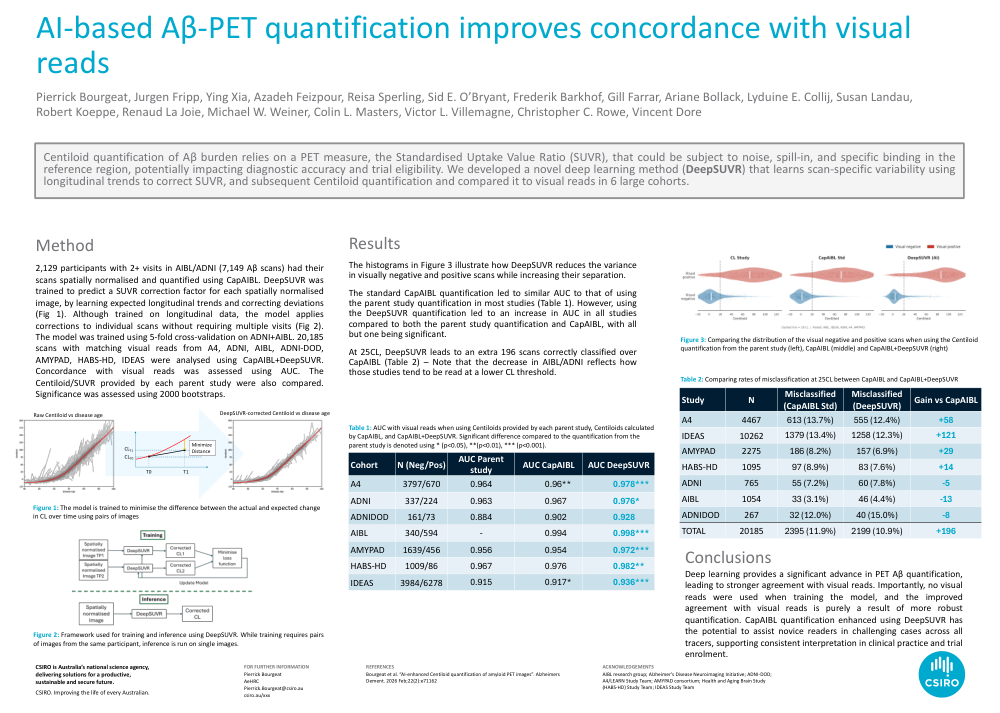
Centiloid quantification of Aβ burden relies on a PET measure, the Standardised Uptake Value Ratio (SUVR), that could be subject to noise, spill-in, and specific binding in the reference region, potentially impacting diagnostic accuracy and trial eligibility. We developed a novel deep learning method (DeepSUVR) that learns scan-specific variability using longitudinal trends to correct SUVR, and subsequent Centiloid quantification and compared it to visual reads in 6 large cohorts.
Method
2,129 participants with 2+ visits in AIBL/ADNI (7,149 Aβ scans) had their scans spatially normalised and quantified using CapAIBL. DeepSUVR was trained to predict a SUVR correction factor for each spatially normalised image, by learning expected longitudinal trends and correcting deviations (Fig 1). Although trained on longitudinal data, the model applies corrections to individual scans without requiring multiple visits (Fig 2). The model was trained using 5-fold cross-validation on ADNI+AIBL. 20,185 scans with matching visual reads from A4, ADNI, AIBL, ADNI-DOD, AMYPAD, HABS-HD, IDEAS were analysed using CapAIBL+DeepSUVR. Concordance with visual reads was assessed using AUC. The Centiloid/SUVR provided by each parent study were also compared. Significance was assessed using 2000 bootstraps.
Results
The histograms in Figure 3 illustrate how DeepSUVR reduces the variance in visually negative and positive scans while increasing their separation.
The standard CapAIBL quantification led to similar AUC to that of using the parent study quantification in most studies (Table 1). However, using the DeepSUVR quantification led to an increase in AUC in all studies compared to both the parent study quantification and CapAIBL, with all but one being significant.
At 25CL, DeepSUVR leads to an extra 196 scans correctly classified over CapAIBL (Table 2) – Note that the decrease in AIBL/ADNI reflects how those studies tend to be read at a lower CL threshold.
Conclusions
Deep learning provides a significant advance in PET Aβ quantification, leading to stronger agreement with visual reads. Importantly, no visual reads were used when training the model, and the improved agreement with visual reads is purely a result of more robust quantification. CapAIBL quantification enhanced using DeepSUVR has the potential to assist novice readers in challenging cases across all tracers, supporting consistent interpretation in clinical practice and trial enrolment.
Comments
Email is required but is not shown publicly.
Loading comments...