4,068 posters, 219 videos, 101 topics, 69 sessions, 14,365 authors, 6,128 institutions
ePostersLive by SciGen Technologies S.A. All rights reserved.
Alzheimer's Association International Conference 2026
July 12-15, 2026 | London, United Kingdom, and Online

1497
ARIA-E Lesion Topography In Real-world ARIA Monitoring Data From 4 Us Sites
Poster Presenter
Authors
Part of Topic
Background
As anti-amyloid therapies become available in the clinic, it is important to better understand the phenomenon known as amyloid related imaging abnormality (ARIA). . Multiple studies have demonstrated that when ARIA occurs it shows a predilection for the posterior lobes of the brain, but why this happens is not fully understood. We investigated the spatial distribution of ARIA-E across the brain using real-world evidence (RWE) from 4 US sites (including non-academic centers) collected from January through December 2025.
Methods
FLAIR MRI data from 81 ARIA-E positive patients, with a median of 3 ARIA assessments (1 to 10 per patient), were processed with a proprietary analysis (Icobrain ARIA)icobrain aria. For each patient, we extracted the maximum ARIA-E lesion volume for 10 brain regions and analyzed its distribution with and without controlling for region volume: bilateral frontal, temporal, parietal, and occipital cortices, cerebellum, and remaining regions.
Results
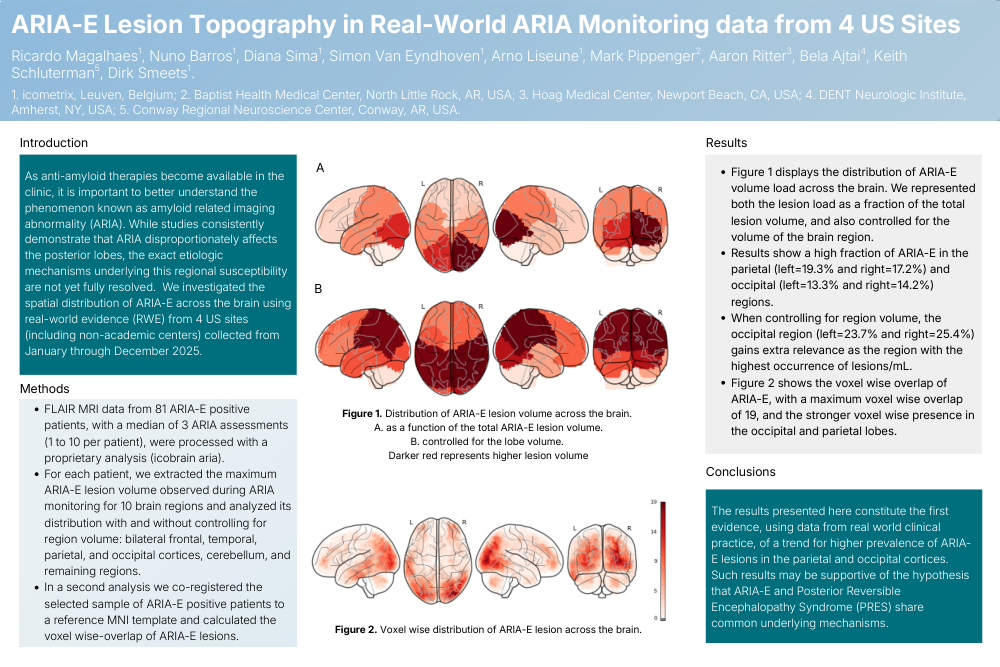
Figure 1 displays the distribution of ARIA-E volume load across the brain. We represented both the lesion load as a fraction of the total lesion volume, and also controlled for the volume of the brain region. Our results show a high fraction of ARIA-E in the parietal (left=19.3% and right=17.2%) and occipital (left=13.3% and right=14.2%) regions. When controlling for region volume, the occipital region (left=23.7% and right=25.4%) gains extra relevance as the region with the highest occurrence of lesions/mL.
Conclusions
The results presented here constitute the first evidence, using data from real world clinical practice, of a trend for higher prevalence of ARIA-E lesions iin the parietal and occipital cortices. Such results may be supportive of the hypothesis that ARIA-E and Posterior Reversible Encephalopathy Syndrome (PRES) share common underlying mechanisms.
Comments
Email is required but is not shown publicly.
Loading comments...