4,068 posters, 219 videos, 101 topics, 69 sessions, 14,365 authors, 6,128 institutions
ePostersLive by SciGen Technologies S.A. All rights reserved.
Alzheimer's Association International Conference 2026
July 12-15, 2026 | London, United Kingdom, and Online

4068
Repetitive Transcranial Magnetic Stimulation In Severe Alzheimer Disease: A Meta-analytic Evaluation Of Cognitive Outcomes
Poster Presenter
Part of Topic
BACKGROUND & OBJECTIVE
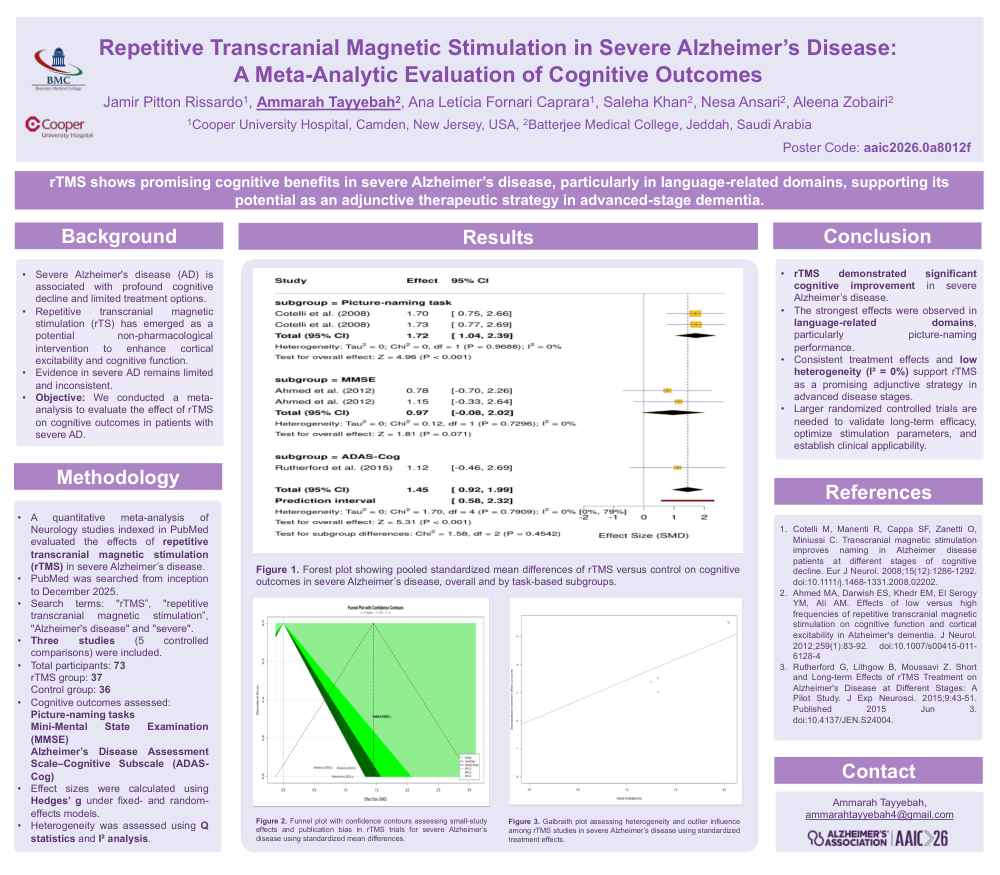
Severe Alzheimer’s disease (AD) is marked by profound cognitive impairment and limited therapeutic options once conventional pharmacologic treatments lose efficacy. Noninvasive brain stimulation, particularly repetitive transcranial magnetic stimulation (rTMS), has emerged as a potential strategy to modulate residual cortical networks even in late disease stages. While rTMS has been studied more extensively in mild-to-moderate AD, its efficacy in severe AD remains unclear. This study aimed to systematically evaluate the effects of rTMS on cognitive outcomes in patients with severe Alzheimer’s disease using data from PubMed-indexed clinical trials.
METHODS
A quantitative meta-analysis was conducted including PubMed-listed studies examining rTMS in severe AD populations. Five controlled comparisons from three studies (PMID: 19049544, 21671144, 26064066) were included, encompassing 73 participants (37 rTMS-treated, 36 controls). Cognitive outcomes were measured using picture-naming tasks, Mini-Mental State Examination (MMSE), and Alzheimer’s Disease Assessment Scale–Cognitive Subscale (ADAS-Cog). Effect sizes were calculated using Hedges’ g under both fixed and random effects models. Heterogeneity was assessed using Q statistics and I² indices.
RESULTS
rTMS demonstrated a significant positive effect on cognitive performance in severe AD. The pooled standardized mean difference was 1.45 (95% CI: 0.92–1.99; p < 0.01), with no observed heterogeneity (I² = 0%). Subgroup analyses revealed the largest effects in language-based picture-naming tasks (SMD = 1.72; 95% CI: 1.04–2.39). MMSE outcomes showed a moderate, though not statistically definitive, benefit (SMD = 0.97; 95% CI: −0.08 to 2.02), while ADAS-Cog results from a single study suggested a favorable trend. No significant subgroup differences were detected.
CONCLUSIONS
rTMS is associated with significant cognitive improvement in severe AD, particularly in language-related domains. Despite small sample sizes, the consistency of effect and lack of heterogeneity support rTMS as a promising adjunctive intervention in advanced AD. Larger, rigorously controlled trials are warranted to confirm durability, optimize stimulation parameters, and determine clinical applicability in late-stage disease.
Comments
Email is required but is not shown publicly.
Loading comments...