4,068 posters, 219 videos, 101 topics, 69 sessions, 14,365 authors, 6,128 institutions
ePostersLive by SciGen Technologies S.A. All rights reserved.
Alzheimer's Association International Conference 2026
July 12-15, 2026 | London, United Kingdom, and Online

9893
Lower State Anxiety And White Matter Hyperintensity Volumes Characterize Superagers Identified Through Multiple Verbal Memory Tests
Poster Presenter
Authors
Part of Topic
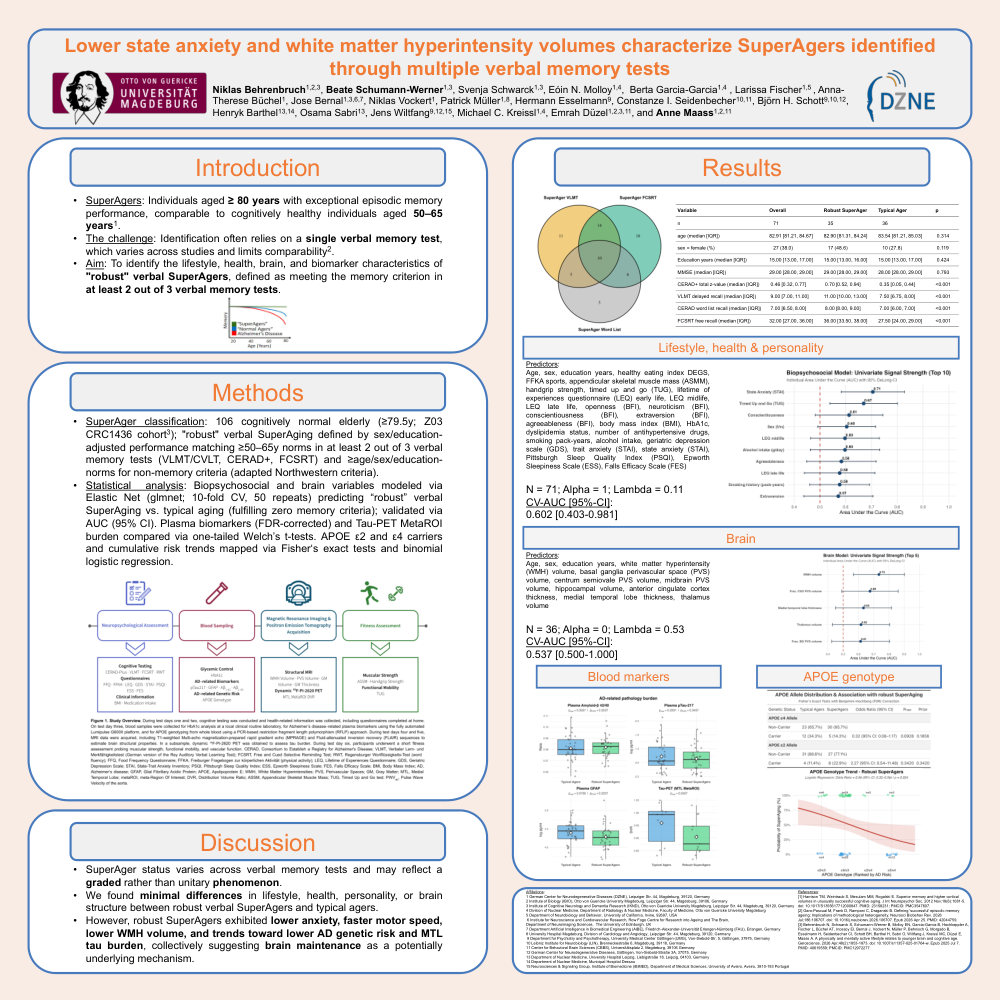
Background: SuperAgers have exceptional verbal memory for their age. Their identification remains nonetheless challenging: the use of different verbal memory tests across studies and reliance on a single verbal memory test within studies raise concerns regarding the consistency and robustness of the SuperAger status. Here, we incorporated multiple verbal memory measures to strengthen the identification process, and studied lifestyle, health, brain and biomarker characteristics as potential contributors to successful cognitive aging.
Methods: We grouped a sample of 106 cognitively normal older adults aged ≥ 79.5 years [age: (83.51±2.78) years, 46 females] from an ongoing study (CRC1436) into SuperAgers and typical agers based on three verbal memory tests (Verbaler Lern- und Merkfähigkeitstest (VLMT) delayed recall, CERAD-Plus word list recall, Free and Cued Selective Reminding Test (FCSRT) free recall [picture version]) and non-memory criteria in analogy to Northwestern criteria. Participants had to be ≥ sex- and education-adjusted z-value of zero for age 57.5 years (word list, FCSRT) or ≥ the sex- and education-specific median value for the age group 50-65 years (VLMT). SuperAgers met the verbal memory criterion in at least two out of three tests in addition to the non-memory criteria, while typical agers did not meet the verbal memory criterion on any test (irrespective of the non-memory criteria). Groups were statistically compared with regard to several lifestyle, health, brain structural, and AD-risk characteristics (see Figure1 for details).
Results: We identified 27, 25, and 10 individuals that fulfilled the verbal memory criterion for one, two and three tests (and the non-memory criteria), respectively (Figure2). Compared with typical agers (n=36), SuperAgers meeting verbal memory criteria in ≥ 2 tests (n=35) had lower state anxiety (padj=0.006) and lower white matter hyperintensity volume (padj=0.03), and they trended towards faster Timed-Up-and-Go times (p=0.07), and lower medial temporal lobe tau burden (p=0.06; Table1).
Conclusions: SuperAger status varies across verbal memory tests and reflects a graded rather than unitary phenomenon. Our findings indicate that SuperAgers with convergent memory performance across multiple tests are characterized by brain maintenance (resistance against age-related pathology) and better bodily and psychological wellbeing.
Comments
Email is required but is not shown publicly.
Loading comments...