4,068 posters, 219 videos, 101 topics, 69 sessions, 14,365 authors, 6,128 institutions
ePostersLive by SciGen Technologies S.A. All rights reserved.
Alzheimer's Association International Conference 2026
July 12-15, 2026 | London, United Kingdom, and Online

5882
FreeSurfer Morphometry Is Sensitive To T2-Weighted Inputs And Manual Editing: A Multi-Cohort Assessment
Poster Presenter
Authors
Haley Wiskoski, Raza Mushtaq, Simeon Smith, Caleb Boehler, Summan Zahra, Juan Arias, Scott French, Edward Bedrick, Kevin Johnson, Maria Altbach, Gene Alexander, Theodore Trouard, Craig Weinkauf
Affiliations
Department of Biomedical Engineering, University of Arizona, Tucson, AZ. USA; Department of Surgery, University of Arizona, Tucson, AZ. USA, Department of Neuroradiology, Barrow Neurological Institute, Phoenix, AZ, USA, Department of Radiology and Imaging Sciences, University of Arizona, Tucson, AZ, USA, Department of Surgery, University of Arizona, Tucson, AZ. USA, Department of Epidemiology and Biostatistics, University of Arizona, Tucson, AZ, USA, Department of Biomedical Engineering, University of Arizona, Tucson, AZ, USA; Department of Radiology and Imaging Sciences, University of Arizona, Tucson, AZ, USA, BIO5 Research Institute, University of Arizona, Tucson, AZ, USA; Evelyn F. McKnight Brain Institute, Tucson, AZ, USA; Departments of Psychology and Psychiatry and Neuroscience and Physiological Sciences Graduate Interdisciplinary Programs, University of Arizona, Tucson, AZ, USA; Arizona Alzheimer’s Consortium, Phoenix, AZ, USA, Department of Biomedical Engineering, University of Arizona, Tucson, AZ, USA; Department of Radiology and Imaging Sciences, University of Arizona, Tucson, AZ, USA; BIO5 Research Institute, University of Arizona, Tucson, AZ, USA; Evelyn F. McKnight Brain Institute, Tucson, AZ, USA, Department of Biomedical Engineering, University of Arizona, Tucson, AZ, USA; Department of Surgery, University of Arizona, Tucson, AZ, USA; Department of Neuroscience, University of Arizona, Tucson, AZ, USA
Part of Topic
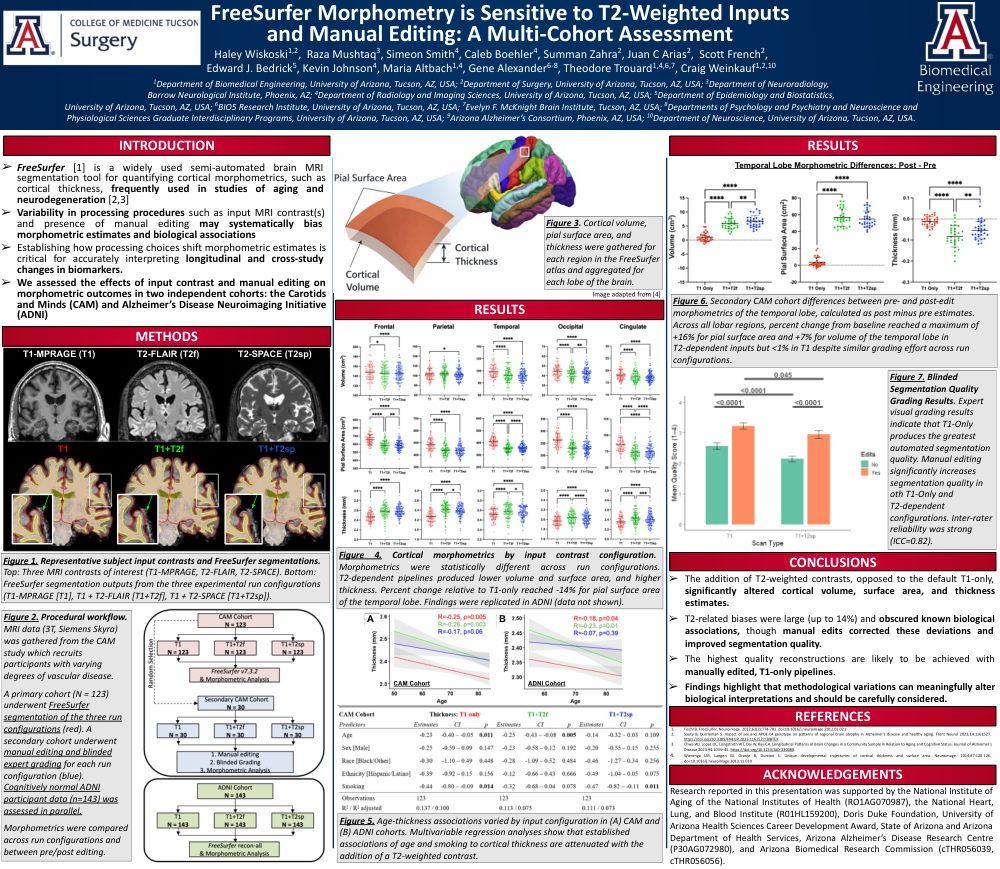
Background: FreeSurfer is a widely used semi-automated brain MRI segmentation tool for quantifying cortical morphometrics, such as cortical thickness, frequently used in studies of aging and neurodegeneration. Variability in processing procedures such as input MRI contrast(s) and presence of manual editing maysystematically bias morphometric estimates and biological association. Establishing how processing choices shift morphometric estimates is critical for accurately interpreting longitudinal and cross-study changes in biomarkers. We assessed the effects of input contrast and manual editing on morphometric outcomes in two independent cohorts: the Carotids and Minds (CAM) and Alzheimer’s Disease Neuroimaging Initiative (ADNI)
Methods: CAM (n=123) and ADNI (n=143) underwent 3T brain MRI following ADNI-4 protocols. FreeSurfer(v7.3.2) was run with three input configurations: T1-MPRAGE, T1+T2-FLAIR (T1+T2f), and T1+T2-SPACE (T1+T2sp). Lobar cortical gray matter volume, pial surface area (SA), white matter SA, and cortical thickness were assessed across configurations. Multiple linear regressions were used to examine cortical thickness associations. A subset of the CAM cohort underwent manual editing; the effects of which were assessed via three-expert visual grading pre/post edits.
Results: CAM cohort results demonstrated that T2-dependent pipelines produced significantly lower volumes and surface area measures, and significantly higher estimates of cortical thickness, compared to T1-only. Findings were reproduced in the ADNI cohort with cross-contrast differences reaching ~14% for pial surface area of the temporal lobe (all p<0.0001). In CAM, T1-only-derived cortical thickness was significantly associated with established biological correlates, age and smoking (p=0.011 and 0.014); T1+T2f and T1+T2sp only captured significant associations with one factor or the other. Similar variations were observed in ADNI: age associations were captured with T1-only and T1+T2f (p=0.007 and 0.008) but not T1+T2sp (p=0.30). Sex, race, and ethnicity relationships also varied across contrasts. Expert grading (ICC=0.82) revealed T1-only produced the greatest baseline segmentation quality (p<0.0001) and manual editing significantly improved quality across inputs resulting in comparable post-edit quality (p=0.045). In all lobar regions, all morphometric estimates were statistically similar across input contrasts after manual editing.
Conclusion: The addition of T2-weighted contrasts, opposed to the default T1-only, significantly altered cortical volume, surface area, and thickness estimates. T2-related biases were large (up to 14%) and obscured known biological associations, though manual edits corrected these deviations and improved segmentation quality. The highest quality reconstructions are likely to be achieved with manually edited, T1-only pipelines. Findings highlight that methodological variations can meaningfully alter biological interpretations and should be carefully considered.
Comments
Email is required but is not shown publicly.
Loading comments...