4,068 posters, 219 videos, 101 topics, 69 sessions, 14,365 authors, 6,128 institutions
ePostersLive by SciGen Technologies S.A. All rights reserved.
Alzheimer's Association International Conference 2026
July 12-15, 2026 | London, United Kingdom, and Online

4199
Do Csf aβ42 Increases Predict Cognitive Benefit? Evidence From Alzheimer’s Disease Trials
Part of Topic
BACKGROUND
Anti-amyloid therapies aim to modify Alzheimer’s disease pathology by reducing amyloid burden, and CSF Aβ42 is a key biomarker of target engagement; however, its relationship with cognitive and behavioral outcomes remains uncertain, which is critical for validating surrogate endpoints and guiding trial design. The objective of this study was to evaluate whether changes in CSF Aβ42 correlate with clinical outcomes measured by Mini-Mental State Examination (MMSE), Neuropsychiatric Inventory (NPI), and Clinical Dementia Rating Scale Sum of Boxes (CDR-SB) in anti-amyloid trials.
METHODS
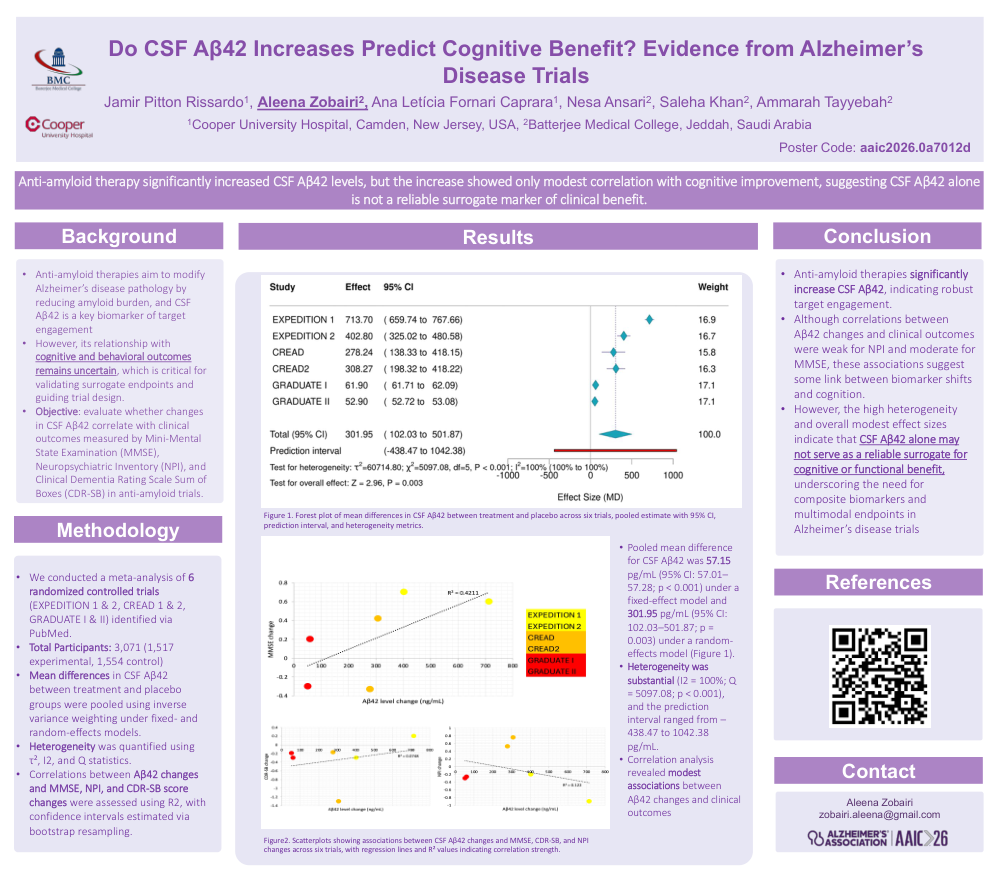
We conducted a meta-analysis of six randomized controlled trials (EXPEDITION 1 & 2, CREAD 1 & 2, GRADUATE I & II) identified via PubMed. Mean differences in CSF Aβ42 between treatment and placebo groups were pooled using inverse variance weighting under fixed- and random-effects models. Heterogeneity was quantified using τ², I2, and Q statistics. Correlations between Aβ42 changes and MMSE, NPI, and CDR-SB score changes were assessed using R2, with confidence intervals estimated via bootstrap resampling.
RESULTS
Across 3,071 participants (1,517 experimental; 1,554 control), pooled mean difference for CSF Aβ42 was 57.15 pg/mL (95% CI: 57.01–57.28; p < 0.001) under a fixed-effect model and 301.95 pg/mL (95% CI: 102.03–501.87; p = 0.003) under a random-effects model (Figure 1). Heterogeneity was substantial (I2 = 100%; Q = 5097.08; p < 0.001), and the prediction interval ranged from –438.47 to 1042.38 pg/mL. Correlation analysis revealed modest associations between Aβ42 changes and clinical outcomes (Figure 2): MMSE (R2 = 0.42; 95% CI: 0.01–0.81), NPI (R2 = –0.12; 95% CI: –0.01, –0.47), and CDR-SB (R2 = 0.07; 95% CI: 0.01–0.34).
CONCLUSIONS
Anti-amyloid therapies significantly increase CSF Aβ42, indicating robust target engagement. Although correlations between Aβ42 changes and clinical outcomes were weak for NPI and moderate for MMSE, these associations suggest some link between biomarker shifts and cognition. However, the high heterogeneity and overall modest effect sizes indicate that CSF Aβ42 alone may not serve as a reliable surrogate for cognitive or functional benefit, underscoring the need for composite biomarkers and multimodal endpoints in Alzheimer’s disease trials.
Comments
Email is required but is not shown publicly.
Loading comments...