4,068 posters, 219 videos, 101 topics, 69 sessions, 14,365 authors, 6,128 institutions
ePostersLive by SciGen Technologies S.A. All rights reserved.
Alzheimer's Association International Conference 2026
July 12-15, 2026 | London, United Kingdom, and Online

7060
Artificial Intelligence For Amyloid PET Interpretation In Alzheimer's Disease: A Systematic Review
Poster Presenter
Authors
Callum Hill, Huw Morgan, Emmanuel Ogunsakin, Evie Day, Tunchanok Ngamsaowaros, Roberto Martinez Camacho, Mahesan Niranjan, Sofia Michopoulou
Affiliations
Faculty of Medicine, University of Southampton, Southampton, UK, School of Electronics and Computer Science, University of Southampton, Southampton, UK, Medical Physics, University Hospital Southampton NHS Foundation Trust, Southampton, UK, Faculty of Medicine, University of Southampton, Southampton, UK, Medical Physics, University Hospital Southampton NHS Foundation Trust, Southampton, UK
Part of Topic
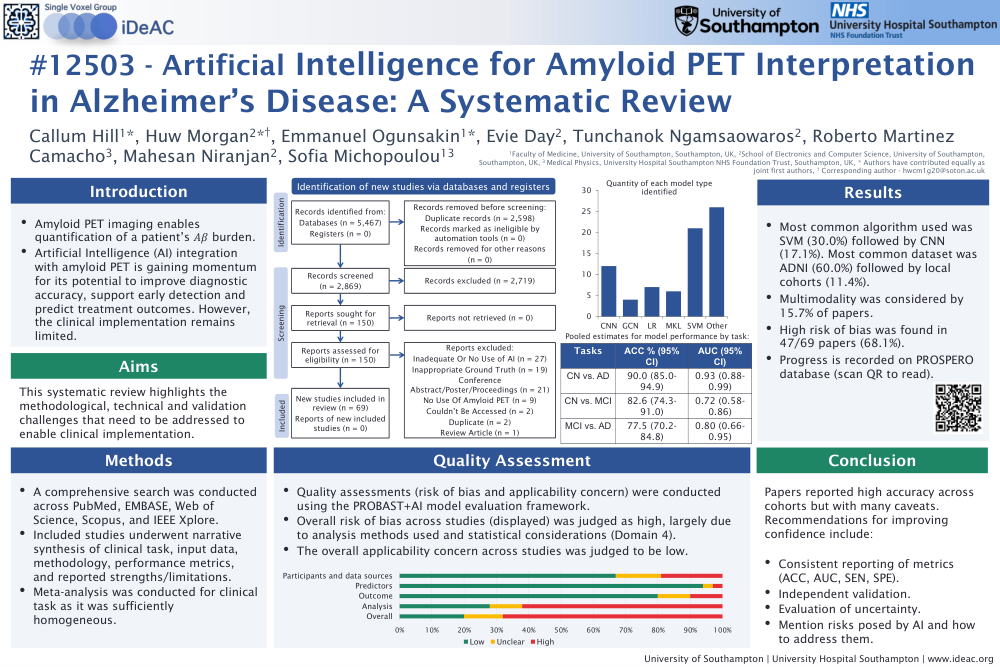
Background: Alzheimer's Disease (AD) is the most prevalent form of dementia, characterised by amyloid-beta (Aϐ) deposition, tau pathology and progressive neurodegeneration, with recent research highlighting the importance of Aϐ in the onset of AD. Amyloid PET imaging allows the quantification of a patient’s Aϐ burden. Artificial Intelligence (AI), encompassing machine learning and deep learning techniques, has advanced rapidly and can be applied to complex medical data such as amyloid PET images. The integration of AI and amyloid PET imaging has gained momentum due to its potential to improve diagnostic accuracy, support early detection and predict treatment outcomes. Despite these advancements, the clinical implementation of these techniques is limited. We are conducting a systematic review to highlight the methodological, technical and validation challenges that need to be addressed in order to realise clinical implementation.
Methods: A comprehensive search of the following databases was carried out; PubMed, EMBASE, Web of Science, Scopus and IEEE Xplore. The study protocol is available on PROSPERO (ID:CRD420251234913). Following the screening process, included studies will undergo a narrative synthesis summarising the clinical task, input data, methodology, diagnostic and prognostic performance metrics, and reported strengths and limitations. Where there is sufficient homogeneity in population, clinical task and methodology, a meta-analysis will be conducted.
Results: The systematic review aims to highlight the current uses of AI with amyloid PET in AD clinical tasks. Our search returned 2,869 articles after de-duplication between databases. After initial abstract screening, 133 papers have been selected for further review. Our initial findings suggest that the most commonly used methods are Support Vector Machines (n=27) and Convolutional Neural Networks (n=26), with the latter quickly growing in popularity (1 in 2020 and 6 in 2023) and becoming the most used in recent years. The narrative synthesis and meta-analysis of selected studies aims to provide a comprehensive overview of the strengths and limitations of AI-driven amyloid PET tools.
Conclusion: This systematic review will contribute to the understanding of the use of AI in amyloid PET imaging and highlight the strengths and weaknesses of current approaches, and outline future developments needed to implement these tools in clinical practice.
Comments
Email is required but is not shown publicly.
Loading comments...