4,068 posters, 219 videos, 101 topics, 69 sessions, 14,365 authors, 6,128 institutions
ePostersLive by SciGen Technologies S.A. All rights reserved.
Alzheimer's Association International Conference 2026
July 12-15, 2026 | London, United Kingdom, and Online

10639
Eligibility Criteria Of Anti-amyloid Therapies: How Many Patients Are Able To Do It In A Cross-sectional Study?
Poster Presenter
Authors
Part of Topic
Title: Eligibility Criteria of Anti-Amyloid Therapies: How Many Patients Are Able to Do It in a Cross-Sectional Study?
Authors: Francisco Durand da Costa¹, Fernando Lazzaretti², Lucas Schilling³, Cristiano Schaffer Aguzzoli³
¹ Neuro Cognition Laboratory, Brain Institute of Rio Grande do Sul, Porto Alegre, Brazil ² Pontifícia Universidade Católica do Rio Grande do Sul, Porto Alegre, Brazil ³
Background: The development of Anti-Amyloid Therapies (AAT), including donanemab and lecanemab, for Alzheimer’s Disease (AD) has shown impact in delaying the progression of the disease and its symptoms. Despite the benefits of the therapies, AAT are restricted to a limited number of AD patients due to their inclusion and exclusion criteria. Also, the high costs of the medication, screening and follow-up make the therapy expensive, especially in low-income countries such as Brazil. Here, we presented and analysed a cross-sectional study of patients in a public system memory clinic, in order to assess the potential application of these new therapies in this real-life scenario, discussing results and impacts.
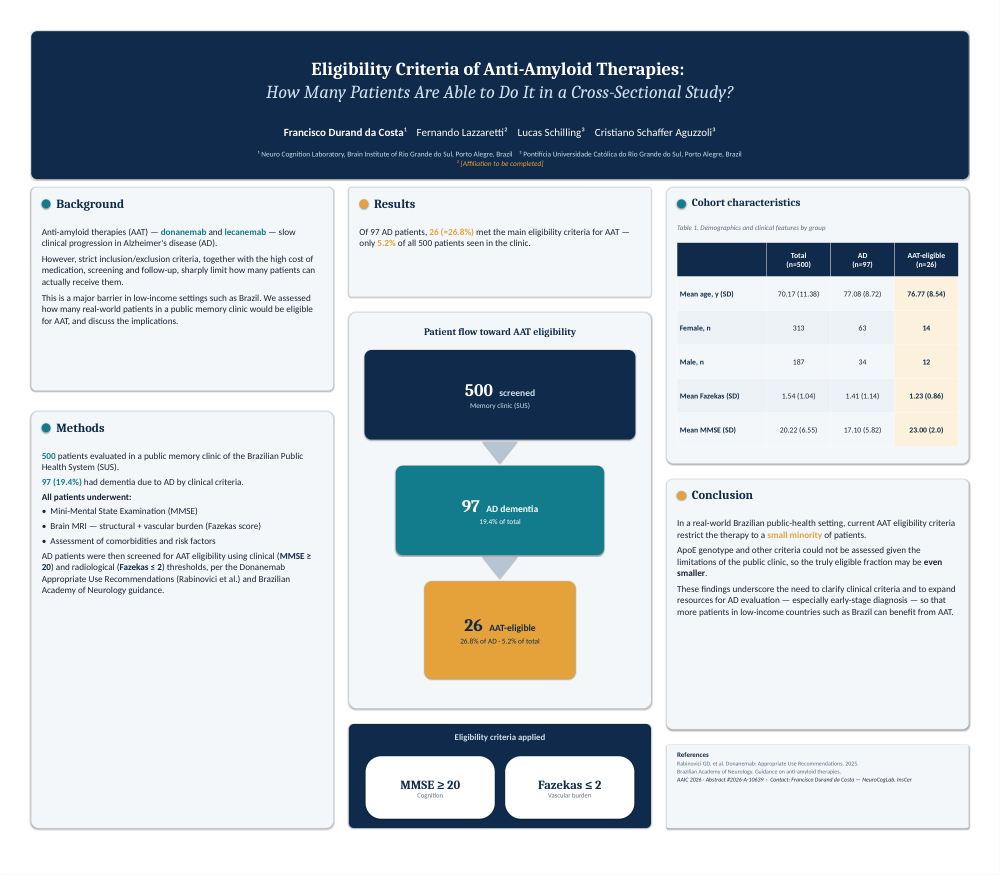
Methods: We studied 500 patients in a Sistema Único de Saúde (SUS) — Brazilian Public Health System — memory clinic. We then identified 97 (19.4%) patients who presented dementia due to AD based on clinical criteria. All the individuals performed a clinical assessment with the Mini-Mental State Examination (MMSE), a radiological screening with Magnetic Resonance Imaging (MRI), including structural and vascular features (Fazekas score), and also a clinical evaluation of comorbidities and risk factors. Further, all AD patients’ data were analyzed to identify which could be eligible for AAT based on clinical data (MMSE ≥ 20) and radiological features (Fazekas score ≤ 2).
Results: From 97 AD patients, 26 (≈26.8%) individuals met the main eligibility criteria for AAT [Table 1], following the Donanemab Appropriate Use Recommendations (Rabinovici et al.) and the Brazilian Academy of Neurology guidelines on AAT. The group of patients able to undergo AAT represents 5.2% of the total (n=500) in the memory clinic.
Conclusion: Our study suggests AAT eligibility criteria in a real-life public scenario in Brazil restrict this therapy. However, in this study we did not assess ApoE status and other criteria due to the limitations of the public memory clinic. Even so, the study suggests just a small group would be able to undergo AAT, making it necessary to better understand the clinical criteria. In the future, low-income countries such as Brazil may provide more resources for evaluating AD patients, mainly for early-stage diagnosis, in order to benefit more patients with AAT.
Comments
Email is required but is not shown publicly.
Loading comments...