4,068 posters, 219 videos, 101 topics, 69 sessions, 14,365 authors, 6,128 institutions
ePostersLive by SciGen Technologies S.A. All rights reserved.
Alzheimer's Association International Conference 2026
July 12-15, 2026 | London, United Kingdom, and Online

4047
A Meta-analysis Of TSPO Neuroinflammation Pet Imaging In Neurodegenerative Diseases
Poster Presenter
Authors
Peter Swann, Axel Laurell, Harry Crook, Leonidas Chouliaras, Maura Malpetti, Ajenthan Surendranathan, Simon Jones, Timothy Rittman, Nicholas Nacastro, Negin Holland, Li Su, Franklin Aigbirhio, James Rowe, John O'Brien, Elijah Mak
Affiliations
University of Cambridge, University College Hospitals, Mayo Clinic, Rochester
Part of Topic
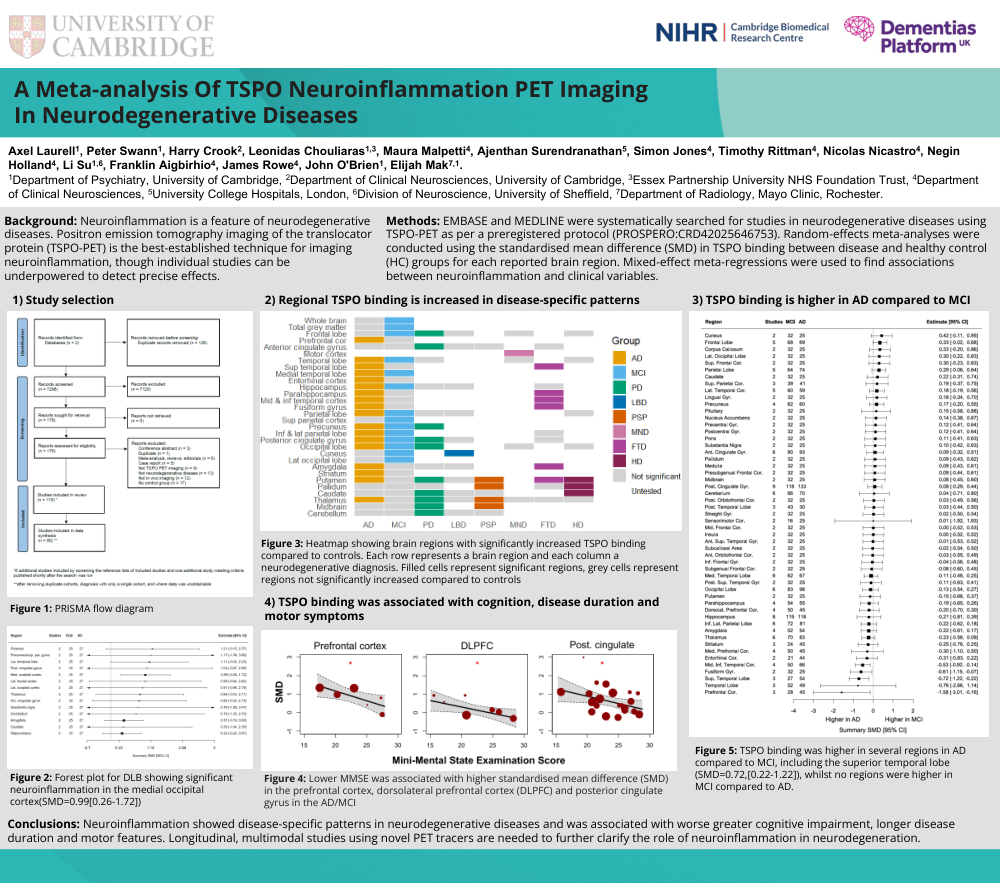
Neuroinflammation is a feature of neurodegenerative diseases, although it is unclear whether this follows disease-specific patterns. Positron emission tomography imaging of the translocator protein (TSPO-PET) is the best-established technique for imaging neuroinflammation, though individual studies can be underpowered to detect precise effects. We used meta-analysis and meta-regression to assess disease-specific patterns of neuroinflammation and its association with clinical features across neurodegenerative dementias.
EMBASE and MEDLINE were systematically searched for studies in neurodegenerative diseases using TSPO-PET as per a preregistered protocol (PROSPERO:CRD42025646753). Random-effects meta-analyses were conducted using the standardised mean difference (SMD) in TSPO binding between disease and healthy control (HC) groups for each reported brain region. Mixed-effect meta-regressions were used to find associations between neuroinflammation and mini-mental state examination (MMSE), disease duration (DD) and Unified Parkinson's Disease Rating Scale (UPDRS-III) in brain regions measured by at least 5 studies.
7296 articles were screened identifying 60 cohorts (1065 patients and 1051 controls) across 10 diseases. We found increased TSPO binding in disease-specific patterns for all examined diseases compared to HC. This included the temporal lobe in Alzheimer’s disease (AD) and mild cognitive impairment (MCI) (AD:SMD=0.67, 95% confidence interval [0.11-1.23], MCI:SMD=0.96[0.58-1.34]), medial occipital cortex in dementia with Lewy bodies (DLB) (SMD=0.99[0.26-1.72]), inferior/middle temporal gyrus in frontotemporal dementia (SMD=1.19[0.69-1.70]), pallidum in progressive supranuclear palsy (SMD=1.05[0.41-1.68]), caudate in Huntington’s disease (SMD=1.00[0.24-1.75]), and putamen in Parkinson’s disease (PD) (SMD=0.56[0.12-1.00]). TSPO binding was higher in several regions in AD compared to MCI, including the superior temporal lobe (SMD=0.72,[0.22-1.22]), whilst no regions were higher in MCI compared to AD. Lower MMSE in AD/MCI was associated with higher binding in the prefrontal cortex (B:-0.11,p=0.03) and posterior cingulate gyrus (B:-0.08,p=0.04). Longer DD was associated with higher binding in the thalamus (B:0.32,p=0.04) in AD/MCI, and in the caudate (B=0.18,p=0.05), putamen (B=0.23,p=0.009) and thalamus (B=0.13,p=0.005) in PD/DLB. Lower UPDRS-III was associated with higher binding in multiple regions in PD/DLB.
Neuroinflammation showed disease-specific patterns in neurodegenerative diseases and was associated with worse greater cognitive impairment, longer DD and motor features. Longitudinal, multimodal studies using novel PET tracers are needed to further clarify the role of neuroinflammation in neurodegeneration.
Comments
Email is required but is not shown publicly.
Loading comments...