4,068 posters, 219 videos, 101 topics, 69 sessions, 14,365 authors, 6,128 institutions
ePostersLive by SciGen Technologies S.A. All rights reserved.
Alzheimer's Association International Conference 2026
July 12-15, 2026 | London, United Kingdom, and Online

275
Entorhinal Cortex Volume As A Predictor Of Visuospatial Decline, Specificity And Dual Mediation Via Tau And Navigation
Part of Topic
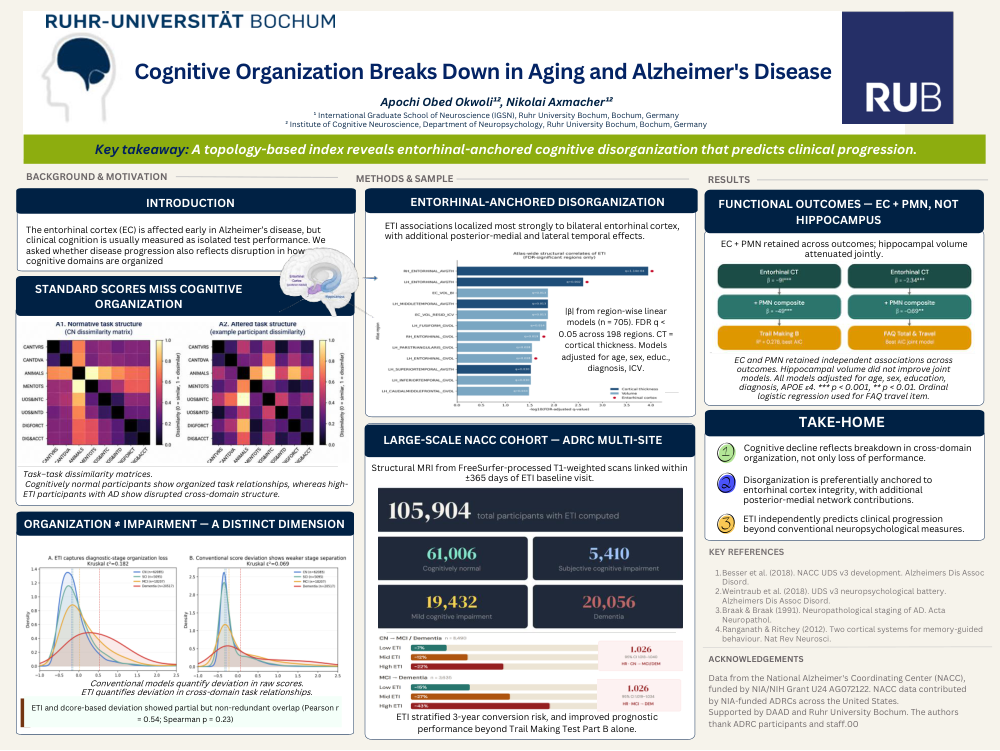
Cognitive Organization Breaks Down in Aging and Alzheimer’s Disease
Apochi Obed Okwoli¹², Nikolai Axmacher¹²
¹ International Graduate School of Neuroscience, Ruhr University Bochum, Bochum, Germany
² Institute of Cognitive Neuroscience, Department of Neuropsychology, Ruhr University Bochum, Bochum, Germany
Key takeaway: A topology-based index reveals entorhinal-anchored cognitive disorganization that predicts clinical progression.
Background & Motivation
Introduction
The entorhinal cortex is affected early in Alzheimer’s disease, but clinical cognition is usually measured as isolated test performance. We asked whether disease progression also reflects disruption in how cognitive domains are organized.
Standard Scores Miss Cognitive Organization
Task–task dissimilarity matrices show that cognitively normal participants have organized task relationships, whereas high-ETI participants with Alzheimer’s disease show disrupted cross-domain structure.
Organization ≠ Impairment — A Distinct Dimension
Conventional models quantify deviation in raw scores.
ETI quantifies deviation in cross-domain task relationships.
ETI and dcor-based deviation showed partial but non-redundant overlap:
Pearson r = 0.54; Spearman ρ = 0.23
Methods & Sample
Large-Scale NACC Cohort — ADRC Multi-Site
Structural MRI from FreeSurfer-processed T1-weighted scans linked within ±365 days of ETI baseline visit.
Total participants with ETI computed: 105,904
Diagnostic groups:
-
Cognitively normal: 61,006
-
Subjective cognitive impairment: 5,410
-
Mild cognitive impairment: 19,432
-
Dementia: 20,056
ETI stratified 3-year conversion risk and improved prognostic performance beyond Trail Making Test Part B alone.
Results
Entorhinal-Anchored Disorganization
ETI associations localized most strongly to bilateral entorhinal cortex, with additional posterior-medial and lateral temporal effects.
|β| from region-wise linear models.
n = 705.
FDR q < 0.05 across 198 regions.
CT = cortical thickness.
Models adjusted for age, sex, education, diagnosis, and intracranial volume.
Functional Outcomes — EC + PMN, Not Hippocampus
EC and PMN retained independent associations across outcomes. Hippocampal volume did not improve joint models.
All models adjusted for age, sex, education, diagnosis, and APOE ε4.
***p < 0.001, **p < 0.01.
Ordinal logistic regression was used for the FAQ travel item.
Take-Home
-
Cognitive decline reflects breakdown in cross-domain organization, not only loss of performance.
-
Disorganization is preferentially anchored to entorhinal cortex integrity, with additional posterior-medial network contributions.
-
ETI independently predicts clinical progression beyond conventional neuropsychological measures.
Key References
-
Besser et al. (2018). NACC UDS v3 development. Alzheimer Disease & Associated Disorders.
-
Weintraub et al. (2018). UDS v3 neuropsychological battery. Alzheimer Disease & Associated Disorders.
-
Braak & Braak (1991). Neuropathological staging of Alzheimer’s disease. Acta Neuropathologica.
-
Ranganath & Ritchey (2012). Two cortical systems for memory-guided behaviour. Nature Reviews Neuroscience.
Acknowledgements
Data were obtained from the National Alzheimer’s Coordinating Center, funded by the National Institute on Aging/National Institutes of Health Grant U24 AG072122. NACC data were contributed by NIA-funded Alzheimer’s Disease Research Centers across the United States.
This work was supported by DAAD and Ruhr University Bochum. The authors thank the ADRC participants and staff.
Comments
Email is required but is not shown publicly.
Loading comments...