4,068 posters, 219 videos, 101 topics, 69 sessions, 14,365 authors, 6,128 institutions
ePostersLive by SciGen Technologies S.A. All rights reserved.
Alzheimer's Association International Conference 2026
July 12-15, 2026 | London, United Kingdom, and Online

9790
Cost-effectiveness Of Anti-β-amyloid Monoclonal Antibodies In Early Alzheimer’s Disease: A Systematic Review
Poster Presenter
Authors
Part of Topic
Cost-effectiveness Of Anti-β-amyloid Monoclonal Antibodies In Early Alzheimer’s Disease: A Systematic Review
Authors: Henrique Werner Balbinot1, Jessica Vargas Lopes1, Fernando Augusto Siuta dos Santos1, Camila Pereira de Souza2, Giulia Murillo Wollmann3.
1Federal University of Health Sciences of Porto Alegre, Porto Alegre, Brazil, 2Federal University of Rio Grande do Sul, Porto Alegre, Brazil, 3Mother of God Hospital, Porto Alegre, Brazil.
Abstract:
Background: Disease-modifying therapies targeting β-amyloid have reshaped the therapeutic landscape of early Alzheimer’s disease (AD). However, their high acquisition costs and modest clinical benefits raise concerns regarding economic value across healthcare systems. This systematic review aimed to synthesize the available evidence on the cost-effectiveness of anti-β-amyloid monoclonal antibodies in patients with early AD.
Methods: A systematic review was conducted in accordance with PRISMA 2020 guidelines. PubMed, Embase, Web of Science, and LILACS were searched for economic modeling studies evaluating cost-effectiveness up to 2026. Eligible studies evaluated anti-β-amyloid monoclonal antibodies versus standard of care (SOC), in patients with early AD, and reported incremental cost-effectiveness ratios (ICER). Data were extracted on country, economic perspective, modeling approach, time horizon, treatment, willingness-to-pay (WTP) thresholds, and cost-effectiveness conclusions. A qualitative synthesis was performed by comparing study-specific ICERs against country-specific WTP thresholds, in order to classify interventions as cost-effective or not. Finally, an overall assessment was performed to summarize the positioning of each therapy across different healthcare settings.
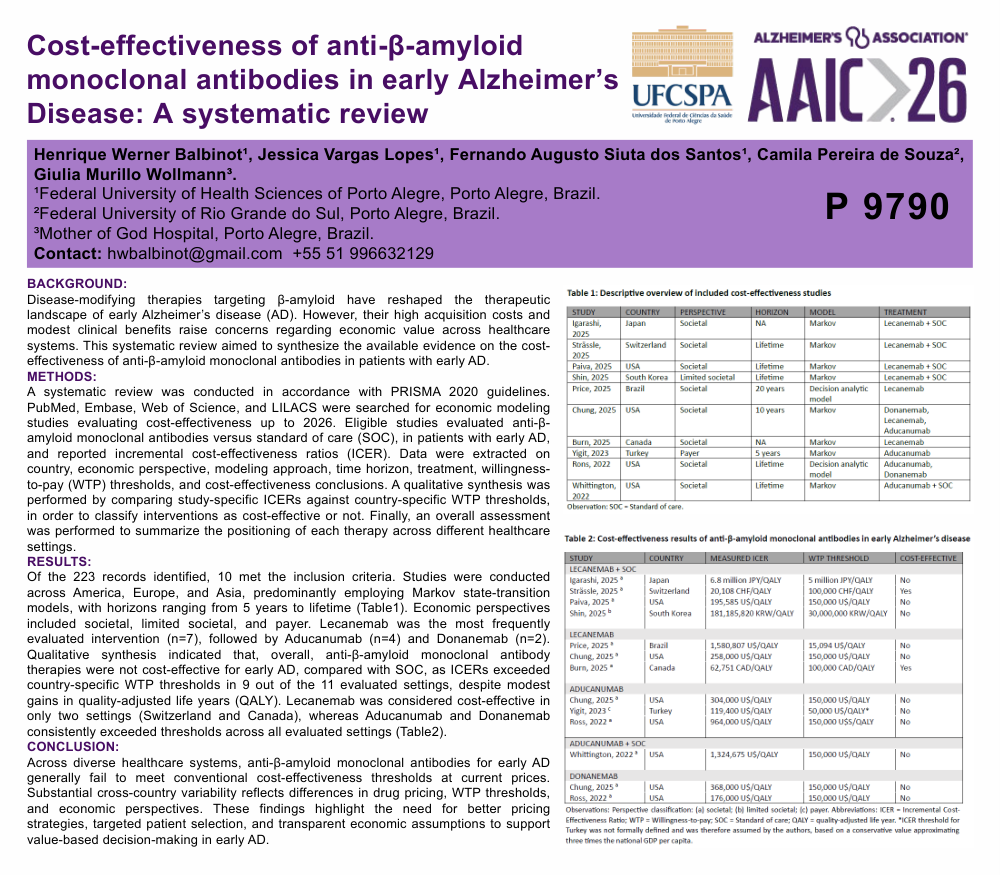
Results: Of the 223 records identified, 10 met the inclusion criteria. Studies were conducted across America, Europe, and Asia, predominantly employing Markov state-transition models, with horizons ranging from 5 years to lifetime (Table1). Economic perspectives included societal, limited societal, and payer. Lecanemab was the most frequently evaluated intervention (n=7), followed by Aducanumab (n=4) and Donanemab (n=2). Qualitative synthesis indicated that, overall, anti-β-amyloid monoclonal antibody therapies were not cost-effective for early AD, compared with SOC, as ICERs exceeded country-specific WTP thresholds in 9 out of the 11 evaluated settings, despite modest gains in quality-adjusted life years (QALY). Lecanemab was considered cost-effective in only two settings (Switzerland and Canada), whereas Aducanumab and Donanemab consistently exceeded thresholds across all evaluated settings (Table2).
Conclusion: Across diverse healthcare systems, anti-β-amyloid monoclonal antibodies for early AD generally fail to meet conventional cost-effectiveness thresholds at current prices. Substantial cross-country variability reflects differences in drug pricing, WTP thresholds, and economic perspectives. These findings highlight the need for better pricing strategies, targeted patient selection, and transparent economic assumptions to support value-based decision-making in early AD.
Comments
Email is required but is not shown publicly.
Loading comments...