4,068 posters, 219 videos, 101 topics, 69 sessions, 14,365 authors, 6,128 institutions
ePostersLive by SciGen Technologies S.A. All rights reserved.
Alzheimer's Association International Conference 2026
July 12-15, 2026 | London, United Kingdom, and Online

9039
Gene-specific Trajectories Of Longitudinal Functional Connectivity In Genetic Frontotemporal Dementia
Poster Presenter
Authors
Maurice Pasternak, Kamen Tsvetanov, Saira Mirza, Maria Carmela Tartaglia, Arabella Bouzigues, Lucy L. Russell, Phoebe H. Foster, John Van Swieten, Lize Jiskoot, Harro Seelaar, Raquel Sánchez-Valle, Robert Laforce, Caroline Graff, Daniela Galimberti, Rik Vandenberghe, Alexandre de Mendonça, Giuseppe De Fede, Isabel Santana, Alexander Gerhard, Johannes Levin, Sandro Sorbi, Markus Otto, Maxime Bertoux, Thibaud Lebouvier, Simon Ducharme, Christopher R Butler, Elizabeth Finger, Matthis Synofzik, Fermin Moreno, Barbara Borroni, Jonathan D Rohrer, Mario Masellis
Affiliations
German Center for Neurodegenerative Diseases (DZNE), Tübingen, Germany, Hurvitz Brain Sciences Research Program, Department of Medicine, Sunnybrook Research Institute, Department of Clinical Neurosciences and Cambridge University Hospitals NHS Trust, University of Cambridge, Cambridge, United Kingdom, Tanz Center for Research in Neurodegenerative Diseases, University of Toronto, Toronto, ON, Canada, University College London, London, United Kingdom, Dementia Research Centre, Department of Neurodegenerative Disease, UCL Queen Square Institute of Neurology, London, United Kingdom, Department of Neurology, Erasmus Medical Center, Rotterdam, Netherlands, Alzheimer's Disease and Other Cognitive Disorders Unit, Hospital Clínic, Institut d'Investigacions Biomèdiques August Pi i Sunyer (IDIBAPS), Barcelona, Spain, Clinique Interdisciplinaire de Mémoire, Département des Sciences Neurologiques, Université Laval, Québec City, QC, Canada, Division of Neurogeriatrics, Department of Neurobiology, Care Sciences and Society, Karolinska Institutet, Stockholm, Sweden, Neurodegenerative Diseases Unit, Fondazione IRCCS Ca' Granda Ospedale Maggiore Policlinico, Milan, ItalY, Laboratory for Cognitive Neurology, Department of Neurosciences, KU Leuven, Leuven, Belgium, Faculty of Medicine, University of Lisbon, Lisbon, Portugal, Neurology 8 Unit - Dementias and Degenerative Pathologies of the Central Nervous System, Fondazione IRCCS Istituto Neurologico Carlo Besta, Milan, Italy, Faculty of Medicine, University of Coimbra, Coimbra, Portugal, Division of Neuroscience and Experimental Psychology, Wolfson Molecular Imaging Centre, Department of Neurology, Ludwig-Maximilians Universität München, Munich, Germany, Department of Neuroscience, Psychology, Drug Research and Child Health, University of Florence, Florence, Italy, Department of Neurology, University of Ulm, Ulm, Germany, Lille Neuroscience & Cognition, Institut national de la santé et de la recherche médicale U1172, University of Lille, Lille, France, Department of Psychiatry, McGill University, Montreal, QC, Canada, Medical Sciences Division, Nuffield Department of Clinical Neurosciences, University of Oxford, Oxford, United Kingdom, Department of Clinical Neurological Sciences, University of Western Ontario, London, ON, Canada, Cognitive Disorders Unit, Department of Neurology, Donostia University Hospital, San Sebastian, Spain, University of Brescia, 25100, Italy, Hurvitz Brain Sciences Research Program, Division of Neurology, Department of Medicine, Sunnybrook Research Institute, Toronto, ON, Canada
Part of Topic
Background
Frontotemporal dementia (FTD) is highly heritable, with autosomal dominant mutations in C9orf72, GRN, or MAPT as the most frequent genetic causes. The salience network, anchored in the anterior cingulate and insular cortices, is hypothesized to underlie the social and behavioural deficits characteristic of bvFTD [1]. Reliable biomarkers sensitive at presymptomatic stages are urgently needed for emerging disease-modifying therapies.
Objectives:
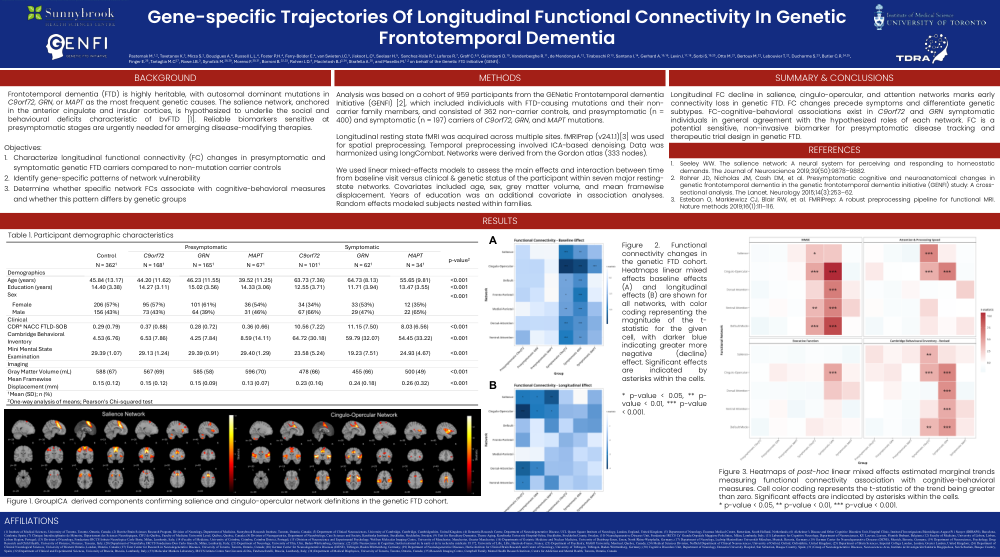
Analysis was based on a cohort of 959 participants from the GENetic Frontotemporal dementia Initiative (GENFI) [2], which included individuals with FTD-causing mutations and their non-carrier family members, and consisted of 362 non-carrier controls, and presymptomatic (n = 400) and symptomatic (n = 197) carriers of C9orf72, GRN, and MAPT mutations.
Longitudinal resting state fMRI was acquired across multiple sites. fMRIPrep (v24.1.1)[3] was used for spatial preprocessing. Temporal preprocessing involved ICA-based denoising. Data was harmonized using longCombat. Networks were derived from the Gordon atlas (333 nodes).
We used linear mixed-effects models to assess the main effects and interaction between time from baseline visit versus clinical & genetic status of the participant within seven major resting-state networks. Covariates included age, sex, grey matter volume, and mean framewise displacement. Years of education was an additional covariate in association analyses. Random effects modeled subjects nested within families.
Summary and Conclusions:
Longitudinal FC decline in salience, cingulo-opercular, and attention networks marks early connectivity loss in genetic FTD. FC changes precede symptoms and differentiate genetic subtypes. FC-cognitive-behavioral associations exist in C9orf72 and GRN symptomatic individuals in general agreement with the hypothesized roles of each network. FC is a potential sensitive, non-invasive biomarker for presymptomatic disease tracking and therapeutic trial design in genetic FTD.
References:
Comments
Email is required but is not shown publicly.
Loading comments...