4,068 posters, 219 videos, 101 topics, 69 sessions, 14,365 authors, 6,128 institutions
ePostersLive by SciGen Technologies S.A. All rights reserved.
Alzheimer's Association International Conference 2026
July 12-15, 2026 | London, United Kingdom, and Online

1635
Brain Age Models As Biomarkers Of Neurodegeneration In Alzheimer’s Disease
Poster Presenter
Authors
Affiliations
Centro Universitario de Imágenes Médicas (CEUNIM), Instituto de Ciencias Físicas (ICIFI) UNSAM-CONICET, Escuela de Ciencia y Tecnología, Universidad Nacional de San Martín (UNSAM), San Martín, Argentina., 2 Fundación INTECNUS, Comisión Nacional de Energía Atómica (CNEA), San Carlos de Bariloche, Argentina.
Part of Topic
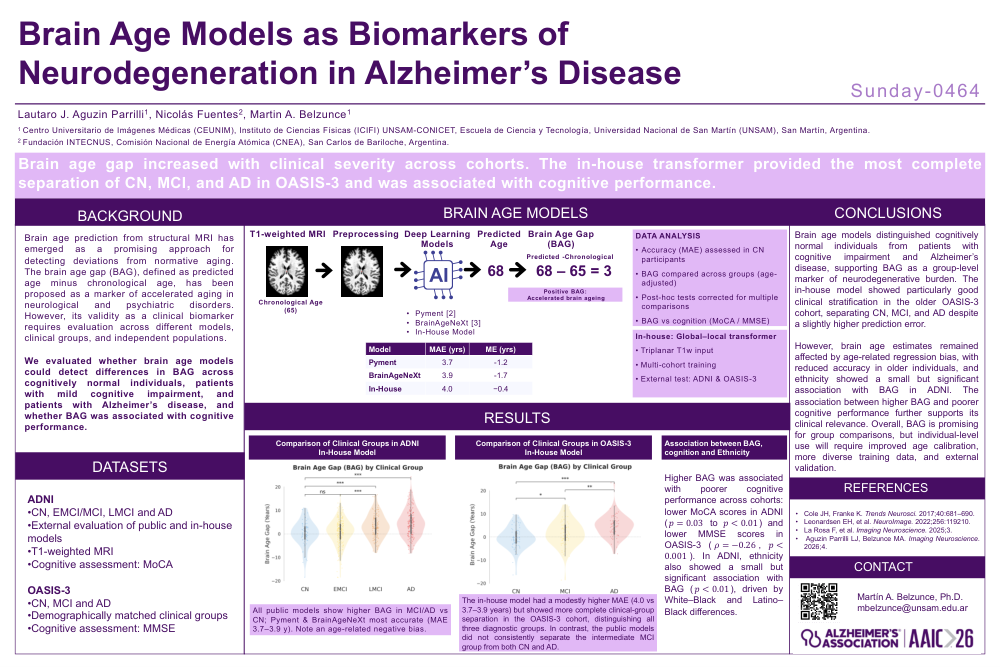
Brain age prediction from structural MRI has emerged as a promising approach for detecting deviations from normative aging. The brain age gap (BAG), defined as predicted age minus chronological age, has been proposed as a marker of accelerated aging in neurological and psychiatric disorders. However, its validity as a clinical biomarker requires evaluation across different models, clinical groups, and independent populations.
We evaluated whether brain age models could detect differences in BAG across cognitively normal individuals, patients with mild cognitive impairment, and patients with Alzheimer’s disease, and whether BAG was associated with cognitive performance.
ADNI
OASIS-3
DATA ANALYSIS
In-house: Global–local transformer
The in-house model had a modestly higher MAE (4.0 vs 3.7–3.9 years) but showed more complete clinical-group separation in the OASIS-3 cohort, distinguishing all three diagnostic groups. In contrast, the public models did not consistently separate the intermediate MCI group from both CN and AD.
Higher BAG was associated with poorer cognitive performance across cohorts: lower MoCA scores in ADNI (p=0.03 to p<0.01) and lower MMSE scores in OASIS-3 (ρ=-0.26, p<0.001). In ADNI, ethnicity also showed a small but significant association with BAG (p<0.01), driven by White–Black and Latino–Black differences.
Brain age models distinguished cognitively normal individuals from patients with cognitive impairment and Alzheimer’s disease, supporting BAG as a group-level marker of neurodegenerative burden. The in-house model showed particularly good clinical stratification in the older OASIS-3 cohort, separating CN, MCI, and AD despite a slightly higher prediction error.
However, brain age estimates remained affected by age-related regression bias, with reduced accuracy in older individuals, and ethnicity showed a small but significant association with BAG in ADNI. The association between higher BAG and poorer cognitive performance further supports its clinical relevance. Overall, BAG is promising for group comparisons, but individual-level use will require improved age calibration, more diverse training data, and external validation.
Comments
Email is required but is not shown publicly.
Loading comments...