4,068 posters, 219 videos, 101 topics, 69 sessions, 14,365 authors, 6,128 institutions
ePostersLive by SciGen Technologies S.A. All rights reserved.
Alzheimer's Association International Conference 2026
July 12-15, 2026 | London, United Kingdom, and Online

10435
Alzheimer's Disease Plasma Biomarkers: Head-to-head Evaluation Of Nulisaseq And Simoa In Clinical And Research Settings
Poster Presenter
Authors
Marco Bucci, Marina Bluma, Mariola Zapater-Fajari, Irina Savitcheva, Konstantinos Chiotis, Nenad Bogdanovic, Anders Wall, Guglielmo Di Molfetta, Ilaria Pola, Kübra Tan, Burak Arslan, Andrea L. Benedet, Nicholas J. Ashton, Henrik Zetterberg, Agneta Nordberg
Affiliations
Department of Neurobiology, Care Sciences and Society, Center for Alzheimer Research, Division of Clinical Geriatrics, Karolinska Institutet, Stockholm, Sweden; Turku PET Centre, University of Turku and Åbo Akademi University, Turku, Finland;, Department of Neurobiology, Care Sciences and Society, Center for Alzheimer Research, Division of Clinical Geriatrics, Karolinska Institutet, Stockholm, Sweden;, Karolinska University Hospital, Medical Radiation Physics and Nuclear Medicine, Stockholm, Sweden., Department of Neurobiology, Care Sciences and Society, Center for Alzheimer Research, Division of Clinical Geriatrics, Karolinska Institutet, Stockholm, Sweden; Theme Inflammation and Aging, Karolinska University Hospital, Stockholm, Sweden, Department of Surgical Sciences, Section of Molecular Imaging & Medical physics, Uppsala University, Uppsala, Sweden; PET Centre, Uppsala University Hospital, Uppsala, Sweden;, Department of Psychiatry and Neurochemistry, Institute of Neuroscience and Physiology, The Sahlgrenska Academy, University of Gothenburg, Gothenburg, Sweden, Department of Psychiatry and Neurochemistry, Institute of Neuroscience and Physiology, The Sahlgrenska Academy, University of Gothenburg, Gothenburg, Sweden; Institute of Psychiatry, Psychology & Neuroscience, King’s College London, Maurice Wohl Clinical Neuroscience Institute, London, UK; NIHR Biomedical Research Centre for Mental Health & Biomedical Research Unit for Dementia at South London & Maudsley NHS Foundation, London, UK, Department of Psychiatry and Neurochemistry, Institute of Neuroscience and Physiology, The Sahlgrenska Academy, University of Gothenburg, Gothenburg, Sweden; Clinical Neurochemistry Laboratory, Sahlgrenska University Hospital, Mölndal, Sweden; Department of Neurodegenerative Disease, UCL Institute of Neurology, Queen Square, London, UK; Hong Kong Center for Neurodegenerative Diseases, Clear Water Bay, Hong Kong, China; Wisconsin Alzheimer’s Disease Research Center, School of Medicine and Public Health, University of Wisconsin-Madison, Madison, USA; Department of Pathology and Laboratory Medicine, School of Medicine and Public Health, University of Wisconsin-Madison, Madison, USA; Centre for Brain Research, Indian Institute of Science, C.V. Raman Avenue, Bangalore, India
Part of Topic
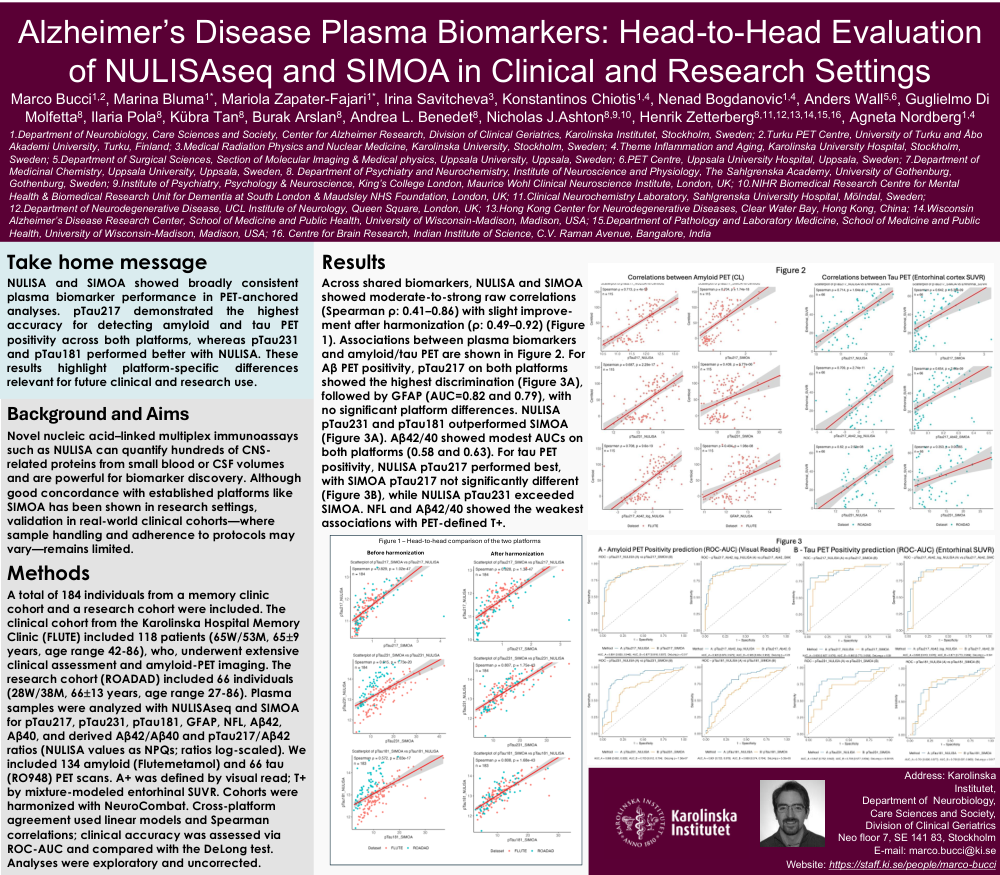
Background: Novel nucleic acid–linked multiplex immunoassays such as NULISA can quantify hundreds of CNS-related proteins from small blood or CSF volumes and are powerful for biomarker discovery. Although good concordance with established platforms like SIMOA has been shown in research settings, validation in real‑world clinical cohorts—where sample handling and adherence to protocols may vary—remains limited.
Methods: A total of 184 individuals from a memory clinic cohort and a research cohort were included. The clinical cohort from the Karolinska Hospital Memory Clinic (FLUTE) included 118 patients (65W/53M, 65±9 years, age range 42-86), who, underwent extensive clinical assessment and amyloid-PET imaging. The research cohort (ROADAD) included 66 individuals (28W/38M, 66±13 years, age range 27-86). Plasma samples were analyzed with NULISAseq and SIMOA for pTau217, pTau231, pTau181, GFAP, NFL, Aβ42, Aβ40, and derived Aβ42/Aβ40 and pTau217/Aβ42 ratios (NULISA values as NPQs; ratios log‑scaled). We included 134 amyloid (Flutemetamol) and 66 tau (RO948) PET scans. A+ was defined by visual read; T+ by mixture‑modeled entorhinal SUVR. Cohorts were harmonized with NeuroCombat. Cross‑platform agreement used linear models and Spearman correlations; clinical accuracy was assessed via ROC‑AUC and compared with the DeLong test. Analyses were exploratory and uncorrected.
Results: Across shared biomarkers, NULISA and SIMOA showed moderate-to-strong raw correlations (Spearman ρ: 0.41–0.86) with slight improvement after harmonization (ρ: 0.49–0.92) (Figure 1). Associations between plasma biomarkers and amyloid/tau PET are shown in Figure 2. For Aβ PET positivity, pTau217 on both platforms showed the highest discrimination (Figure 3A), followed by GFAP (AUC=0.82 and 0.79), with no significant platform differences. NULISA pTau231 and pTau181 outperformed SIMOA (Figure 3A). Aβ42/40 showed modest AUCs on both platforms (0.58 and 0.63). For tau PET positivity, NULISA pTau217 performed best, with SIMOA pTau217 not significantly different (Figure 3B), while NULISA pTau231 exceeded SIMOA. NFL and Aβ42/40 showed the weakest associations with PET‑defined T+.
Conclusions: NULISA and SIMOA showed broadly consistent plasma biomarker performance in PET‑anchored analyses. pTau217 demonstrated the highest accuracy for detecting amyloid and tau PET positivity across both platforms, whereas pTau231 and pTau181 performed better with NULISA. These results highlight platform‑specific differences relevant for future clinical and research use.
Comments
Email is required but is not shown publicly.
Loading comments...