4,068 posters, 219 videos, 101 topics, 69 sessions, 14,365 authors, 6,128 institutions
ePostersLive by SciGen Technologies S.A. All rights reserved.
Alzheimer's Association International Conference 2026
July 12-15, 2026 | London, United Kingdom, and Online

7204
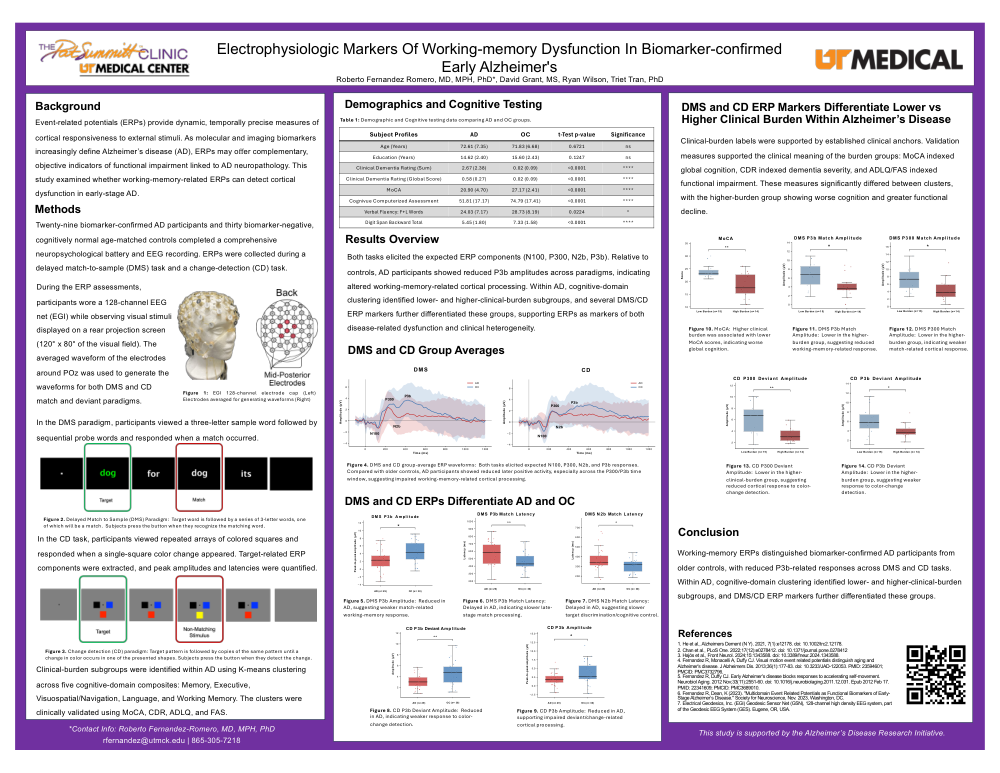
Electrophysiologic Markers Of Working-memory Dysfunction In Biomarker-confirmed Early Alzheimer's
Poster Presenter
Part of Topic
Electrophysiologic Markers Of Working-memory Dysfunction In Biomarker-confirmed Early Alzheimer's
Background: Event‑related potentials (ERPs) provide dynamic, temporally precise measures of cortical responsiveness to external stimuli. As molecular and imaging biomarkers increasingly define Alzheimer’s disease (AD), ERPs may offer complementary, objective indicators of functional impairment linked to AD neuropathology. This study examined whether working‑memory-related ERPs can detect cortical dysfunction in early‑stage AD.
Methods: Twenty‑nine biomarker‑confirmed AD participants and thirty biomarker‑negative, cognitively normal age‑matched controls completed a comprehensive neuropsychological battery and EEG recording. ERPs were collected during a delayed match‑to‑sample (DMS) task and a change‑detection (CD) task. In the DMS paradigm, participants viewed a three‑letter sample word followed by sequential probe words and responded when a match occurred. In the CD task, participants viewed repeated arrays of colored squares and responded when a single‑square color change appeared. Target‑related ERP components were extracted, and peak amplitudes and latencies were quantified.
Results: Both tasks elicited the expected ERP components (N100, P300, N2b, P3b). Relative to controls, AD participants showed significantly reduced P3b amplitudes across paradigms. P3b amplitude correlated with multiple cognitive measures, particularly those assessing attention and working memory. No group differences emerged for other ERP components, indicating a selective deficit in working‑memory-related processing.
Conclusion: Working‑memory ERPs robustly distinguished AD participants from controls. Reduced P3b amplitude reflects a domain‑specific marker of cortical dysfunction in early AD and supports the utility of ERPs as promising functional biomarkers.
Comments
Email is required but is not shown publicly.
Loading comments...