4,068 posters, 219 videos, 101 topics, 69 sessions, 14,365 authors, 6,128 institutions
ePostersLive by SciGen Technologies S.A. All rights reserved.
Alzheimer's Association International Conference 2026
July 12-15, 2026 | London, United Kingdom, and Online

10524
Impact Of Gratitude On Reducing Psychosis Related Dementia Symptoms Of Old Age .
Poster Presenter
Authors
Part of Topic
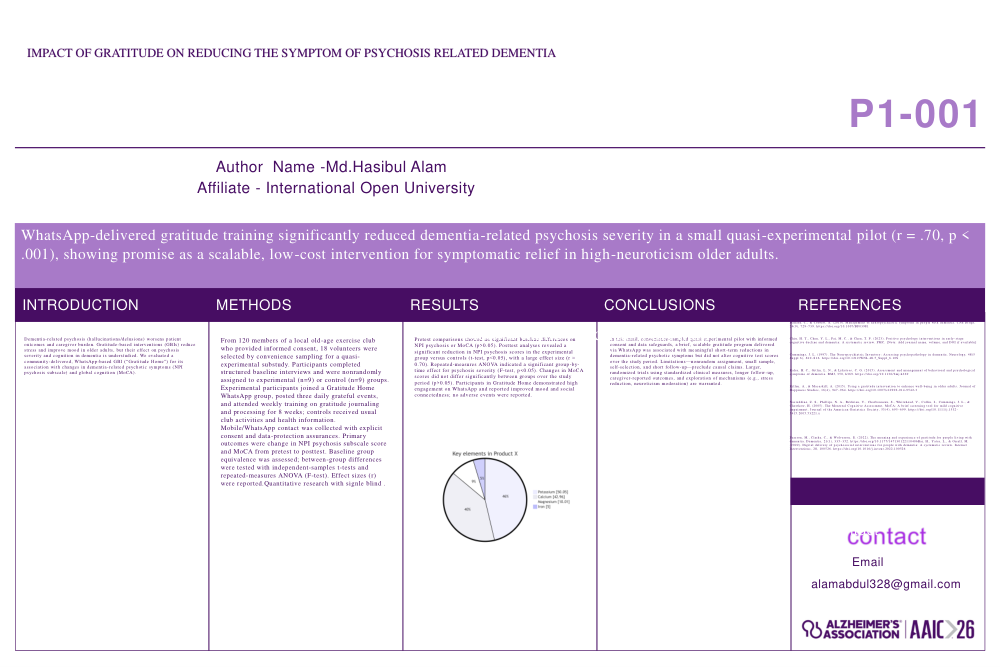
WhatsApp-delivered gratitude training significantly reduced dementia-related psychosis severity in a small quasi-experimental pilot (r = .70, p < .001), showing promise as a scalable, low-cost intervention for symptomatic relief in high-neuroticism older adults.
Dementia-related psychosis (hallucinations/delusions) worsens patient outcomes and caregiver burden. Gratitude-based interventions (GBIs) reduce stress and improve mood in older adults, but their effect on psychosis severity and cognition in dementia is understudied. We evaluated a community-delivered, WhatsApp-based GBI (“Gratitude Home”) for its association with changes in dementia-related psychotic symptoms (NPI psychosis subscale) and global cognition (MoCA).
From 120 members of a local old-age exercise club who provided informed consent, 18 volunteers were selected by convenience sampling for a quasi-experimental substudy. Participants completed structured baseline interviews and were nonrandomly assigned to experimental (n=9) or control (n=9) groups. Experimental participants joined a Gratitude Home WhatsApp group, posted three daily grateful events, and attended weekly training on gratitude journaling and processing for 8 weeks; controls received usual club activities and health information. Mobile/WhatsApp contact was collected with explicit consent and data-protection assurances. Primary outcomes were change in NPI psychosis subscale score and MoCA from pretest to posttest. Baseline group equivalence was assessed; between-group differences were tested with independent-samples t-tests and repeated-measures ANOVA (F-test). Effect sizes (r) were reported.Quantitative research with signle blind .
Pretest comparisons showed no significant baseline differences on NPI psychosis or MoCA (p>0.05). Posttest analyses revealed a significant reduction in NPI psychosis scores in the experimental group versus controls (t-test, p<0.05), with a large effect size (r ≈ 0.70). Repeated-measures ANOVA indicated a significant group-by-time effect for psychosis severity (F-test, p<0.05). Changes in MoCA scores did not differ significantly between groups over the study period (p>0.05). Participants in Gratitude Home demonstrated high engagement on WhatsApp and reported improved mood and social connectedness; no adverse events were reported.
In this small, convenience-sampled quasi-experimental pilot with informed consent and data safeguards, a brief, scalable gratitude program delivered via WhatsApp was associated with meaningful short-term reductions in dementia-related psychotic symptoms but did not alter cognitive test scores over the study period. Limitations—nonrandom assignment, small sample, self-selection, and short follow-up—preclude causal claims. Larger, randomized trials using standardized clinical measures, longer follow-up, caregiver-reported outcomes, and exploration of mechanisms (e.g., stress reduction, neuroticism moderation) are warranted.
References
Ballard, C., & Corbett, A. (2010). Management of neuropsychiatric symptoms in people with dementia. CNS Drugs, 24(9), 729–739. https://doi.org/10.1007/BF03259981
Chiu, H. T., Chen, Y. L., Pai, M. C., & Chen, T. F. (2023). Positive psychology interventions in early-stage cognitive decline and dementia: A systematic review. PMC. [Note: Add journal name, volume, and DOI if available]
Cummings, J. L. (1997). The Neuropsychiatric Inventory: Assessing psychopathology in dementia. Neurology, 48(5 Suppl 6), S10–S16. https://doi.org/10.1212/WNL.48.5_Suppl_6.10S
Kales, H. C., Gitlin, L. N., & Lyketsos, C. G. (2015). Assessment and management of behavioral and psychological symptoms of dementia. BMJ, 350, h369. https://doi.org/10.1136/bmj.h369
Killen, A., & Macaskill, A. (2015). Using a gratitude intervention to enhance well-being in older adults. Journal of Happiness Studies, 16(4), 947–964. https://doi.org/10.1007/s10902-014-9542-3
Nasreddine, Z. S., Phillips, N. A., Bédirian, V., Charbonneau, S., Whitehead, V., Collin, I., Cummings, J. L., & Chertkow, H. (2005). The Montreal Cognitive Assessment, MoCA: A brief screening tool for mild cognitive impairment. Journal of the American Geriatrics Society, 53(4), 695–699. https://doi.org/10.1111/j.1532-5415.2005.53221.x
Pearson, M., Clarke, C., & Wolverson, E. (2022). The meaning and experience of gratitude for people living with dementia. Dementia, 21(1), 335–352. https://doi.org/10.1177/14713012211040675
Rai, H., Yates, L., & Orrell, M. (2022). Digital delivery of psychosocial interventions for people with dementia: A systematic review. Internet Interventions, 28, 100526. https://doi.org/10.1016/j.invent.2022.100526
Comments
Email is required but is not shown publicly.
Loading comments...