4,068 posters, 219 videos, 101 topics, 69 sessions, 14,365 authors, 6,128 institutions
ePostersLive by SciGen Technologies S.A. All rights reserved.
Alzheimer's Association International Conference 2026
July 12-15, 2026 | London, United Kingdom, and Online

3371
Astrocytic Biomarkers Show Stronger Links to Memory Brainwaves Than Classical AD Biomarkers
Part of Topic
Control/Tracking Number:
2026-FRA-3371-AAIC
Activity:
Featured Research Session - Presenting Author
Current Date/Time:
1/15/2026 11:50:24 AM
Astrocytic Biomarkers Show Stronger Links to Memory Brainwaves Than Classical ADBiomarkers
Author Block:
Yang Jiang, Xian Wu, Yuriko Katsumata, Kate Foley, Tiffany Sudduth, Gregory Jicha, Donna Wilcock, Christopher M. Norris
1University of Kentucky College of Medicine, Lexington, KY, USA; 2 University of KentuckyCollege of Medicine, Indianapolis, IN, USA.
Abstract:
Background:
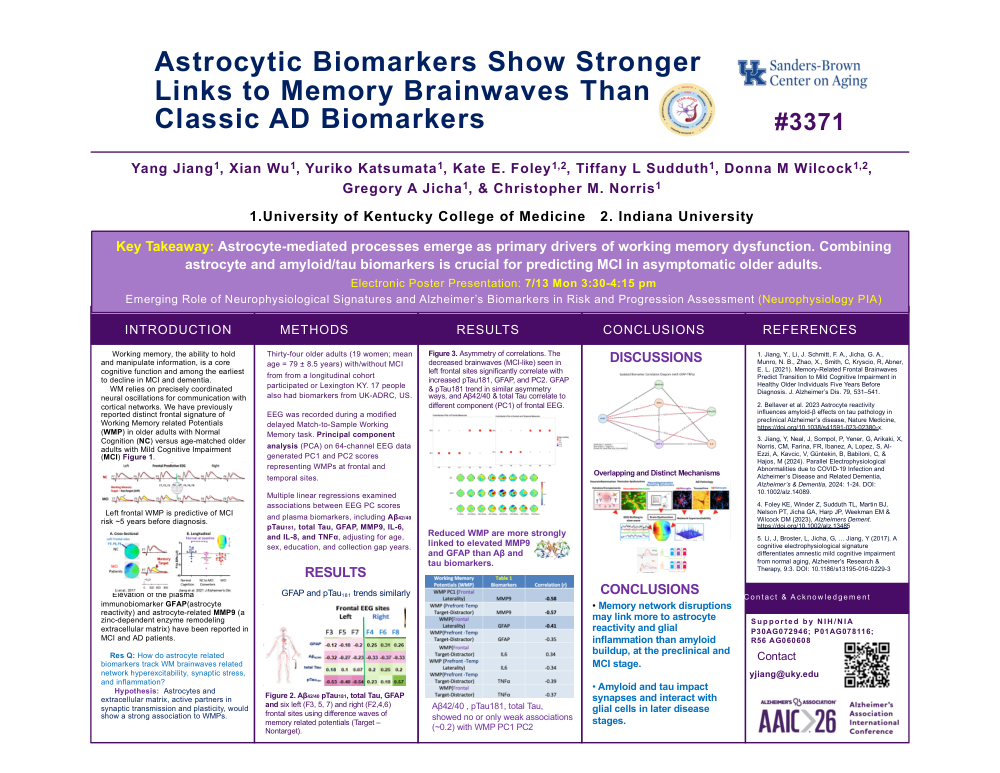
Working memory is a core cognitive function and among the earliest to decline in Alzheimer’s and dementia. The ability to hold and manipulate information relies on preciselycoordinated neural oscillations, particularly in the prefrontal cortex and hippocampus, forcommunication with cortical networks. Elevation of the plasma immunobiomarker GFAP(astrocyte reactivity) has emerged as an early predictor from mild cognitive impairment (MCI) to AD. Astrocyte-related MMP9 (a zinc-dependent enzyme that remodels the extracellular matrix),also plays a dynamic role in synaptic plasticity and long-term potentiation, critical for memory.Working Memory Potentials (WMP) capture post-synaptic oscillatory activity during retrieval. Herewe investigated associations between WMP and AD and astrocytic biomarkers. We hypothesizedthat astrocytes and extracellular matrix, active partners in synaptic transmission and plasticity,would show a strong association to WMPs.
Methods:
Thirty-four older adults (19 women; mean age = 79 ± 8.5 years) with/without MCI orAD from a longitudinal University of Kentucky ADRC cohort participated. EEG was recordedduring a modified delayed Match-to-Sample Working Memory task. Principal component analysis(PCA) on 64-channel EEG data generated PC1 and PC2 scores representing WMPs at frontal andtemporal sites. Multiple linear regressions examined associations between EEG PC scores andplasma biomarkers, including Aβ42/40, pTau181, total Tau, GFAP, MMP9, IL-6, and IL-8, andTNFα, adjusting for age, sex, education, and collection gap years.
Results:
PC1 (memory target strength) explained 61% of variance in EEG signals, while PC2(Laterality) accounted for 35% of WMPs. Reduced WMP, resembling MCI brainwaves, were stronglycorrelated with elevated MMP-9 (PC1 r = -0.57; PC2 -0.58), GFAP (r= -0.35 to -0.41), and Table1. Surprisingly, Aβ42/40 , pTau181, total Tau, showed no or only weak associations with WMP.Among biomarkers, increased GFAP was linked to higher Aβ42/40 (r = 0.38), and elevated MMP9(r = 0.37). MMP-9 correlated strongly with IL-6 (r = 0.53).
Conclusion:
Biomarkers for astrocyte reactivity rather than amyloid or tau biomarkers are moreclosely tied to memory related brainwaves predictive of MCI or AD conversion. These findings suggest that neuroinflammatory and extracellular matrix pathways play key roles in cognitiveimpairments, offering potential targets for early intervention.
Comments
Email is required but is not shown publicly.
Loading comments...