4,068 posters, 219 videos, 101 topics, 69 sessions, 14,365 authors, 6,128 institutions
ePostersLive by SciGen Technologies S.A. All rights reserved.
Alzheimer's Association International Conference 2026
July 12-15, 2026 | London, United Kingdom, and Online

10020
Blood Biomarkers And Neuroimaging In Alzheimer’S Disease: Convergence, Discordance, And Clinical Meaning
Poster Presenter
Authors
Henry Oyoyo, Precious Fadele, Chukwuebuka Asogwa, Victor Femi-Lawal, Jonas Ibekwe, Ajibola Moshood, Timileyin Olanrewaju, Olajire Ajegbemika, Marvellous Adelaja, Olumide Noah, Chukwuma Igwe, Samuel Omojola, Blessed Olaomo, Mayowa Owolabi, Rufus Akinyemi
Affiliations
Department of Medicine and Surgery, University of Ibadan, Ibadan, Nigeria., Department of Medicine and Surgery, University of Nigeria, Enugu, Nigeria., Department of Physiotherapy, University of Ibadan, Ibadan, Nigeria, Department of Medicine and Surgery, University of Lagos, Lagos, Nigeria., Center for Genomics and Precision Medicine, Ibadan, Nigeria.
Part of Topic
Blood Biomarkers and Neuroimaging in Alzheimer’s Disease: Convergence, Discordance, and Clinical Meaning
Author Block
Henry Demian Oyoyo¹˒², Precious Kehinde Fadele³, Dimeji Olawuyi¹˒², Victor Oluwafemi Femi-Lawal¹˒², Jonas Ibekwe¹˒², Chukwuebuka Asogwa¹˒², Ajibola Ajibola Moshood¹˒², Timileyin Victoria Olanrewaju⁴˒², Olajire Ajegbemika¹˒², Marvellous Adelaja¹˒², Olumide Noah⁵, Chukwuma Igwe¹˒², Samuel Omojola¹˒², Blessed Olaomo¹˒², Mayowa Ojo Owolabi⁶˒⁷, Rufus Akinyemi⁶˒⁷
Affiliations
¹ Department of Medicine and Surgery, University of Ibadan, Ibadan, Nigeria.
² College Research and Innovation Hub (CRIH), Ibadan, Nigeria.
³ Department of Medicine and Surgery, University of Nigeria, Enugu, Nigeria.
⁴ Department of Physiotherapy, University of Ibadan, Ibadan, Nigeria.
⁵ Department of Medicine and Surgery, University of Lagos, Lagos, Nigeria.
⁶ Department of Medicine and Surgery, College of Medicine, University of Ibadan, Ibadan, Nigeria.
⁷ Center for Genomics and Precision Medicine, Ibadan, Nigeria.
Background
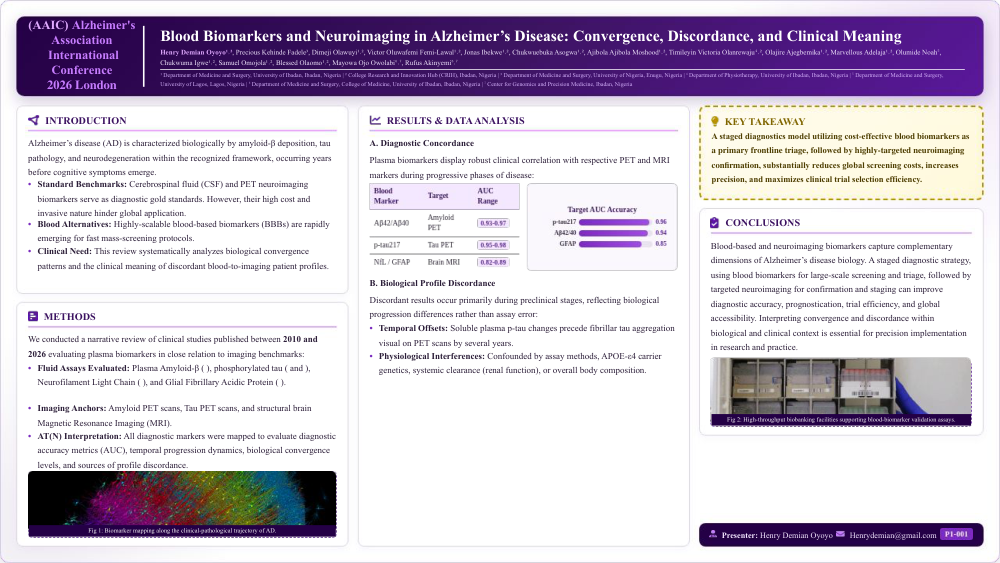
Alzheimer’s disease (AD) is defined biologically by amyloid-β deposition, tau pathology, and neurodegeneration, often detectable years before clinical symptoms. While amyloid and tau PET and cerebrospinal fluid (CSF) biomarkers remain reference standards, their high cost, invasiveness, and limited accessibility constrain widespread use. Blood-based biomarkers have rapidly advanced as scalable alternatives, yet their alignment with neuroimaging biomarkers and the clinical meaning of concordant and discordant profiles requires systematic synthesis.
Methods
We conducted a review of studies published between 2010 and 2026 evaluating plasma amyloid-β (Aβ42/40), phosphorylated tau (p-tau181, p-tau217), neurofilament light chain (NfL), and glial fibrillary acidic protein (GFAP) in relation to amyloid PET, tau PET, and structural MRI. Evidence was interpreted within the AT(N) framework, focusing on diagnostic accuracy, temporal dynamics, biological convergence, and sources of discordance.
Results
Plasma Aβ42/40 demonstrated strong concordance with amyloid PET, achieving reported area-under-the-curve values of approximately 0.93–0.97 and often becoming abnormal 7–8 years before PET positivity. Plasma p-tau181 and p-tau217 showed robust associations with tau PET and reliably differentiated AD from non-AD dementias, with p-tau217 exhibiting the strongest disease specificity and prognostic value. Blood markers of neurodegeneration, including NfL and GFAP, correlated with MRI-derived hippocampal atrophy, cortical thinning, and longitudinal cognitive decline, though NfL lacked AD specificity. Discordance between blood and imaging biomarkers was common in preclinical and borderline disease stages, frequently reflecting biological timing differences (e.g., soluble tau changes preceding fibrillar tau detectable by PET), assay variability, APOE ε4 status, mixed pathologies, and systemic factors such as renal function or body composition. Importantly, discordant profiles often represented transitional or heterogeneous disease states rather than measurement error.
Conclusions
Blood-based and neuroimaging biomarkers capture complementary dimensions of Alzheimer’s disease biology. A staged diagnostic strategy, using blood biomarkers for large-scale screening and triage, followed by targeted neuroimaging for confirmation and staging can improve diagnostic accuracy, prognostication, trial efficiency, and global accessibility. Interpreting convergence and discordance within biological and clinical context is essential for precision implementation in research and practice.
Comments
Email is required but is not shown publicly.
Loading comments...