4,068 posters, 219 videos, 101 topics, 69 sessions, 14,365 authors, 6,128 institutions
ePostersLive by SciGen Technologies S.A. All rights reserved.
Alzheimer's Association International Conference 2026
July 12-15, 2026 | London, United Kingdom, and Online

11004
Effects And Efficacy Of Invasive And Non-invasive Neuromodulation In Patients With Lewy Body Dementia: A Systematic Review
Poster Presenter
Authors
Vitório Serafim, Giulya da Rocha Germann Alves, Matias Pinheiro de Neto, Gabryel dos Santos Ferreira, Tábata Smagala, Camila Pereira de Souza, Henrique Werner Balbinot, Jessica Vargas Lopes, Fernando Augusto Siuta dos Santos, Liana Lisboa Fernandez
Affiliations
Universidade Federal de Ciências da Saúde de Porto Alegre, Porto Alegre, Brazil, Universidade Federal do Rio Grande do Sul, Porto Alegre, Brazil, Department of Basic Health Sciences, Universidade Federal de Ciências da Saúde de Porto Alegre, Porto Alegre, Brazil
Part of Topic
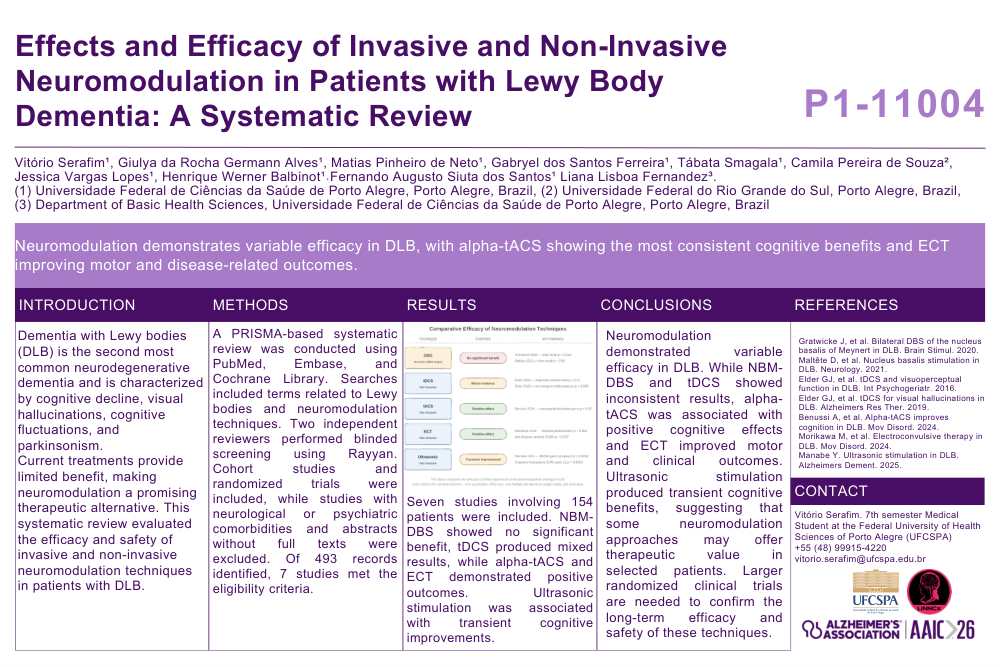
Background: Dementia with Lewy bodies (DLB) is a major clinical challenge due to its complex cognitive, motor, and psychiatric manifestations, which often respond poorly to conventional pharmacological treatments. Neuromodulation has emerged as a promising therapeutic strategy by targeting dysfunctional neural circuits. Methods: A systematic review was conducted using PubMed, Embase, and Cochrane databases with the terms “Lewy Bodies,” “Deep Brain Stimulation,” “Electroconvulsive Therapy,” “transcranial direct current stimulation,” and “transcranial alternating current stimulation,” combined with AND. Cohort studies and randomized trials were included, while studies with psychiatric or neurological comorbidities and abstracts without full texts were excluded. Two reviewers independently performed blinded screening using Rayyan. Of 493 identified records, 7 studies met the eligibility criteria after duplicate removal. Results: Total of 154 patients were included (96 intervention, 58 placebo). Efficacy varied significantly across modalities. For invasive Deep Brain Stimulation of Nucleus Basalis of Meynert (NBM-DBS), Gratwicke et al. (2020) reported no significant cognitive benefits in primary outcomes such as total recall (p=0.416) or reaction time (p=0.600), or neuropsychiatric symptoms (p=0.066). Similarly, Maltête et al. (2021) found no difference in free recall scores between active and sham stimulation (p=0.80). In non-invasive transcranial direct current stimulation (tDCS), Elder et al. (2016) observed early promise with improved choice reaction time (p=0.01) and digit vigilance (p=0.02). However, Elder et al. (2019) found no significant reduction in visual hallucinations (p=0.808) or improvements in MMSE scores (p=0.27). Transcranial alternating current stimulation (tACS) showed robust efficacy, Benussi et al. (2024) demonstrated that occipital alpha-tACS significantly improved visuospatial and executive functions (p<0.05). Electroconvulsive Therapy (ECT) by Morikawa et al. (2024) revealed significantly reducing parkinsonism (Hoehn & Yahr, p<0.001) and disease severity (CDR, p=0.037). Finally, a Ultrasonic Stimulation by Manabe (2025) reported transient cognitive gains (MMSE week 8, p=0.0254) and improvements in cognitive fluctuations (CFI week 12, p=0.0039). Conclusions: Neuromodulation in DLB shows variable potential depending on the technique. While NBM-DBS and tDCS lack consistent evidence for primary cognitive benefits, alpha-tACS demonstrates positive cognitive effects, and ECT is effective for psychiatric symptoms. These findings support the need for larger, methodologically robust clinical trials.
Comments
Email is required but is not shown publicly.
Loading comments...