4,068 posters, 219 videos, 101 topics, 69 sessions, 14,365 authors, 6,128 institutions
ePostersLive by SciGen Technologies S.A. All rights reserved.
Alzheimer's Association International Conference 2026
July 12-15, 2026 | London, United Kingdom, and Online

1538
Salivary Biomarkers For Alzheimer’S Disease: A Comparative Analysis Between An Original Cohort And Published Evidence.
Poster Presenter
Part of Topic
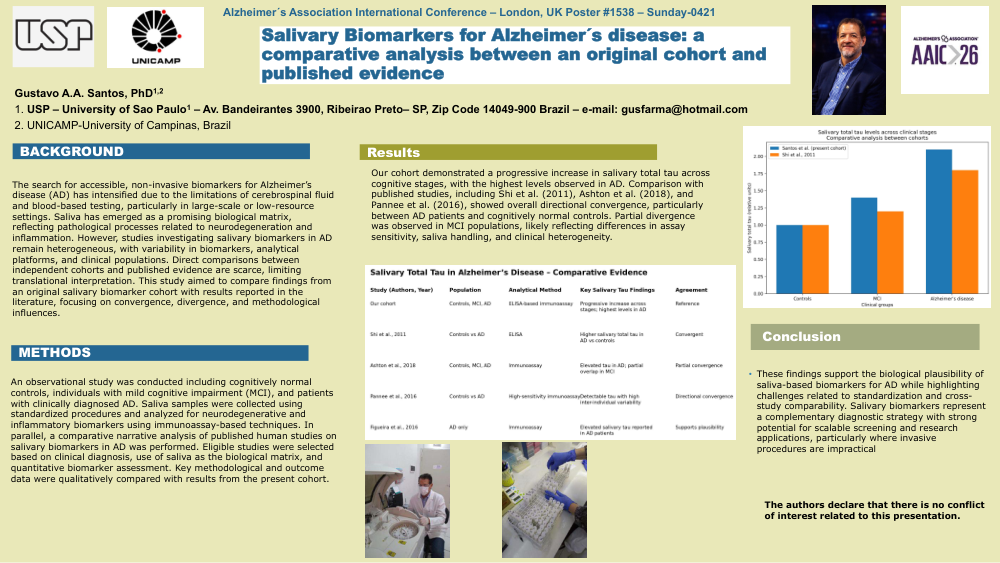
Alzheimer's disease (AD) remains one of the greatest challenges in modern medicine, largely due to the need for accessible, scalable, and minimally invasive diagnostic tools capable of identifying the disease across its continuum. In this context, our study represents a significant contribution to the emerging field of salivary biomarkers for neurodegenerative disorders. By integrating original clinical data with a comprehensive comparative analysis of published evidence, this work provides an important step toward establishing saliva as a biologically meaningful and clinically relevant matrix for AD research.
A major strength of this study lies in its translational approach, combining observations from an original cohort of cognitively normal individuals, patients with mild cognitive impairment (MCI), and patients with Alzheimer's disease, with a critical evaluation of the international literature. This strategy enabled not only the validation of our findings against independent cohorts but also the identification of methodological factors that may explain discrepancies across studies.
Our results demonstrated a progressive increase in salivary total tau levels throughout the Alzheimer's continuum, with the highest concentrations observed in patients with established AD. Importantly, these findings showed remarkable directional convergence with landmark studies conducted by Shi et al., Ashton et al., and Pannee et al., reinforcing the biological plausibility of salivary biomarkers as indicators of neurodegenerative processes. Furthermore, the observed variability among MCI populations highlights the complexity of early-stage disease and underscores the necessity for standardized protocols and harmonized analytical methods.
Beyond its scientific findings, this work addresses one of the most important barriers to implementing salivary biomarkers in clinical practice: the lack of cross-study comparability and methodological standardization. By critically examining these limitations, our study contributes to the development of a more robust framework for future multicenter investigations and biomarker validation studies.
Overall, this research strengthens the concept that salivary biomarkers may represent a transformative and complementary diagnostic strategy for Alzheimer's disease. Their non-invasive nature, low cost, scalability, and potential applicability in resource-limited settings position saliva-based diagnostics as a promising tool for early detection, population screening, longitudinal monitoring, and precision medicine approaches in dementia care. This work therefore contributes not only to the scientific advancement of Alzheimer's disease research but also to the broader goal of improving global access to dementia diagnosis and care.
Comments
Email is required but is not shown publicly.
Loading comments...