4,068 posters, 219 videos, 101 topics, 69 sessions, 14,365 authors, 6,128 institutions
ePostersLive by SciGen Technologies S.A. All rights reserved.
Alzheimer's Association International Conference 2026
July 12-15, 2026 | London, United Kingdom, and Online

5377
Patterns And Determinants Of Misdiagnosed Dementia In A Memory Clinic Cohort
Poster Presenter
Authors
Isabela Weber, Caroline Santiago, Maria Eduarda Dissenha, Renata Alves, Karen Socher
Affiliations
Part of Topic
INTRODUCTION
Accurate dementia diagnosis remains challenging due
to overlapping clinical manifestations and diverse
etiologies. Misdiagnosis may delay appropriate care
and increase the burden on patients and caregivers.
This study examined factors associated with diagnostic
errors and determined which dementia subtypes were
most frequently misclassified in a specialized memory
clinic.
METHODS
In this ambispective cohort study, patients with
dementia misdiagnosis referred to a cognitive
outpatient clinic between May and November 2025
were evaluated. Initial diagnoses were compared with
final diagnoses established after clinical follow-up and
diagnostic review. Clinical and demographic data were
collected, and final diagnoses were classified as
Alzheimer’s disease (AD) or non-AD dementia.
Diagnostic performance metrics were calculated, and
binary logistic regression was used to identify
predictors of the final diagnosis, adjusting for age, sex,
and education.
RESULTS
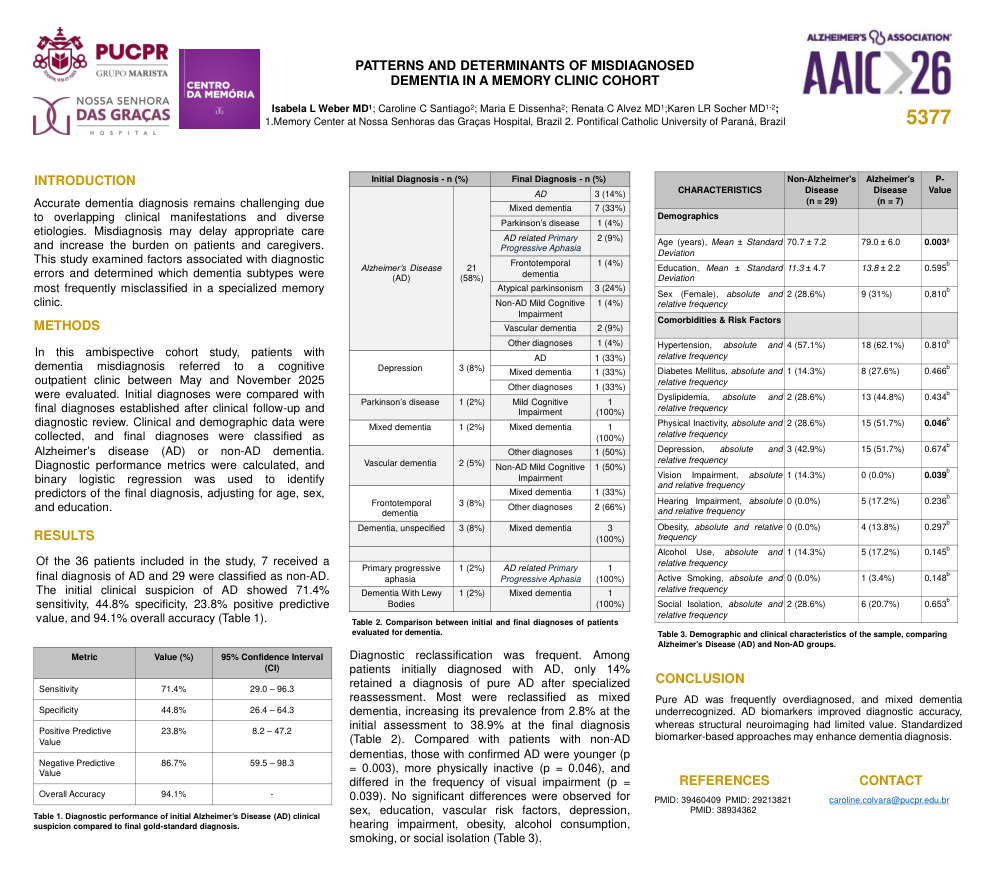
Of the 36 patients included in the study, 7 received a
final diagnosis of AD and 29 were classified as non-AD.
The initial clinical suspicion of AD showed 71.4%
sensitivity, 44.8% specificity, 23.8% positive predictive
value, and 94.1% overall accuracy (Table 1).
Diagnostic reclassification was frequent. Among
patients initially diagnosed with AD, only 14%
retained a diagnosis of pure AD after specialized
reassessment. Most were reclassified as mixed
dementia, increasing its prevalence from 2.8% at the
initial assessment to 38.9% at the final diagnosis
(Table 2). Compared with patients with non-AD
dementias, those with confirmed AD were younger (p
= 0.003), more physically inactive (p = 0.046), and
differed in the frequency of visual impairment (p =
0.039). No significant differences were observed for
sex, education, vascular risk factors, depression,
hearing impairment, obesity, alcohol consumption,
smoking, or social isolation (Table 3).
CONCLUSION
Pure AD was frequently overdiagnosed, and mixed dementia
underrecognized. AD biomarkers improved diagnostic accuracy,
whereas structural neuroimaging had limited value. Standardized
biomarker-based approaches may enhance dementia diagnosis.
Comments
Email is required but is not shown publicly.
Loading comments...