4,068 posters, 219 videos, 101 topics, 69 sessions, 14,365 authors, 6,128 institutions
ePostersLive by SciGen Technologies S.A. All rights reserved.
Alzheimer's Association International Conference 2026
July 12-15, 2026 | London, United Kingdom, and Online

2351
Associations Of Systems-based Dna Methylation Clocks With Cognitive Impairment And Blood-based Biomarkers Of Alzheimer’S Disease
Poster Presenter
Authors
Steve Nguyen, Bowei Zhang, Raghav Sehgal, Michael LaMonte, Steve Horvath, Mark Espeland, Stephen Rapp, Adam Maihofer, Caroline Nievergelt, Andrea LaCroix, Linda McEvoy, Ramon Casanova, Eric Hyde, Susan Resnick, Aladdin Shadyab
Affiliations
Department of Psychiatry, Yale University School of Medicine, New Haven, Connecticut, USA, Department of Medicine, Division of Geriatrics, David Geffen School of Medicine, University of California, Los Angeles, CA, USA, Herbert Wertheim School of Public Health and Human Longevity Science, University of California San Diego, La Jolla, CA, USA, Department of Epidemiology and Environmental Health, State University of New York at Buffalo, Buffalo, NY, USA, Division of Gerontology and Geriatric Medicine, School of Medicine, Wake Forest University, Winston-Salem, North Carolina, USA, Department of Psychiatry and Behavioral Medicine, Wake Forest University School of Medicine, Winston-Salem, NC, USA, Department of Psychiatry, University of California San Diego, La Jolla, CA, USA, Kaiser Permanente Washington Health Research Institute, Seattle, WA, USA, Department of Biostatistics and Data Science, Wake Forest University School of Medicine, Winston-Salem, North Carolina, University of Pennsylvania, Philadelphia, PA, USA
Part of Topic
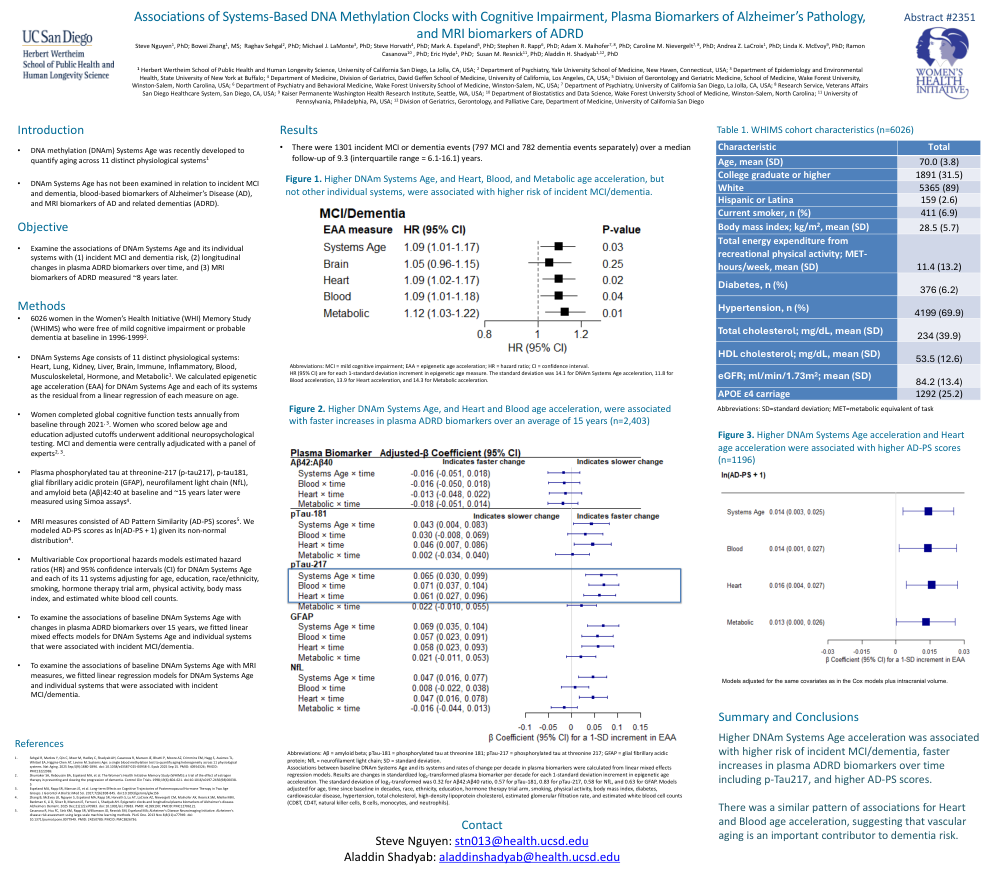
Associations of Systems-Based DNA Methylation Clocks with Cognitive Impairment, Plasma Biomarkers of Alzheimer’s Pathology, and MRI biomarkers of ADRD
Steve Nguyen1, PhD; Bowei Zhang, MS; Raghav Sehgal, PhD; Michael J. LaMonte, PhD; Steve Horvath2, PhD; Mark A. Espeland3, PhD; Stephen R. Rapp4, PhD; Adam X. Maihofer5, 6, PhD; Caroline M. Nievergelt5, 6, PhD; Andrea Z. LaCroix1, PhD; Linda K. McEvoy7, PhD; Ramon Casanova8 , PhD; Eric Hyde1, PhD; Susan M. Resnick9, PhD; Aladdin H. Shadyab1,10, PhD
1 Herbert Wertheim School of Public Health and Human Longevity Science, University of California San Diego, La Jolla, CA, USA; 2 Department of Medicine, Division of Geriatrics, David Geffen School of Medicine, University of California, Los Angeles, CA, USA; 3 Division of Gerontology and Geriatric Medicine, School of Medicine, Wake Forest University, Winston-Salem, North Carolina, USA; 4 Department of Psychiatry and Behavioral Medicine, Wake Forest University School of Medicine, Winston-Salem, NC, USA; 5 Department of Psychiatry, University of California San Diego, La Jolla, CA, USA; 6 Research Service, Veterans Affairs San Diego Healthcare System, San Diego, CA, USA; 7 Kaiser Permanente Washington Health Research Institute, Seattle, WA, USA; 8 Department of Biostatistics and Data Science, Wake Forest University School of Medicine, Winston-Salem, North Carolina; 9 University of Pennsylvania, Philadelphia, PA, USA; 10 Division of Geriatrics, Gerontology, and Palliative Care, Department of Medicine, University of California San Diego
Introduction
DNA methylation (DNAm) Systems Age was recently developed to quantify aging across 11 distinct physiological systems1
DNAm Systems Age has not been examined in relation to incident MCI and dementia, blood-based biomarkers of Alzheimer’s Disease (AD), and MRI biomarkers of AD and related dementias (ADRD).
Objective
Examine the associations of DNAm Systems Age and its individual systems with (1) incident MCI and dementia risk, (2) longitudinal changes in plasma ADRD biomarkers over time, and (3) MRI biomarkers of ADRD measured ~8 years later.
Methods
6026 women in the Women’s Health Initiative (WHI) Memory Study (WHIMS) who were free of mild cognitive impairment or probable dementia at baseline in 1996-19992.
DNAm Systems Age consists of 11 distinct physiological systems: Heart, Lung, Kidney, Liver, Brain, Immune, Inflammatory, Blood, Musculoskeletal, Hormone, and Metabolic1. We calculated epigenetic age acceleration (EAA) for DNAm Systems Age and each of its systems as the residual from a linear regression of each measure on age.
Women completed global cognitive function tests annually from baseline through 2021, 3. Women who scored below age and education adjusted cutoffs underwent additional neuropsychological testing. MCI and dementia were centrally adjudicated with a panel of experts2, 3.
Plasma phosphorylated tau at threonine-217 (p-tau217), p-tau181, glial fibrillary acidic protein (GFAP), neurofilament light chain (NfL), and amyloid beta (Aβ)42:40 at baseline and ~15 years later were measured using Simoa assays4.
MRI measures consisted of AD Pattern Similarity (AD-PS) scores5. We modeled AD-PS scores as ln(AD-PS + 1) given its non-normal distribution4.
Multivariable Cox proportional hazards models estimated hazard ratios (HR) and 95% confidence intervals (CI) for DNAm Systems Age and each of its 11 systems adjusting for age, education, race/ethnicity, smoking, hormone therapy trial arm, physical activity, body mass index, and estimated white blood cell counts.
To examine the associations of baseline DNAm Systems Age with changes in plasma ADRD biomarkers over 15 years, we fitted linear mixed effects models for DNAm Systems Age and individual systems that were associated with incident MCI/dementia.
To examine the associations of baseline DNAm Systems Age with MRI measures, we fitted linear regression models for DNAm Systems Age and individual systems that were associated with incident MCI/dementia.
Results
Figure 1. Higher DNAm Systems Age, and Heart, Blood, and Metabolic age acceleration, but not other individual systems, were associated with higher risk of incident MCI/dementia.
Figure 2. Higher DNAm Systems Age, and Heart and Blood age acceleration, were associated with faster increases in plasma ADRD biomarkers over an average of 15 years (n=2,403)
Figure 3. Higher DNAm Systems Age acceleration and Heart age acceleration were associated with higher AD-PS scores (n=1196)
Summary and Conclusions
Higher DNAm Systems Age acceleration was associated with higher risk of incident MCI/dementia, faster increases in plasma ADRD biomarkers over time including p-Tau217, and higher AD-PS scores.
There was a similar pattern of associations for Heart and Blood age acceleration, suggesting that vascular aging is an important contributor to dementia risk.
Comments
Email is required but is not shown publicly.
Loading comments...