4,068 posters, 219 videos, 101 topics, 69 sessions, 14,365 authors, 6,128 institutions
ePostersLive by SciGen Technologies S.A. All rights reserved.
Alzheimer's Association International Conference 2026
July 12-15, 2026 | London, United Kingdom, and Online

3007
Optimal Combination Of Plasma Biomarkers, Cognitive Tests And Clinical Information For The Workup Of Cognitive Impairment In Primary Care
Poster Presenter
Authors
Anika Wuestefeld, Pontus Tideman, Danielle van Westen, Shorena Janelidze, Beata Borgström Bolmsjö, Ruben Smith, Gemma Salvadó, Linda Karlsson, Erik Stomrud, Niklas Mattsson-Carlgren, Oskar Hansson, Sebastian Palmqvist
Affiliations
Lund University, Lund, Sweden, Lund University, Lund & Region Skåne, Malmö, Sweden, Lund University, Lund & Region Skåne, Lund, Sweden, Lund University, Lund, Sweden & Barcelonaβeta Brain Research Center, Barcelona, Spain
Part of Topic
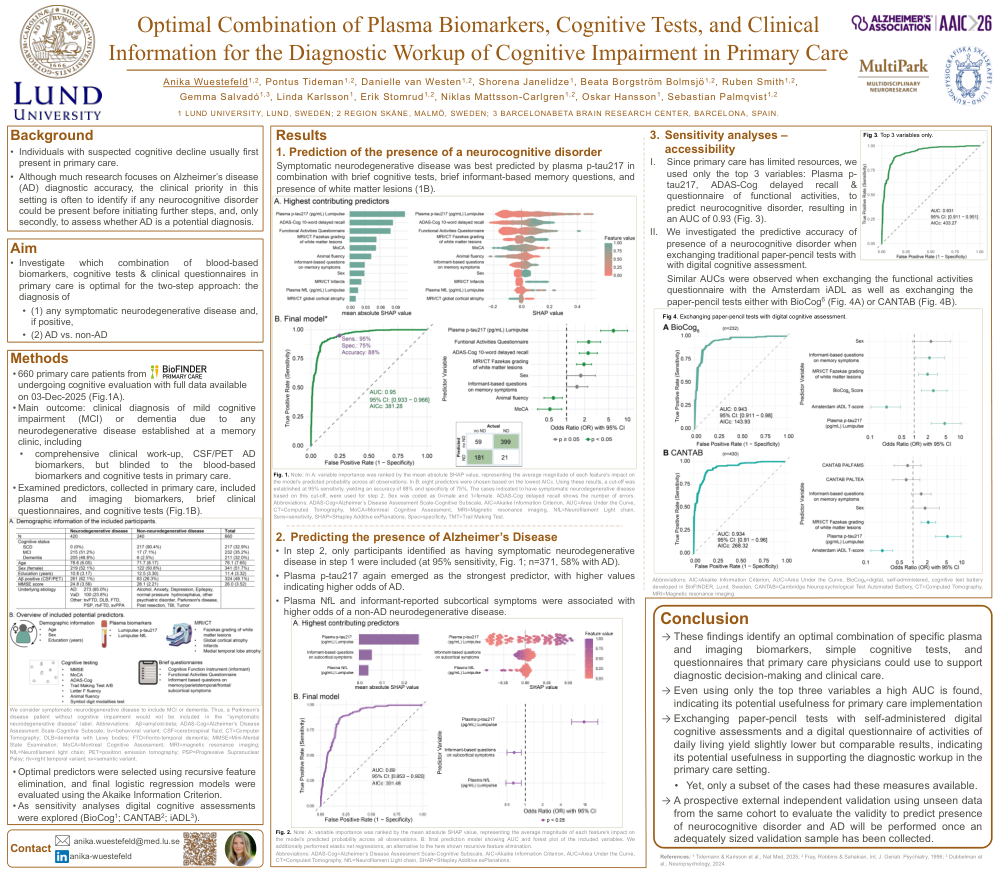
Background: Individuals with suspected cognitive decline usually first present in primary care. Although much research focuses on Alzheimer’s disease (AD) diagnostic accuracy, the clinical priority in this setting is often to identify if any neurodegenerative disease could be present before initiating further steps, and only secondly to assess whether AD is a potential diagnosis. Therefore, we investigated which combination of blood-based biomarkers, cognitive tests and clinical questionnaires is optimal for a two-step approach: the diagnosis of (1) any symptomatic neurodegenerative disease and, if positive, (2) AD vs. non-AD.
Methods: We included 660 patients undergoing cognitive evaluation in primary care (BioFINDER-Primary Care study) with full data available on 03-Dec-2025 (Fig.1A). The main outcome was a clinical diagnosis of MCI/dementia due to any neurodegenerative disease, established at a memory clinic including comprehensive clinical work-up, CSF/PET AD biomarkers, but blinded to the blood-based biomarkers and cognitive tests in primary care. Examined predictors, collected in primary care, included plasma and imaging biomarkers, brief clinical questionnaires, and brief cognitive tests. Optimal predictors were selected using recursive feature elimination, and final logistic regression models were evaluated using the Akaike Information Criterion.
Results: In step 1, symptomatic neurodegenerative disease was best predicted by plasma p-tau217 in combination with brief cognitive tests (MoCA, 10-word delayed recall, animal fluency), brief informant-based memory questions, and white matter lesions (AUC=0.95). When using digital cognitive tests instead, slightly lower but similar AUCs are found.
In step 2, discriminating MCI/dementia due to AD vs. non-AD, only participants identified as having symptomatic neurodegenerative disease in step 1 were included (at 95% sensitivity; n=371, 58% with AD). Plasma p-tau217 again emerged as the strongest predictor, with higher values indicating higher odds of AD, while plasma NfL and informant-reported subcortical symptoms were associated with higher odds of a non-AD neurodegenerative disease (AUC=0.89).
An alternative statistical approach (elastic net regressions) yielded highly similar results.
Conclusions: These findings identify an optimal combination of specific plasma and imaging biomarkers, simple cognitive tests, and questionnaires that primary care physicians could use to support diagnostic decision-making and clinical care. An external independent validation using unseen data from prospectively recruited patients from the same cohort once the sample size is sufficient.
Comments
Email is required but is not shown publicly.
Loading comments...