4,068 posters, 219 videos, 101 topics, 69 sessions, 14,365 authors, 6,128 institutions
ePostersLive by SciGen Technologies S.A. All rights reserved.
Alzheimer's Association International Conference 2026
July 12-15, 2026 | London, United Kingdom, and Online

2306
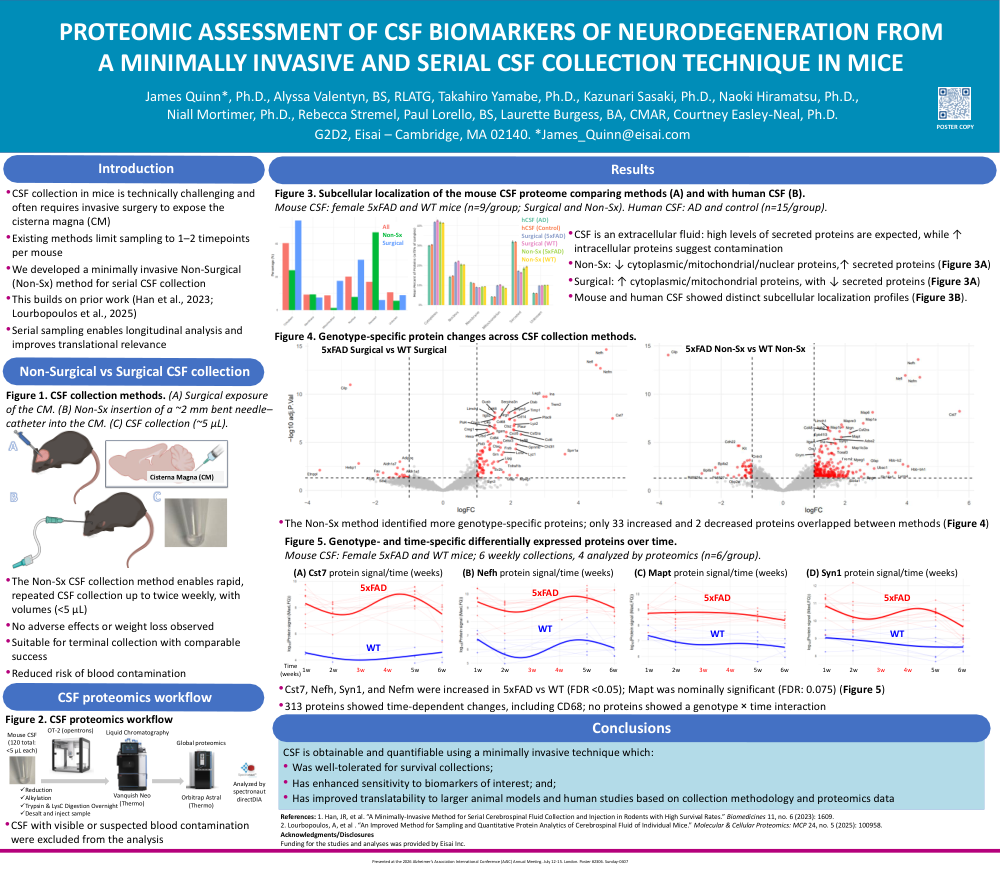
Proteomic Assessment Of CSF Biomarkers Of Neurodegeneration From A Minimally Invasive And Serial CSF Collection Technique In Mice
Poster Presenter
Part of Topic
Introduction:
• CSF collection in mice is technically challenging and often requires invasive surgery to expose the cisterna magna (CM).
• Existing methods limit sampling to 1–2 timepoints per mouse.
• We developed a minimally invasive Non-Surgical (Non-Sx) method for serial CSF collection.
• This builds on prior work (Han et al., 2023; Lourbopoulos et al., 2025).
• Serial sampling enables longitudinal analysis and improves translational relevance.
Non-Surgical vs Surgical CSF collection:
• The Non-Sx CSF collection method enables rapid, repeated CSF collection up to twice weekly, with volumes (<5 μL).
• No adverse effects or weight loss observed.
• Suitable for terminal collection with comparable success.
• Reduced risk of blood contamination.
CSF proteomics workflow:
• CSF with visible or suspected blood contamination were excluded from the analysis.
Results:
Figure 3. Subcellular localization of the mouse CSF proteome comparing methods (A) and with human CSF (B). Mouse CSF: female 5xFAD and WT mice (n=9/group; Surgical and Non-Sx). Human CSF: AD and control (n=15/group).
• CSF is an extracellular fluid: high levels of secreted proteins are expected, while ↑ intracellular proteins suggest contamination.
• Non-Sx: ↓ cytoplasmic/mitochondrial/nuclear proteins,↑ secreted proteins (Figure 3A).
• Surgical: ↑ cytoplasmic/mitochondrial proteins, with ↓ secreted proteins (Figure 3A).
• Mouse and human CSF showed distinct subcellular localization profiles (Figure 3B).
Figure 4. Genotype-specific protein changes across CSF collection methods.
• The Non-Sx method identified more genotype-specific proteins; only 33 increased and 2 decreased proteins overlapped between methods (Figure 4).
Figure 5. Genotype- and time-specific differentially expressed proteins over time. Mouse CSF: Female 5xFAD and WT mice; 6 weekly collections, 4 analyzed by proteomics (n=6/group).
• Cst7, Nefh, Syn1, and Nefm were increased in 5xFAD vs WT (FDR <0.05); Mapt was nominally significant (FDR: 0.075) (Figure 5).
• 313 proteins showed time-dependent changes, including CD68; no proteins showed a genotype × time interaction.
Conclusions:
CSF is obtainable and quantifiable using a minimally invasive technique which:
• Was well-tolerated for survival collections;
• Has enhanced sensitivity to biomarkers of interest; and;
• Has improved translatability to larger animal models and human studies based on collection methodology and proteomics data.
References:
1. Han, JR, et al. “A Minimally-Invasive Method for Serial Cerebrospinal Fluid Collection and Injection in Rodents with High Survival Rates.” Biomedicines 11, no. 6 (2023): 1609.
2. Lourbopoulos, A, et al . “An Improved Method for Sampling and Quantitative Protein Analytics of Cerebrospinal Fluid of Individual Mice.” Molecular & Cellular Proteomics: MCP 24, no. 5 (2025): 100958.
Acknowledgments/Disclosures:
Funding for the studies and analyses was provided by Eisai Inc.
Presented at the 2026 Alzheimer’s Association International Conference (AAIC) Annual Meeting. July 12-15. London. Poster #2306
Comments
Email is required but is not shown publicly.
Loading comments...