4,068 posters, 219 videos, 101 topics, 69 sessions, 14,365 authors, 6,128 institutions
ePostersLive by SciGen Technologies S.A. All rights reserved.
Alzheimer's Association International Conference 2026
July 12-15, 2026 | London, United Kingdom, and Online

6233
Bidirectional Control Energy (BiCE): An EEG Biomarker Of Neural Efficiency Relevant To Alzheimer’s Disease In A Photobiomodulation Study
Poster Presenter
Part of Topic
Video
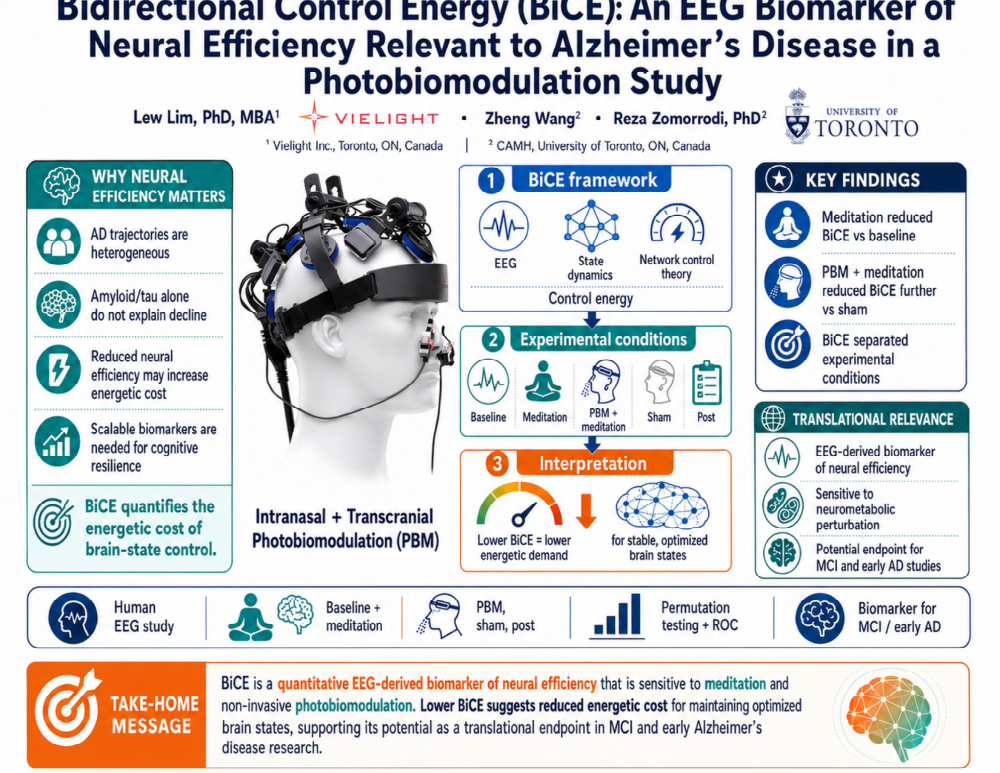
Bidirectional Control Energy (BiCE): An EEG Biomarker of Neural Efficiency Relevant to Alzheimer’s Disease in a Photobiomodulation Study
Background
Alzheimer’s disease (AD) is increasingly recognized as a multifactorial condition characterized by heterogeneous trajectories that are incompletely explained by amyloid or tau pathology alone. Converging evidence suggests that declining cognitive performance in AD is associated with reduced neural efficiency, reflected in the increasing energetic cost required to sustain stable and flexible brain states. Conversely, meditative cognitive states have been associated with improved attentional control, executive function, and cognitive efficiency in healthy and aging populations. Quantitative, scalable biomarkers capable of capturing transitions between impaired and optimized cognitive states may therefore provide complementary endpoints for evaluating non-invasive interventions aimed at supporting cognitive resilience across the Alzheimer’s disease spectrum.
Methods
We applied a bidirectional control-energy (BiCE) framework derived from network control theory to human electroencephalography (EEG) data to quantify the energetic cost of maintaining brain-state dynamics across cortico–subcortical systems. BiCE metrics were evaluated across experimental conditions including baseline, meditation, intranasal and transcranial photobiomodulation (itPBM) combined with meditation, sham stimulation, and post-intervention assessment. Statistical significance was assessed using permutation testing, and classification performance was evaluated using receiver operating characteristic analyses.
Results
BiCE values decreased during meditation relative to baseline, consistent with reduced energetic demand for sustaining stable brain states associated with enhanced cognitive control. Further reductions in control energy were observed when meditation was combined with itPBM compared with sham stimulation. BiCE metrics demonstrated robust separability between experimental conditions, indicating sensitivity to neurometabolic perturbation rather than nonspecific or artifactual effects.
Conclusion
These findings support BiCE as a quantitative EEG-derived biomarker of neural efficiency that is sensitive to non-invasive photobiomodulation. While not disease-specific, control-energy metrics may provide a novel translational endpoint for assessing whether interventions facilitate access to cognitively optimized brain states. Although the present study does not assess durability beyond the stimulation period, prior clinical photobiomodulation studies suggest that regular intervention may be required to maintain functional benefits. By quantifying the energetic cost of sustaining optimized brain states, BiCE offers a framework for evaluating interventions that may help counteract efficiency-related cognitive impairment in mild cognitive impairment and early Alzheimer’s disease. Further studies integrating BiCE with clinical and biological markers are warranted.
Comments
Email is required but is not shown publicly.
Loading comments...