4,068 posters, 219 videos, 101 topics, 69 sessions, 14,365 authors, 6,128 institutions
ePostersLive by SciGen Technologies S.A. All rights reserved.
Alzheimer's Association International Conference 2026
July 12-15, 2026 | London, United Kingdom, and Online

10303
Baseline Characteristics Of Anti-amyloid Therapy Patients At A Reference Center In Brazil
Poster Presenter
Authors
Carlos Lokschin, Francisco Da Costa, Fernando Lazzaretti, Bernardo Sommer Cimirro, Isabella Roesler, Cristiano Schaffer Aguzzoli, Lucas Schilling
Affiliations
Pontifícia Universidade Católica do Rio Grande do Sul - PUCRS, nstituto do Cérebro do Rio Grande do Sul (InsCer, Neurology, Hospital São Lucas da PUCRS
Part of Topic
Background: Alzheimer’s disease (AD) has undergone major diagnostic and therapeutic advances over the past decades, culminating in the development of anti-amyloid therapies (AATs). Anti-amyloid monoclonal antibodies have demonstrated reductions in clinical progression among patients with early symptomatic AD. In Brazil, regulatory approval of AATs—donanemab and lecanemab—represented a major milestone for access to disease-modifying therapies in a low- and middle-income country (LMIC). However, real-world data describing patient characteristics initiating AATs in LMIC settings remain scarce.
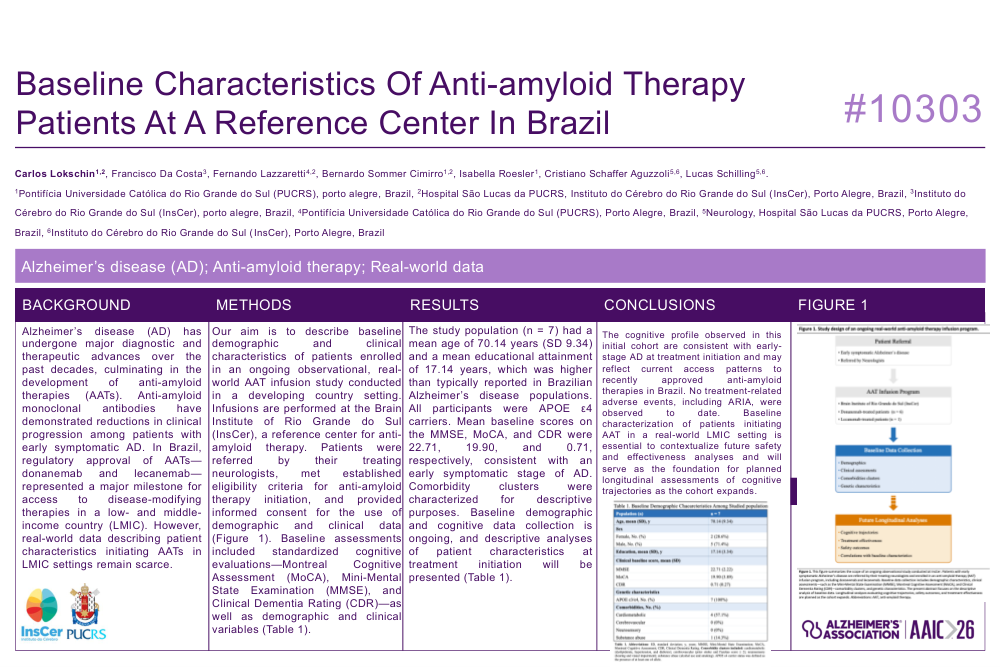
Methods: Our aim is to describe baseline demographic and clinical characteristics of patients enrolled in an ongoing observational, real-world AAT infusion study conducted in a developing country setting. Infusions are performed at the Brain Institute of Rio Grande do Sul (InsCer), a reference center for anti-amyloid therapy. Patients were referred by their treating neurologists, met established eligibility criteria for anti-amyloid therapy initiation, and provided informed consent for the use of demographic and clinical data (Figure 1). Baseline assessments included standardized cognitive evaluations—Montreal Cognitive Assessment (MoCA), Mini-Mental State Examination (MMSE), and Clinical Dementia Rating (CDR)—as well as demographic and clinical variables (Table 1).
Results: The study population (n = 7) had a mean age of 70.14 years (SD 9.34) and a mean educational attainment of 17.14 years, which was higher than typically reported in Brazilian Alzheimer’s disease populations. All participants were APOE ε4 carriers. Mean baseline scores on the MMSE, MoCA, and CDR were 22.71, 19.90, and 0.71, respectively, consistent with an early symptomatic stage of AD. Comorbidity clusters were characterized for descriptive purposes. Baseline demographic and cognitive data collection is ongoing, and descriptive analyses of patient characteristics at treatment initiation will be presented (Table 1).
Conclusion: The cognitive profile observed in this initial cohort are consistent with early-stage AD at treatment initiation and may reflect current access patterns to recently approved anti-amyloid therapies in Brazil. No treatment-related adverse events, including ARIA, were observed to date. Baseline characterization of patients initiating AAT in a real-world LMIC setting is essential to contextualize future safety and effectiveness analyses and will serve as the foundation for planned longitudinal assessments of cognitive trajectories as the cohort expands.
Comments
Email is required but is not shown publicly.
Loading comments...