4,068 posters, 219 videos, 101 topics, 69 sessions, 14,365 authors, 6,128 institutions
ePostersLive by SciGen Technologies S.A. All rights reserved.
Alzheimer's Association International Conference 2026
July 12-15, 2026 | London, United Kingdom, and Online

6225
Impact Of A Blood-based Biomarker On Neurologist Diagnostic Decisions For Alzheimer’s Disease: A Randomized Virtual Trial
Poster Presenter
Authors
Lopamudra Das, Trever Burgon, Kinal Bhatt, Kelsy Gibson Ferrara, David Paculdo, Eric de Belen, Czarlota Valdenor
Affiliations
Part of Topic
Impact of a Blood-Based Biomarker on Neurologist Diagnostic Decision-Making for Alzheimer’s Disease: A Randomized Virtual Trial
Lopamudra Das¹, Trever Burgon², Kinal Bhatt¹, Kelsy Gibson Ferrara², David Paculdo², Eric De Belen², Czarlota Valdenor²
¹Beckman Coulter Diagnostics, Brea, CA; ²QURE Healthcare, San Francisco, CA
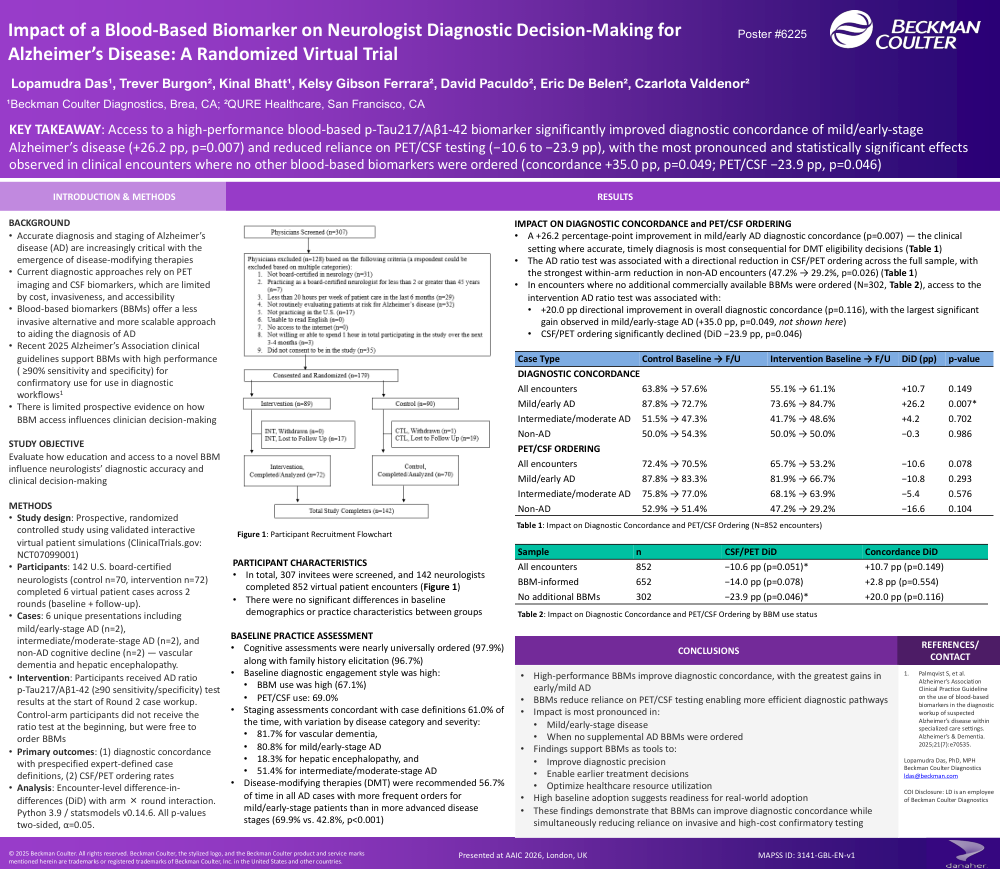
KEY TAKEAWAY: Access to a high-performance blood-based p‑Tau217/Aβ1‑42 biomarker significantly improved diagnostic concordance of mild/early-stage Alzheimer’s disease (+26.2 pp, p=0.007) and reduced reliance on PET/CSF testing (−10.6 to −23.9 pp), with the most pronounced and statistically significant effects observed in clinical encounters where no other blood-based biomarkers were ordered (concordance +35.0 pp, p=0.049; PET/CSF −23.9 pp, p=0.046)
BACKGROUND
• Accurate diagnosis and staging of Alzheimer’s disease (AD) are increasingly critical with the emergence of disease-modifying therapies
• Current diagnostic approaches rely on PET imaging and CSF biomarkers, which are limited by cost, invasiveness, and accessibility
• Blood-based biomarkers (BBMs) offer a less invasive alternative and more scalable approach to aiding the diagnosis of AD
• Recent 2025 Alzheimer’s Association clinical guidelines support BBMs with high performance ( ≥90% sensitivity and specificity) for confirmatory use for use in diagnostic workflows1
• There is limited prospective evidence on how BBM access influences clinician decision-making
STUDY OBJECTIVE
Evaluate how education and access to a novel BBM influence neurologists’ diagnostic accuracy and clinical decision-making
METHODS
• Study design: Prospective, randomized controlled study using validated interactive virtual patient simulations (ClinicalTrials.gov: NCT07099001)
• Participants: 142 U.S. board-certified neurologists (control n=70, intervention n=72) completed 6 virtual patient cases across 2 rounds (baseline + follow-up).
• Cases: 6 unique presentations including mild/early-stage AD (n=2), intermediate/moderate-stage AD (n=2), and non-AD cognitive decline (n=2) — vascular dementia and hepatic encephalopathy.
• Intervention: Participants received AD ratio p‑Tau217/Aβ1‑42 (≥90 sensitivity/specificity) test results at the start of Round 2 case workup. Control-arm participants did not receive the ratio test at the beginning, but were free to order BBMs
• Primary outcomes: (1) diagnostic concordance with prespecified expert-defined case definitions, (2) CSF/PET ordering rates
• Analysis: Encounter-level difference-in-differences (DiD) with arm × round interaction. Python 3.9 / statsmodels v0.14.6. All p-values two-sided, α=0.05.
RESULTS
Figure 1: Participant Recruitment Flowchart
PARTICIPANT CHARACTERISTICS
• In total, 307 invitees were screened, and 142 neurologists completed 852 virtual patient encounters (Figure 1)
• There were no significant differences in baseline demographics or practice characteristics between groups
BASELINE PRACTICE ASSESSMENT
• Cognitive assessments were nearly universally ordered (97.9%) along with family history elicitation (96.7%)
• Baseline diagnostic engagement style was high:
• BBM use was high (67.1%)
• PET/CSF use: 69.0%
• Staging assessments concordant with case definitions 61.0% of the time, with variation by disease category and severity:
• 81.7% for vascular dementia,
• 80.8% for mild/early-stage AD
• 18.3% for hepatic encephalopathy, and
• 51.4% for intermediate/moderate-stage AD
• Disease-modifying therapies (DMT) were recommended 56.7% of time in all AD cases with more frequent orders for mild/early-stage patients than in more advanced disease stages (69.9% vs. 42.8%, p<0.001)
IMPACT ON DIAGNOSTIC CONCORDANCE and PET/CSF ORDERING
• A +26.2 percentage-point improvement in mild/early AD diagnostic concordance (p=0.007) — the clinical setting where accurate, timely diagnosis is most consequential for DMT eligibility decisions (Table 1)
• The AD ratio test was associated with a directional reduction in CSF/PET ordering across the full sample, with the strongest within-arm reduction in non-AD encounters (47.2% → 29.2%, p=0.026) (Table 1)
• In encounters where no additional commercially available BBMs were ordered (N=302, Table 2), access to the intervention AD ratio test was associated with:
• +20.0 pp directional improvement in overall diagnostic concordance (p=0.116), with the largest significant gain observed in mild/early-stage AD (+35.0 pp, p=0.049, not shown here)
• CSF/PET ordering significantly declined (DiD −23.9 pp, p=0.046)
|
Case Type |
Control Baseline → F/U |
Intervention Baseline → F/U |
DiD (pp) |
p-value |
||||
|
DIAGNOSTIC CONCORDANCE |
|
|||||||
|
All encounters |
63.8% → 57.6% |
55.1% → 61.1% |
+10.7 |
0.149 |
|
|||
|
Mild/early AD |
87.8% → 72.7% |
73.6% → 84.7% |
+26.2 |
0.007* |
|
|||
|
Intermediate/moderate AD |
51.5% → 47.3% |
41.7% → 48.6% |
+4.2 |
0.702 |
|
|||
|
Non-AD |
50.0% → 54.3% |
50.0% → 50.0% |
−0.3 |
0.986 |
|
|||
|
PET/CSF ORDERING |
|
|||||||
|
All encounters |
72.4% → 70.5% |
65.7% → 53.2% |
−10.6 |
0.078 |
||||
|
Mild/early AD |
87.8% → 83.3% |
81.9% → 66.7% |
−10.8 |
0.293 |
||||
|
Intermediate/moderate AD |
75.8% → 77.0% |
68.1% → 63.9% |
−5.4 |
0.576 |
||||
|
Non-AD |
52.9% → 51.4% |
47.2% → 29.2% |
−16.6 |
0.104 |
||||
Table 1: Impact on Diagnostic Concordance and PET/CSF Ordering (N=852 encounters)
|
Sample |
n |
CSF/PET DiD |
Concordance DiD |
|
All encounters |
852 |
−10.6 pp (p=0.051)* |
+10.7 pp (p=0.149) |
|
BBM-informed |
652 |
−14.0 pp (p=0.078) |
+2.8 pp (p=0.554) |
|
No additional BBMs |
302 |
−23.9 pp (p=0.046)* |
+20.0 pp (p=0.116) |
Table 2: Impact on Diagnostic Concordance and PET/CSF Ordering by BBM use status
CONCLUSIONS
• High-performance BBMs improve diagnostic concordance, with the greatest gains in early/mild AD
• BBMs reduce reliance on PET/CSF testing enabling more efficient diagnostic pathways
• Impact is most pronounced in:
• Mild/early-stage disease
• When no supplemental AD BBMs were ordered
• Findings support BBMs as tools to:
• Improve diagnostic precision
• Enable earlier treatment decisions
• Optimize healthcare resource utilization
• High baseline adoption suggests readiness for real-world adoption
• These findings demonstrate that BBMs can improve diagnostic concordance while simultaneously reducing reliance on invasive and high-cost confirmatory testing
REFERENCES/CONTACT
1. Palmqvist S, et al. Alzheimer’s Association Clinical Practice Guideline on the use of blood-based biomarkers in the diagnostic workup of suspected Alzheimer’s disease within specialized care settings. Alzheimer’s & Dementia. 2025;21(7):e70535.
Lopamudra Das, PhD, MPH
Beckman Coulter Diagnostics
ldas@beckman.com
COI Disclosure: LD is an employee of Beckman Coulter Diagnostics
© 2025 Beckman Coulter. All rights reserved. Beckman Coulter, the stylized logo, and the Beckman Coulter product and service marks mentioned herein are trademarks or registered trademarks of Beckman Coulter, Inc. in the United States and other countries.
Comments
Email is required but is not shown publicly.
Loading comments...