4,068 posters, 219 videos, 101 topics, 69 sessions, 14,365 authors, 6,128 institutions
ePostersLive by SciGen Technologies S.A. All rights reserved.
Alzheimer's Association International Conference 2026
July 12-15, 2026 | London, United Kingdom, and Online

10671
Identifying Eligible Candidates For Alzheimer’s Disease-Modifying Treatment With The Digital Clock And Recall
Poster Presenter
Part of Topic
Title:
Identifying Eligible Candidates for Alzheimer's Disease-Modifying Treatment with the Digital Clock and Recall
Authors:
Ali Jannati¹,²,³, Karl Thompson¹, Claudio Toro-Serey¹, Daniel Schulman¹, Connor Higgins¹, John Showalter¹, David Bates¹, Alvaro Pascual-Leone¹,²,³, Sean Tobyne¹
Affiliations:
¹ Linus Health, Boston, MA, USA
² Harvard Medical School, Boston, MA, USA
³ Marcus Institute for Aging Research, Hebrew SeniorLife, Boston, MA, USA
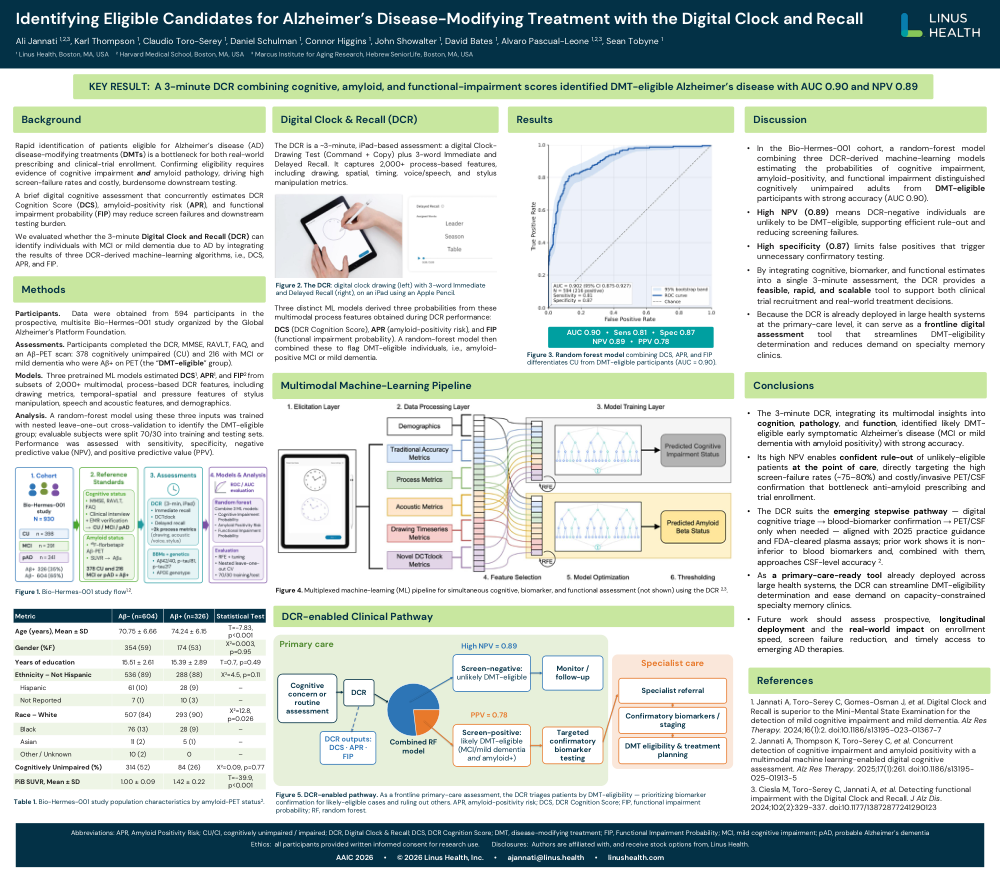
KEY RESULT: A 3-minute DCR combining cognitive, amyloid, and functional-impairment scores identified DMT-eligible Alzheimer's disease with AUC 0.90 and NPV 0.89
Background
Rapid identification of patients eligible for Alzheimer's disease (AD) disease-modifying treatments (DMTs) is a bottleneck for both real-world prescribing and clinical-trial enrollment. Confirming eligibility requires evidence of cognitive impairment and amyloid pathology, driving high screen-failure rates and costly, burdensome downstream testing.
A brief digital cognitive assessment that concurrently estimates DCR Cognition Score (DCS), amyloid-positivity risk (APR), and functional impairment probability (FIP) may reduce screen failures and downstream testing burden.
We evaluated whether the 3-minute Digital Clock and Recall (DCR) can identify individuals with MCI or mild dementia due to AD by integrating the results of three DCR-derived machine-learning algorithms, i.e., DCS, APR, and FIP.
Methods
Participants. Data were obtained from 594 participants in the prospective, multisite Bio-Hermes-001 study organized by the Global Alzheimer's Platform Foundation.
Assessments. Participants completed the DCR, MMSE, RAVLT, FAQ, and an Aβ-PET scan: 378 cognitively unimpaired (CU) and 216 with MCI or mild dementia who were Aβ+ on PET (the "DMT-eligible" group).
Models. Three pretrained ML models estimated DCS¹, APR¹, and FIP² from subsets of 2,000+ multimodal, process-based DCR features, including drawing metrics, temporal-spatial and pressure features of stylus manipulation, speech and acoustic features, and demographics.
Analysis. A random-forest model using these three inputs was trained with nested leave-one-out cross-validation to identify the DMT-eligible group; evaluable subjects were split 70/30 into training and testing sets. Performance was assessed with sensitivity, specificity, negative predictive value (NPV), and positive predictive value (PPV).
Figure 1. Bio-Hermes-001 study flow¹,².
Table 1. Bio-Hermes-001 study population characteristics by amyloid-PET status²
| Metric | Aβ− (n=604) | Aβ+ (n=326) | Statistical Test |
|---|---|---|---|
| Age (years), Mean ± SD | 70.75 ± 6.66 | 74.24 ± 6.15 | T=−7.83, p<0.001 |
| Gender (%F) | 354 (59) | 174 (53) | X²=0.003, p=0.95 |
| Years of education | 15.51 ± 2.61 | 15.39 ± 2.89 | T=0.7, p=0.49 |
| Ethnicity – Not Hispanic | 536 (89) | 288 (88) | X²=4.5, p=0.11 |
| Hispanic | 61 (10) | 28 (9) | – |
| Not Reported | 7 (1) | 10 (3) | – |
| Race – White | 507 (84) | 293 (90) | X²=12.8, p=0.026 |
| Black | 76 (13) | 28 (9) | – |
| Asian | 11 (2) | 5 (1) | – |
| Other / Unknown | 10 (2) | 0 | – |
| Cognitively Unimpaired (%) | 314 (52) | 84 (26) | X²=0.09, p=0.77 |
| PiB SUVR, Mean ± SD | 1.00 ± 0.09 | 1.42 ± 0.22 | T=−39.9, p<0.001 |
Digital Clock & Recall (DCR)
The DCR is a ~3-minute, iPad-based assessment: a digital Clock-Drawing Test (Command + Copy) plus 3-word Immediate and Delayed Recall. It captures 2,000+ process-based features, including drawing, spatial, timing, voice/speech, and stylus manipulation metrics.
Figure 2. The DCR: digital clock drawing (left) with 3-word Immediate and Delayed Recall (right), on an iPad using an Apple Pencil.
Three distinct ML models derived three probabilities from these multimodal process features obtained during DCR performance: DCS (DCR Cognition Score), APR (amyloid-positivity risk), and FIP (functional impairment probability). A random-forest model then combined these to flag DMT-eligible individuals, i.e., amyloid-positive MCI or mild dementia.
Multimodal Machine-Learning Pipeline
Figure 4. Multiplexed machine-learning (ML) pipeline for simultaneous cognitive, biomarker, and functional assessment (not shown) using the DCR ²,³.
Results
AUC 0.90 • Sens 0.81 • Spec 0.87 • NPV 0.89 • PPV 0.78
Figure 3. Random forest model combining DCS, APR, and FIP differentiates CU from DMT-eligible participants (AUC = 0.90).
DCR-enabled Clinical Pathway
Primary care:
Cognitive concern or routine assessment → DCR → DCR outputs: DCS · APR · FIP → Combined RF model
- High NPV = 0.89 — Screen-negative: unlikely DMT-eligible → Monitor / follow-up
- PPV = 0.78 — Screen-positive: likely DMT-eligible (MCI/mild dementia and amyloid+) → Targeted confirmatory biomarker testing
Specialist care:
Specialist referral → Confirmatory biomarkers / staging → DMT eligibility & treatment planning
Figure 5. DCR-enabled pathway. As a frontline primary-care assessment, the DCR triages patients by DMT-eligibility — prioritizing biomarker confirmation for likely-eligible cases and ruling out others. APR, amyloid-positivity risk; DCS, DCR Cognition Score; FIP, functional impairment probability; RF, random forest.
Discussion
- In the Bio-Hermes-001 cohort, a random-forest model combining three DCR-derived machine-learning models estimating the probabilities of cognitive impairment, amyloid-positivity, and functional impairment distinguished cognitively unimpaired adults from DMT-eligible participants with strong accuracy (AUC 0.90).
- High NPV (0.89) means DCR-negative individuals are unlikely to be DMT-eligible, supporting efficient rule-out and reducing screening failures.
- High specificity (0.87) limits false positives that trigger unnecessary confirmatory testing.
- By integrating cognitive, biomarker, and functional estimates into a single 3-minute assessment, the DCR provides a feasible, rapid, and scalable tool to support both clinical trial recruitment and real-world treatment decisions.
- Because the DCR is already deployed in large health systems at the primary-care level, it can serve as a frontline digital assessment tool that streamlines DMT-eligibility determination and reduces demand on specialty memory clinics.
Conclusions
- The 3-minute DCR, integrating its multimodal insights into cognition, pathology, and function, identified likely DMT-eligible early symptomatic Alzheimer's disease (MCI or mild dementia with amyloid positivity) with strong accuracy.
- Its high NPV enables confident rule-out of unlikely-eligible patients at the point of care, directly targeting the high screen-failure rates (~75–80%) and costly/invasive PET/CSF confirmation that bottleneck anti-amyloid prescribing and trial enrollment.
- The DCR suits the emerging stepwise pathway — digital cognitive triage → blood-biomarker confirmation → PET/CSF only when needed — aligned with 2025 practice guidance and FDA-cleared plasma assays; prior work shows it is non-inferior to blood biomarkers and, combined with them, approaches CSF-level accuracy ².
- As a primary-care-ready tool already deployed across large health systems, the DCR can streamline DMT-eligibility determination and ease demand on capacity-constrained specialty memory clinics.
- Future work should assess prospective, longitudinal deployment and the real-world impact on enrollment speed, screen failure reduction, and timely access to emerging AD therapies.
References
- Jannati A, Toro-Serey C, Gomes-Osman J, et al. Digital Clock and Recall is superior to the Mini-Mental State Examination for the detection of mild cognitive impairment and mild dementia. Alz Res Therapy. 2024;16(1):2. doi:10.1186/s13195-023-01367-7
- Jannati A, Thompson K, Toro-Serey C, et al. Concurrent detection of cognitive impairment and amyloid positivity with a multimodal machine learning-enabled digital cognitive assessment. Alz Res Therapy. 2025;17(1):261. doi:10.1186/s13195-025-01913-5
- Ciesla M, Toro-Serey C, Jannati A, et al. Detecting functional impairment with the Digital Clock and Recall. J Alz Dis. 2024;102(2):329-337. doi:10.1177/13872877241290123
Abbreviations: APR, Amyloid Positivity Risk; CU/CI, cognitively unimpaired / impaired; DCR, Digital Clock & Recall; DCS, DCR Cognition Score; DMT, disease-modifying treatment; FIP, Functional Impairment Probability; MCI, mild cognitive impairment; pAD, probable Alzheimer's dementia
Ethics: all participants provided written informed consent for research use.
Disclosures: Authors are affiliated with, and receive stock options from, Linus Health.
AAIC 2026 • © 2026 Linus Health, Inc. • ajannati@linus.health • linushealth.com
Comments
Email is required but is not shown publicly.
Loading comments...