4,068 posters, 219 videos, 101 topics, 69 sessions, 14,365 authors, 6,128 institutions
ePostersLive by SciGen Technologies S.A. All rights reserved.
Alzheimer's Association International Conference 2026
July 12-15, 2026 | London, United Kingdom, and Online

7276
Community Led Priority Setting For Dementia Risk Factor Research In Rural Kilimanjaro, Tanzania.
Poster Presenter
Authors
Grace Anderson, Laura Wright, Aloyce Kisoli, Amour Mkubila, Zakayo Joctani, Sabasi Rite, Aurelia Mallya, Leonsi Mtenga, Hadija Ulomi, Edward Mbowe, Lachlan Fotheringham, Damas Mlaki, Richard Walker, Louise Robinson, Kalaria Rajesh, Bernad Mbwele, Paddick Stella Marie
Affiliations
, Newcastle University, AMRCO/Dementia alliance of Tanzania, KCRI, Anderson Memorial Rehabilitation & Care Organisation, Akilimali, Mirembe Hospital, Newcastle Univerity, UDSM
Part of Topic
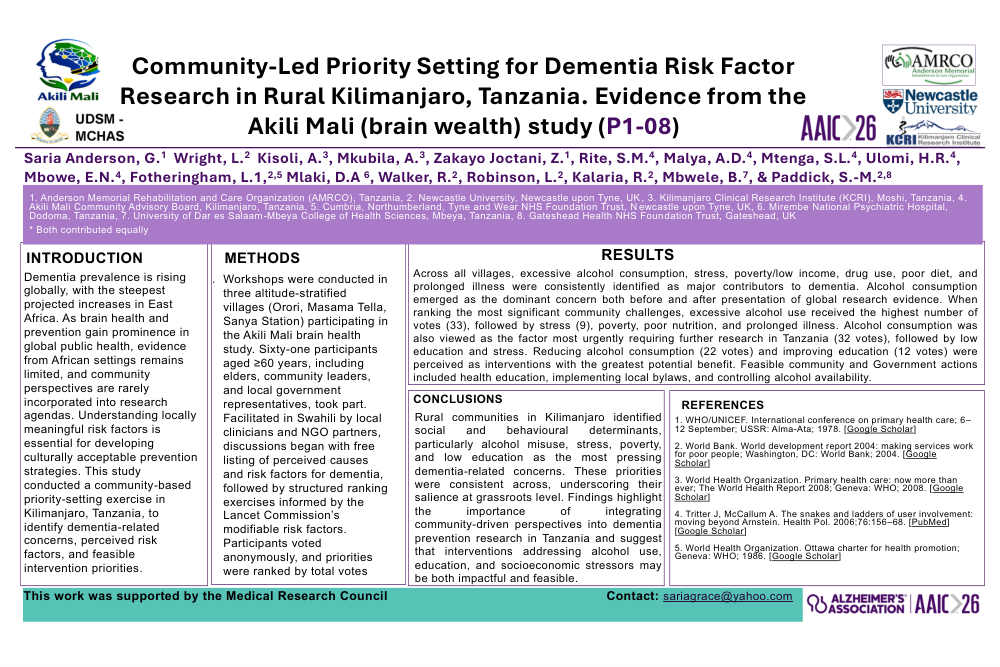
Community-Led Priority Setting for Dementia Risk Factor Research in Rural Kilimanjaro, Tanzania. Evidence from the Akili Mali (brain wealth) study(P1-08)
Saria Anderson, G.1Wright, L.2Kisoli, A.3, Mkubila, A.3, Zakayo Joctani, Z.1, Rite, S.M.4, Malya, A.D.4, Mtenga, S.L.4, Ulomi, H.R.4,
Mbowe, E.N.4, Fotheringham, L.1,2,5Mlaki, D.A 6, Walker, R.2, Robinson, L.2, Kalaria, R.2, Mbwele, B.7, & Paddick, S.-M.2,8
INTRODUCTION
Dementia prevalence is rising globally, with the steepest projected increases in East Africa. As brain health and prevention gain prominence in global public health, evidence from African settings remains limited, and community perspectives are rarely incorporated into research agendas. Understanding locally meaningful risk factors is essential for developing culturally acceptable prevention strategies. This study conducted a community‑based priority‑setting exercise in Kilimanjaro, Tanzania, to identify dementia‑related concerns, perceived risk factors, and feasible intervention priorities.
METHODS
Workshops were conducted in three altitude‑stratified villages (Orori, Masama Tella, Sanya Station) participating in the Akili Mali brain health study. Sixty‑one participants aged ≥60 years, including elders, community leaders, and local government representatives, took part. Facilitated in Swahili by local clinicians and NGO partners, discussions began with free listing of perceived causes and risk factors for dementia, followed by structured ranking exercises informed by the Lancet Commission’s modifiable risk factors. Participants voted anonymously, and priorities were ranked by total votes
RESULTS
Across all villages, excessive alcohol consumption, stress, poverty/low income, drug use, poor diet, and prolonged illness were consistently identified as major contributors to dementia. Alcohol consumption emerged as the dominant concern both before and after presentation of global research evidence. When ranking the most significant community challenges, excessive alcohol use received the highest number of votes (33), followed by stress (9), poverty, poor nutrition, and prolonged illness. Alcohol consumption was also viewed as the factor most urgently requiring further research in Tanzania (32 votes), followed by low education and stress. Reducing alcohol consumption (22 votes) and improving education (12 votes) were perceived as interventions with the greatest potential benefit. Feasible community and Government actions included health education, implementing local bylaws, and controlling alcohol availability.
CONCLUSION
Rural communities in Kilimanjaro identified social and behavioural determinants, particularly alcohol misuse, stress, poverty, and low education as the most pressing dementia‑related concerns. These priorities were consistent across, underscoring their salience at grassroots level. Findings highlight the importance of integrating community‑driven perspectives into dementia prevention research in Tanzania and suggest that interventions addressing alcohol use, education, and socioeconomic stressors may be both impactful and feasible.
REFERENCES
1. WHO/UNICEF. International conference on primary health care; 6–12 September; USSR: Alma-Ata; 1978. [Google Scholar]
2. World Bank. World development report 2004: making services work for poor people; Washington, DC: World Bank; 2004. [Google Scholar]
3. World Health Organization. Primary health care: now more than ever; The World Health Report 2008; Geneva: WHO; 2008. [Google Scholar]
4. Tritter J, McCallum A. The snakes and ladders of user involvement: moving beyond Arnstein. Health Pol. 2006;76:156–68. [PubMed] [Google Scholar]
5. World Health Organization. Ottawa charter for health promotion; Geneva: WHO; 1986. [Google Scholar]
Comments
Email is required but is not shown publicly.
Loading comments...