4,068 posters, 219 videos, 101 topics, 69 sessions, 14,365 authors, 6,128 institutions
ePostersLive by SciGen Technologies S.A. All rights reserved.
Alzheimer's Association International Conference 2026
July 12-15, 2026 | London, United Kingdom, and Online

10446
Neuromodulation For Sleep And Cognition In Mild Cognitive Impairment And Early Alzheimer’S Disease: A Systematic Review
Poster Presenter
Authors
Jessica Vargas Lopes, Henrique Werner Balbinot, Fernando Augusto Siuta dos Santos, Camila Pereira de Souza, Tábata Smagala, Vitório Serafim, Matias Pinheiro de Macedo Neto, Gabryel dos Santos Ferreira, Giulya da Rocha Germann Alves, Giulia Murillo Wollmann
Affiliations
Universidade Federal de Ciências da Saúde de Porto Alegre, Porto Alegre, Brazil, Universidade Federal do Rio Grande do Sul, Porto Alegre, Brazil, Serviço de Neurologia e Neurocirurgia, Hospital Mãe de Deus, Porto Alegre, Brazil.
Part of Topic
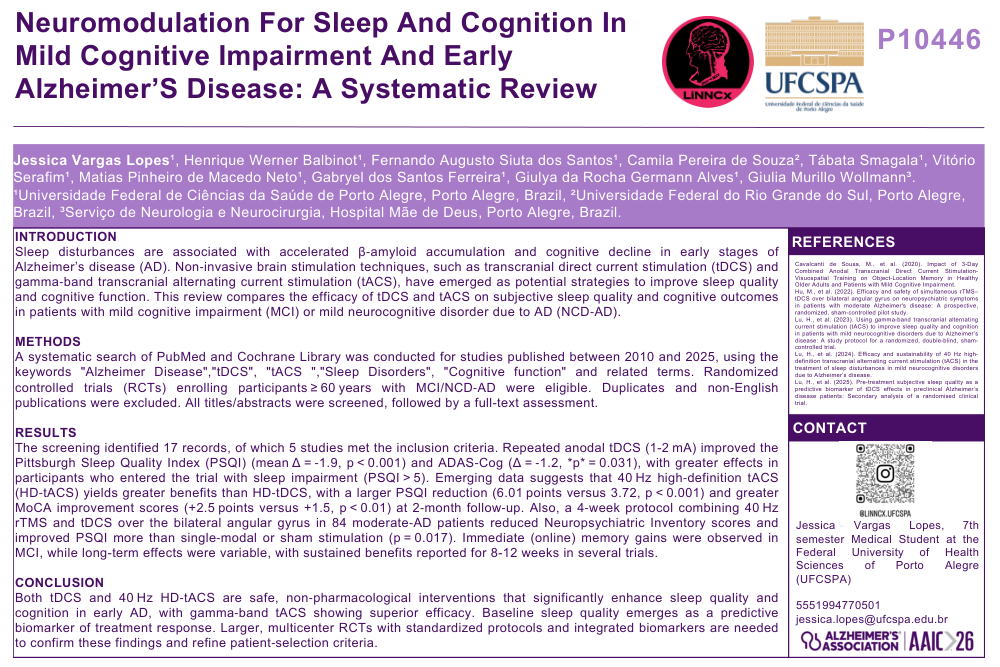
Background: Sleep disturbances are associated with accelerated β‑amyloid accumulation and cognitive decline in early stages of Alzheimer’s disease (AD). Non‑invasive brain stimulation techniques, such as transcranial direct current stimulation (tDCS) and gamma‑band transcranial alternating current stimulation (tACS), have emerged as potential strategies to improve sleep quality and cognitive function. This review compares the efficacy of tDCS and tACS on subjective sleep quality and cognitive outcomes in patients with mild cognitive impairment (MCI) or mild neurocognitive disorder due to AD (NCD‑AD).
Methods: A systematic search of PubMed and Cochrane Library was conducted for studies published between 2010 and 2025, using the keywords "Alzheimer Disease","tDCS", "tACS ","Sleep Disorders", "Cognitive function" and related terms. Randomized controlled trials (RCTs) enrolling participants ≥ 60 years with MCI/NCD‑AD were eligible. Duplicates and non‑English publications were excluded. All titles/abstracts were screened, followed by a full-text assessment.
Results: The screening identified 17 records, of which 5 studies met the inclusion criteria. Repeated anodal tDCS (1-2 mA) improved the Pittsburgh Sleep Quality Index (PSQI) (mean Δ = ‑1.9, p < 0.001) and ADAS‑Cog (Δ = ‑1.2, *p* = 0.031), with greater effects in participants who entered the trial with sleep impairment (PSQI > 5). Emerging data suggests that 40 Hz high‑definition tACS (HD‑tACS) yields greater benefits than HD‑tDCS, with a larger PSQI reduction (6.01 points versus 3.72, p < 0.001) and greater MoCA improvement scores (+2.5 points versus +1.5, p < 0.01) at 2‑month follow‑up. Also, a 4‑week protocol combining 40 Hz rTMS and tDCS over the bilateral angular gyrus in 84 moderate‑AD patients reduced Neuropsychiatric Inventory scores and improved PSQI more than single‑modal or sham stimulation (p = 0.017). Immediate (online) memory gains were observed in MCI, while long-term effects were variable, with sustained benefits reported for 8-12 weeks in several trials.
Conclusion: Both tDCS and 40 Hz HD‑tACS are safe, non‑pharmacological interventions that significantly enhance sleep quality and cognition in early AD, with gamma‑band tACS showing superior efficacy. Baseline sleep quality emerges as a predictive biomarker of treatment response. Larger, multicenter RCTs with standardized protocols and integrated biomarkers are needed to confirm these findings and refine patient‑selection criteria.
Comments
Email is required but is not shown publicly.
Loading comments...