4,068 posters, 219 videos, 101 topics, 69 sessions, 14,365 authors, 6,128 institutions
ePostersLive by SciGen Technologies S.A. All rights reserved.
Alzheimer's Association International Conference 2026
July 12-15, 2026 | London, United Kingdom, and Online

4704
Developing A Novel Genomic Biomarker For The Early Detection Of Neurodegeneration
Poster Presenter
Part of Topic
Introduction:
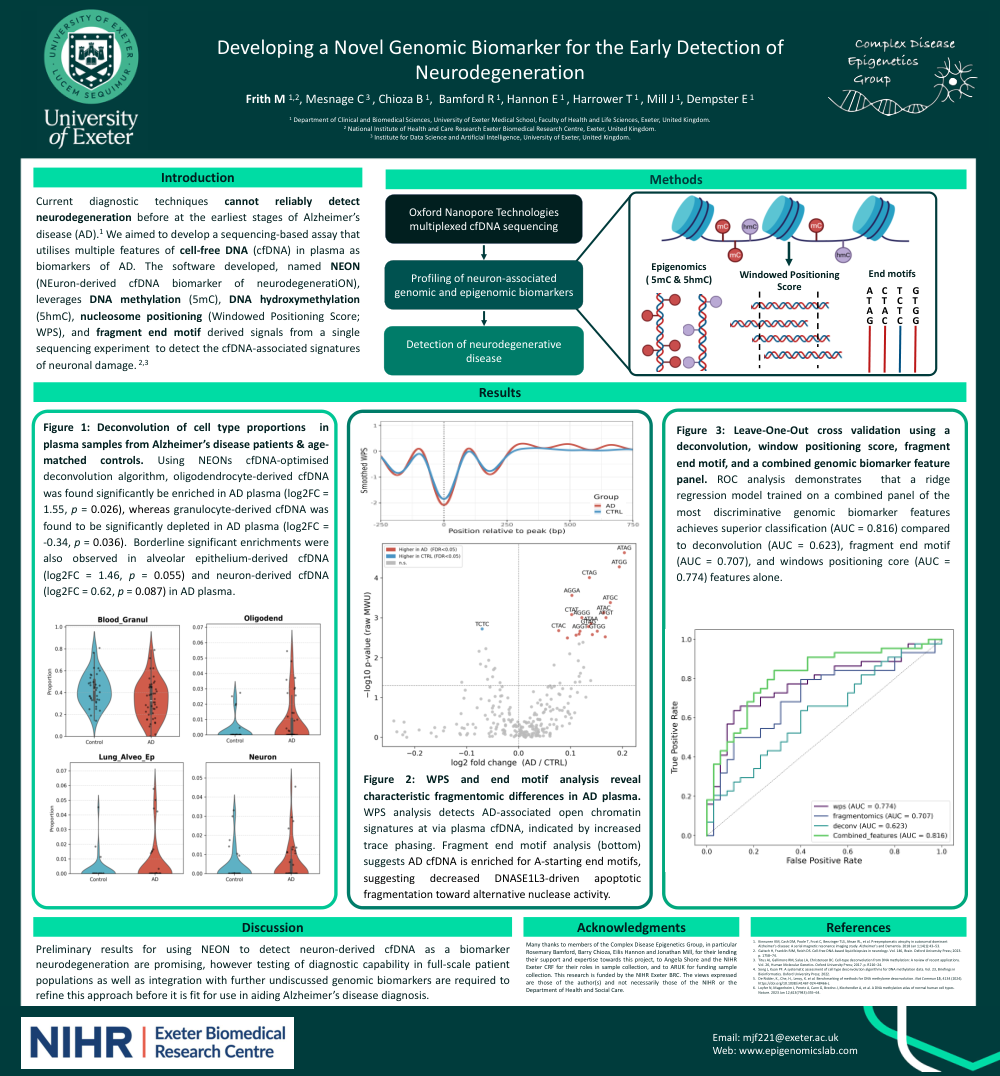
Current diagnostic techniques cannot reliably detect neurodegeneration before at the earliest stages of Alzheimer’s disease (AD).1 We aimed to develop a sequencing-based assay that utilises multiple features of cell-free DNA (cfDNA) in plasma as biomarkers of AD. The software developed, named NEON (NEuron-derived cfDNA biomarker of neurodegeneratiON), leverages DNA methylation (5mC), DNA hydroxymethylation (5hmC), nucleosome positioning (Windowed Positioning Score; WPS), and fragment end motif derived signals from a single sequencing experiment to detect the cfDNA-associated signatures of neuronal damage. 2,3
Results:
Figure 1: Deconvolution of cell type proportions in plasma samples from Alzheimer’s disease patients & age-matched controls. Using NEONs cfDNA-optimised deconvolution algorithm, oligodendrocyte-derived cfDNA was found significantly be enriched in AD plasma (log2FC = 1.55, p = 0.026), whereas granulocyte-derived cfDNA was found to be significantly depleted in AD plasma (log2FC = -0.34, p = 0.036). Borderline significant enrichments were also observed in alveolar epithelium-derived cfDNA (log2FC = 1.46, p = 0.055) and neuron-derived cfDNA (log2FC = 0.62, p = 0.087) in AD plasma.
Figure 2: WPS and end motif analysis reveal characteristic fragmentomic differences in AD plasma. WPS analysis detects AD-associated open chromatin signatures at via plasma cfDNA, indicated by increased trace phasing. Fragment end motif analysis (bottom) suggests AD cfDNA is enriched for A-starting end motifs, suggesting decreased DNASE1L3-driven apoptotic fragmentation toward alternative nuclease activity.
Figure 3: Leave-One-Out cross validation using a deconvolution, window positioning score, fragment end motif, and a combined genomic biomarker feature panel. ROC analysis demonstrates that a ridge regression model trained on a combined panel of the most discriminative genomic biomarker features achieves superior classification (AUC = 0.816) compared to deconvolution (AUC = 0.623), fragment end motif (AUC = 0.707), and windows positioning core (AUC = 0.774) features alone.
Discussion:
Preliminary results for using NEON to detect neuron-derived cfDNA as a biomarker neurodegeneration are promising, however testing of diagnostic capability in full-scale patient populations as well as integration with further undiscussed genomic biomarkers are required to refine this approach before it is fit for use in aiding Alzheimer’s disease diagnosis
Comments
Email is required but is not shown publicly.
Loading comments...