4,068 posters, 219 videos, 101 topics, 69 sessions, 14,365 authors, 6,128 institutions
ePostersLive by SciGen Technologies S.A. All rights reserved.
Alzheimer's Association International Conference 2026
July 12-15, 2026 | London, United Kingdom, and Online

3625
Dynamical Eye Movement Analysis For The Detection Of Mild Cognitive Impairment
Part of Topic
Video
Dynamical Eye Movement Analysis for the Detection of Mild Cognitive Impairment
Sonja Cecchetti¹*, Andrew T. Duchowski², and Marco Cavallo¹
¹Department of Theoretical and Applied Sciences, eCampus University, 22060 Novedrate, Italy
²School of Computing, Clemson University, Clemson, SC 29634, USA
*Correspondence: Sonja Cecchetti (cecchettisonja@gmail.com; +39 3494443924)
Background:
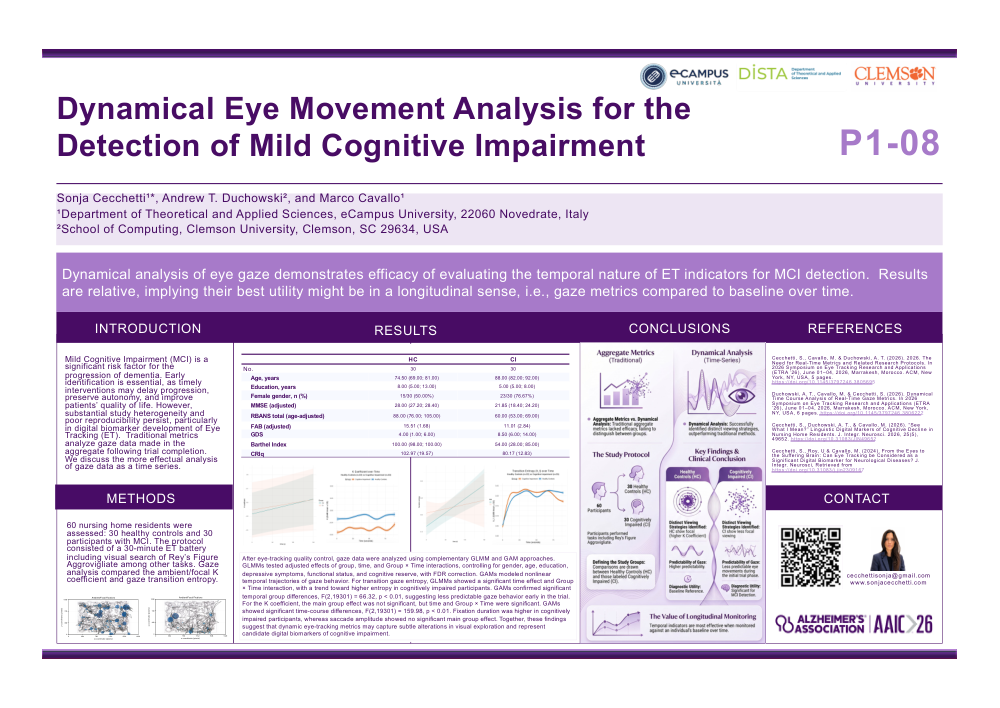
Mild Cognitive Impairment (MCI) is a significant risk factor for the progression of dementia. Early identification is essential, as timely interventions may delay progression, preserve autonomy, and improve patients’ quality of life. However, substantial study heterogeneity and poor reproducibility persist, particularly in digital biomarker development of Eye Tracking (ET). Traditional metrics analyze gaze data made in the aggregate following trial completion. We discuss the more effectual analysis of gaze data as a time series.
Objective:
The goal is to derive sensitive and replicable real-time digital biomarkers for the early detection of cognitive decline.
Methods:
60 nursing home residents were assessed: 30 healthy controls (HC; mean age: 75.7 ± 6.2; mean MMSE score: 27.8 ± 1.4) and 30 participants with MCI (CI; mean age: 86.3 ± 5.4; mean MMSE score: 21.0 ± 2.6). The protocol consisted of a 30-minute ET battery including visual search of Rey’s Figure Aggrovigliate among other tasks. Gaze analysis compared the ambient/focal K coefficient and gaze transition entropy.
Results:
After eye-tracking quality control, gaze data were analyzed using complementary GLMM and GAM approaches. GLMMs tested adjusted effects of group, time, and Group × Time interactions, controlling for gender, age, education, depressive symptoms, functional status, and cognitive reserve, with FDR correction. GAMs modeled nonlinear temporal trajectories of gaze behavior. For transition gaze entropy, GLMMs showed a significant time effect and Group × Time interaction, with a trend toward higher entropy in cognitively impaired participants. GAMs confirmed significant temporal group differences, F(2,19301) = 66.32, p < 0.01, suggesting less predictable gaze behavior early in the trial.
For the K coefficient, the main group effect was not significant, but time and Group × Time were significant. GAMs showed significant time-course differences, F(2,19301) = 159.98, p < 0.01. Fixation duration was higher in cognitively impaired participants, whereas saccade amplitude showed no significant main group effect. Together, these findings suggest that dynamic eye-tracking metrics may capture subtle alterations in visual exploration and represent candidate digital biomarkers of cognitive impairment.
Conclusions:
Dynamical analysis of eye gaze demonstrates efficacy of evaluating the temporal nature of ET indicators for MCI detection. Results are relative, implying their best utility might be in a longitudinal sense, i.e., gaze metrics compared to baseline over time.
Keywords:
mild cognitive impairment, eye tracking, digital biomarkers, dementia
References:
Cecchetti, S., Cavallo, M. & Duchowski, A. T. (2026). 2026. The Need for Real-Time Metrics and Related Research Protocols. In 2026 Symposium on Eye Tracking Research and Applications (ETRA ’26), June 01–04, 2026, Marrakesh, Morocco. ACM, New York, NY, USA, 5 pages. https://doi.org/10.1145/3797246.3805695
Duchowski, A. T., Cavallo, M. & Cecchetti, S. (2026). Dynamical Time Course Analysis of Real-Time Gaze Metrics. In 2026 Symposium on Eye Tracking Research and Applications (ETRA ’26), June 01–04, 2026, Marrakesh, Morocco. ACM, New York, NY, USA, 6 pages. https://doi.org/10.1145/3797246.3806222
Cecchetti, S., Duchowski, A. T., & Cavallo, M. (2026). “See What I Mean?” Linguistic Digital Markers of Cognitive Decline in Nursing Home Residents. J. Integr. Neurosci. 2026, 25(5), 49652. https://doi.org/10.31083/JIN49652
Cecchetti, S., Roy, U & Cavallo, M. (2024). From the Eyes to the Suffering Brain: Can Eye Tracking be Considered as a Significant Digital Biomarker for Neurological Diseases? J. Integr. Neurosci, Retrieved from https://doi.org/10.31083/j.jin2309167
Comments
Email is required but is not shown publicly.
Loading comments...