4,068 posters, 219 videos, 101 topics, 69 sessions, 14,365 authors, 6,128 institutions
ePostersLive by SciGen Technologies S.A. All rights reserved.
Alzheimer's Association International Conference 2026
July 12-15, 2026 | London, United Kingdom, and Online

3247
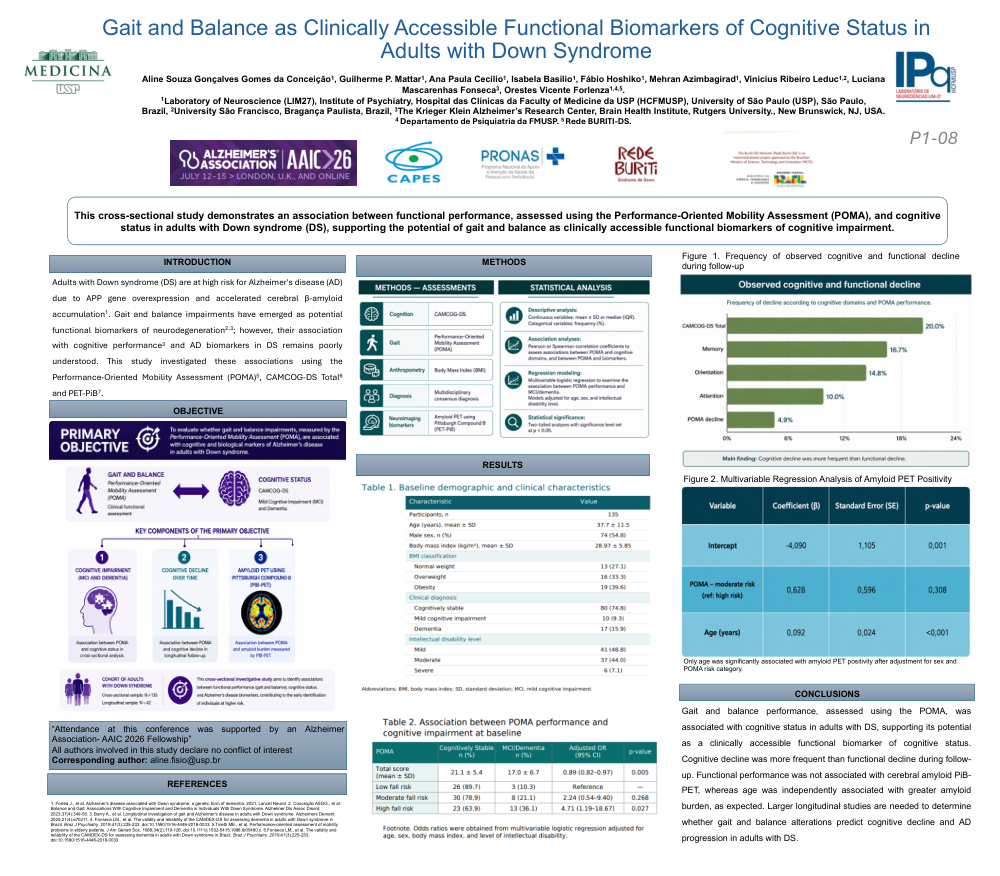
Gait And Balance As Clinically Accessible Functional Biomarkers Of Cognitive Status In Adults With Down Syndrome
Poster Presenter
Authors
Aline S.G.G da Conceicao, Guilherme P. Mattar, Isabela Basilio, Fábio Tsuyoshi Hoshiko, Mehran Azimbagirad, Vinicius Ribeiro Leduc, Luciana Mascarenhas Fonseca, Orestes Vicente Forlenza
Affiliations
1.Laboratory of Neuroscience (LIM27), Institute of Psychiatry, Hospital das Clínicas da Faculty of Medicine da USP (HCFMUSP), University of São Paulo (USP), São Paulo, Brazil., 1.Laboratory of Neuroscience (LIM27), Institute of Psychiatry, Hospital das Clínicas da Faculty of Medicine da USP (HCFMUSP), University of São Paulo (USP), São Paulo, Brazil. 2. University São Francisco, Bragança Paulista, Brazil, 3. The Krieger Klein Alzheimer’s Research Center, Brain Health Institute, Rutgers University, New Brunswick, NJ, USA, 1. Laboratory of Neuroscience (LIM27), Institute of Psychiatry, Hospital das Clínicas da Faculty of Medicine da USP (HCFMUSP), University of São Paulo (USP), São Paulo, Brazil. 4. Departamento de Psiquiatria da FMUSP. 5. Rede BURITI-DS.
Part of Topic
Gait And Balance As Clinically Accessible Functional Biomarkers Of Cognitive Status In Adults With Down Syndrome:
Author Block:Aline Souza Gonçalves Gomes da Conceição1, Guilherme P. Mattar1, Isabela Basilio1, Fábio Tsuyoshi Hoshiko1, Mehran Azimbagirad1, Vinicius Ribeiro Leduc1,2, Luciana Mascarenhas Fonseca3, Orestes Vicente Forlenza1,4,5.
1Laboratory ofNeuroscience(LIM27), InstituteofPsychiatry, Hospital das Clínicas daFacultyofMedicine da USP (HCFMUSP), Universityof São Paulo (USP), São Paulo, Brazil, 2University São Francisco, Bragança Paulista, Brazil, 3The Krieger Klein Alzheimer’sResearch Center, Brain Health Institute, Rutgers University., New Brunswick, NJ, USA. 4 Departamento de Psiquiatria da FMUSP. 5 Rede BURITI-DS.
Abstract:
Background: Adults with Down syndrome (DS) are at increased risk of early-onset Alzheimer’s disease (AD), largely associated with amyloid overproduction. Given the limitations of cognitive assessment in this population, functional markers such as gait and balance are particularly relevant for early detection of decline; however, evidence in aging adults with DS remains limited.
Methods: This preliminary analysis included 135 adults with DS aged ≥ 20 years from the University of São Paulo, were included (mean age 37.7 years; 54.8% male). Gait and balance were evaluated using the Performance-Oriented Mobility Assessment (POMA), and cognitive performance was assessed using CAMDEX-DS across one or two timepoints. Statistical analyses included correlations, regression models, and nonparametric tests. Associations between POMA, consensus clinical diagnosis, and cerebral amyloid beta burden (Aβ-PET) by Pittsburgh compound B positron emission tomography (PIB-PET) in a subset of participants (n=40) were explored. Linear regression models were adjusted for age, sex, and body mass index (BMI).
Results: At baseline, 36.3% of participants presented high fall risk. Baseline POMA was significantly associated with clinical diagnosis (p = 0.005), and individuals classified as high fall risk had 4.7-fold increased odds of Mild Cognitive Impairment or Dementia compared with those at low risk. Among participants with follow-up data, POMA scores showed no significant longitudinal decline, while a modest reduction was observed in attention (p = 0.049). Changes in POMA were weak but significantly correlated with changes in memory (r = 0.384; p = 0.040). In adjusted models restricted to the PET subsample, POMA was not independently associated with amyloid burden. Clinical diagnosis was significantly associated with Aβ burden when adjusted for age, sex and BMI (B = 1.17, p = 0.027).
Conclusion: Gait and balance performance was significantly associated with clinical diagnosis in adults with DS and was related to specific cognitive domains, particularly attention and memory. Although no independent association with Aβ burden was detected, the small PET subsample limited statistical power. These findings support the use of gait-based measures as clinically meaningful, low-cost, and non-invasive functional biomarkers. Larger longitudinal studies are warranted to clarify their role in integrated functional-cognitive monitoring frameworks for neurodegenerative risk.
Author Disclosure Information: A.S. Conceição: Grant/Research Support; Self; CAPES-PROEX 88887.989052/2024-00, PRONAS-CAAE 40401420700000068.
Comments
Email is required but is not shown publicly.
Loading comments...