4,068 posters, 219 videos, 101 topics, 69 sessions, 14,365 authors, 6,128 institutions
ePostersLive by SciGen Technologies S.A. All rights reserved.
Alzheimer's Association International Conference 2026
July 12-15, 2026 | London, United Kingdom, and Online

9004
Age-related Frequency Of Plasma P-tau217 Positivity Across The Alzheimer’S Disease Continuum And Its Relationship To aί And Tau PET Status
Poster Presenter
Authors
Alvaro de Oliveira Franco, Guilherme Povala, Bruna Bellaver, Raphael de Luca e Tuma, Matheus Scarpatto Rodrigues, Andréia Rocha, Markley Silva Oliveira, Marina Scop Medeiros, Pampa Saha, Douglas Leffa, Livia Amaral, Guilherme Negrini, Firoza Z. Lussier, Rayan Mroué, Carolina Soares, Emma Ruppert, Juli Singer, Tara Gingrich, Alzheimer’s Disease Neuroimaging Initiative ADNI, A4 Study Team A4, Chang Hyung Hong, Hyun Woong Roh, Sang Joon Son, Sterling Johnson, Beth Snitz, Dana L. Tudorascu, Thomas Karikari, Pamela C. L. Ferreira, Eduardo Zimmer, Tharick A. Pascoal
Affiliations
, Department of Psychiatry, University of Pittsburgh, Pittsburgh, USA; Graduate Program in Biological Sciences: Biochemistry, UFRGS, Porto Alegre, Brazil, Department of Psychiatry, University of Pittsburgh, Pittsburgh, USA, Ajou University School of Medicine, Suwon, Republic of Korea, University of Wisconsin, Madison, USA, Department of Neurology, University of Pittsburgh, Pittsburgh, USA, Graduate Program in Biological Sciences: Biochemistry, UFRGS, Porto Alegre, Brazil, Department of Psychiatry, University of Pittsburgh, Pittsburgh, USA; Department of Neurology, University of Pittsburgh, Pittsburgh, USA
Part of Topic
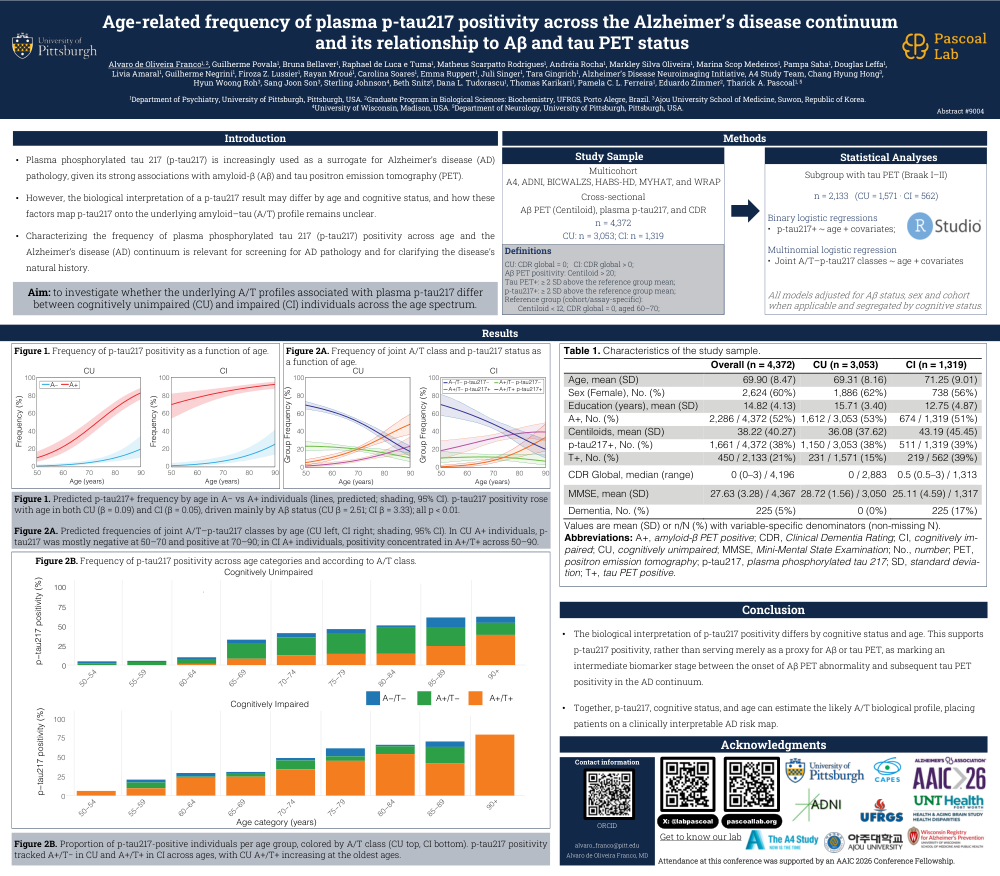
Background: Characterizing the frequency of plasma phosphorylated tau 217 (p-tau217) positivity across age and the Alzheimer's disease (AD) continuum is relevant to screening for AD pathology and to understanding the disease's natural history. Here, we examined the frequency of p-tau217 positivity across age in cognitively unimpaired (CU) and cognitively impaired (CI) individuals and its association with A/T groups based on amyloid-β (Aβ) and tau positron emission tomography (PET).
Methods: We evaluated 4,372 individuals across the AD continuum from six cohorts (CU: n = 3,053; CI: n = 1,319) with available p-tau217 and Aβ PET data (Table 1). Tau PET SUVR in Braak I-II regions was available for 2,133 participants (1,571 CU; 562 CI). A+ was defined as Aβ PET Centiloids > 20. P-tau217+ and T+ were defined as ≥ 2 SD above the CU reference mean. Positivity frequencies for p-tau217 and PET biomarkers were modeled using logistic and multinomial logistic regression as a function of age, sex, cohort, and Aβ PET status when applicable.
Results: The frequency of p-tau217 positivity increased with age in both CU (β = 0.09, p < 0.01) and CI (β = 0.05, p < 0.01), and was mainly associated with Aβ PET status (CU: β = 2.51, p < 0.01; CI: β = 3.33, p < 0.01) (Figure 1). Among CU A+ participants, most individuals were p-tau217− between ages 50-70 and p-tau217+ between ages 70-90 (Figure 2A). In CI A+ participants, p-tau217 positivity was predominantly observed in the A+/T+ group across ages 50-90 (Figure 2A-B). Overall, p-tau217 positivity was more associated with A+/T− in CU individuals and with A+/T+ in CI individuals across ages (Figure 2B).
Conclusion: Notably, we demonstrated for the first time that the implications of p-tau217 positivity differ by cognitive status and age, predominantly indexing A+/T− states in CU individuals and A+/T+ states in CI individuals. This pattern supports p-tau217 positivity—rather than serving merely as a proxy for Aβ or tau PET—as marking an intermediate biomarker stage between the onset of Aβ PET abnormality and subsequent tau PET positivity in the AD continuum.
Comments
Email is required but is not shown publicly.
Loading comments...