4,068 posters, 219 videos, 101 topics, 69 sessions, 14,365 authors, 6,128 institutions
ePostersLive by SciGen Technologies S.A. All rights reserved.
Alzheimer's Association International Conference 2026
July 12-15, 2026 | London, United Kingdom, and Online

10334
Systemic Medication Exposure And Biomarkers Of Preclinical Alzheimer’S Disease
Poster Presenter
Authors
Frida Lenér, Iris Bosch, Laura Stankeviciute, Roshini Sridhar, Fredrik Öhman, Nicolai Franzmeier, David Berron, Silke Kern, Henrik Zetterberg, Konstantinos Poulakis, Linus Jönsson, Hanna Gyllensten, Michael Schöll
Affiliations
German Center for Neurodegenerative Diseases (DZNE), Magdeburg, Germany, Department of Psychiatry and Neurochemistry, Institute of Neuroscience and Physiology, Sahlgrenska Academy, University of Gothenburg, Mölndal, Sweden, Institute for Stroke and Dementia Research (ISD), University Hospital, Ludwig-Maximilians-Universität München, Munich, Germany, Division of Clinical Geriatrics, Center for Alzheimer Research, Department of Neurobiology, Care Sciences and Society, Karolinska Institutet, Stockholm, Sweden, Department of Neurobiology, Care Sciences and Society, Karolinska Institute, Solna, Sweden, Institute of Health and Care Sciences, Sahlgrenska Academy, University of Gothenburg, Gothenburg, Sweden
Part of Topic
About the study
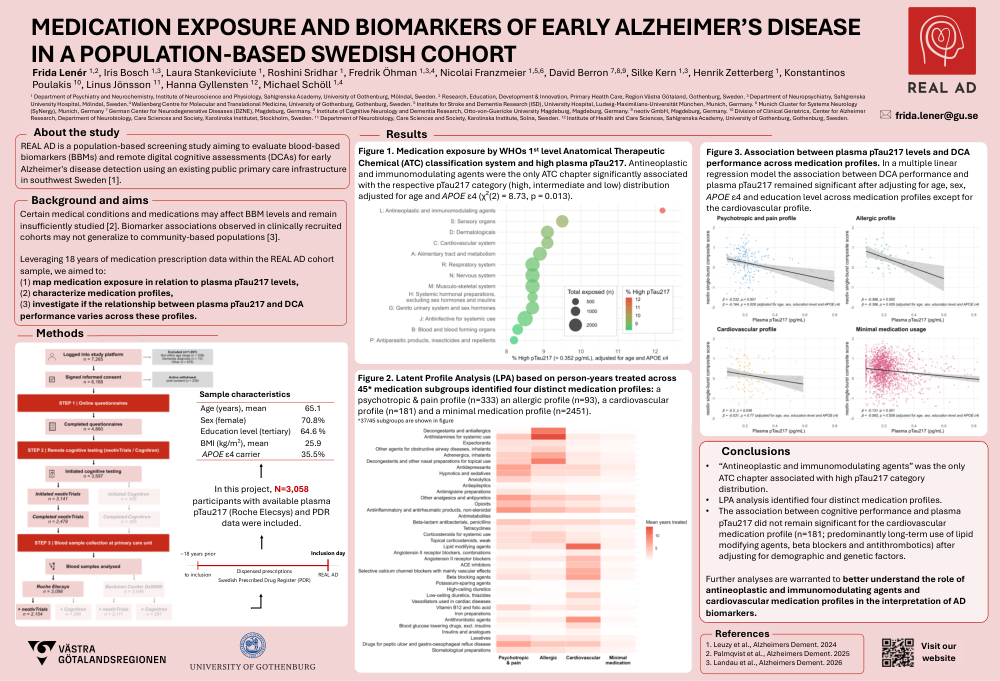
REAL AD is a population-based screening study aiming to evaluate blood-based biomarkers (BBMs) and remote digital cognitive assessments (DCAs) for early Alzheimer's disease detection using an existing public primary care infrastructure in southwest Sweden [1].
Background and aims
Certain medical conditions and medications may affect BBM levels and remain insufficiently studied [2]. Biomarker associations observed in clinically recruited cohorts may not generalize to community-based populations [3].
Leveraging 18 years of medication prescription data within the REAL AD cohort sample, we aimed to:
(1) map medication exposure in relation to plasma pTau217 levels,
(2) characterize medication profiles,
(3) investigate if the relationship between plasma pTau217 and DCA performance varies across these profiles.
Methods
In this project, N=3,058 participants with available plasma pTau217 (Roche Elecsys) and PDR data were included.
Results
Figure 1. Medication exposure by WHOs 1 st level Anatomical Therapeutic Chemical (ATC) classification system and high plasma pTau217. Antineoplastic and immunomodulating agents were the only ATC chapter significantly associated with the respective pTau217 category (high, intermediate and low) distribution adjusted for age and APOE ε4 (χ²(2) = 8.73, p = 0.013).
Figure 2. Latent Profile Analysis (LPA) based on person-years treated across 45* medication subgroups identified four distinct medication profiles: a psychotropic & pain profile (n=333) an allergic profile (n=93), a cardiovascular profile (n=181) and a minimal medication profile (n=2451).
Figure 3. Association between plasma pTau217 levels and DCA performance across medication profiles. In a multiple linear regression model the association between DCA performance and plasma pTau217 remained significant after adjusting for age, sex, APOE ε4 and education level across medication profiles except for the cardiovascular profile.
Conclusions
• “Antineoplastic and immunomodulating agents” was the only ATC chapter associated with high pTau217 category distribution.
• LPA analysis identified four distinct medication profiles.
• The association between cognitive performance and plasma pTau217 did not remain significant for the cardiovascular medication profile (n=181; predominantly long-term use of lipid modifying agents, beta blockers and antithrombotics) after adjusting for demographic and genetic factors.
Further analyses are warranted to better understand the role of antineoplastic and immunomodulating agents and cardiovascular medication profiles in the interpretation of AD biomarkers.
References
1. Leuzy et al., Alzheimers Dement. 2024
2. Palmqvist et al., Alzheimers Dement. 2025
3. Landau et al., Alzheimers Dement. 2026
Comments
Email is required but is not shown publicly.
Loading comments...