4,068 posters, 219 videos, 101 topics, 69 sessions, 14,365 authors, 6,128 institutions
ePostersLive by SciGen Technologies S.A. All rights reserved.
Alzheimer's Association International Conference 2026
July 12-15, 2026 | London, United Kingdom, and Online

634
Association Between Apoe4 And Depressive Symptoms In Cognitively Healthy Older Adults And With Mild Cognitive Impairment
Poster Presenter
Authors
Maria Clara Ribeiro Zucato, Danilo Barroso de Sousa, Ari Alex Ramos, Cecilia Patricia Popolin, Pedro Henrique Moreira Victoriano, Marcia Regina Cominetti
Affiliations
Department of Gerontology, UFSCar, São Carlos, Brazil, Department of Medicine, UFSCar, São Carlos, Brazil, Department of Gerontology, UFSCar, São Carlos, Brazil. Trinity College Dublin, Global Brain Health Institute, Dublin, Ireland.
Part of Topic
Association Between Apoe4 And Depressive Symptoms In Cognitively Healthy Older Adults And With Mild Cognitive Impairment
Abstract:
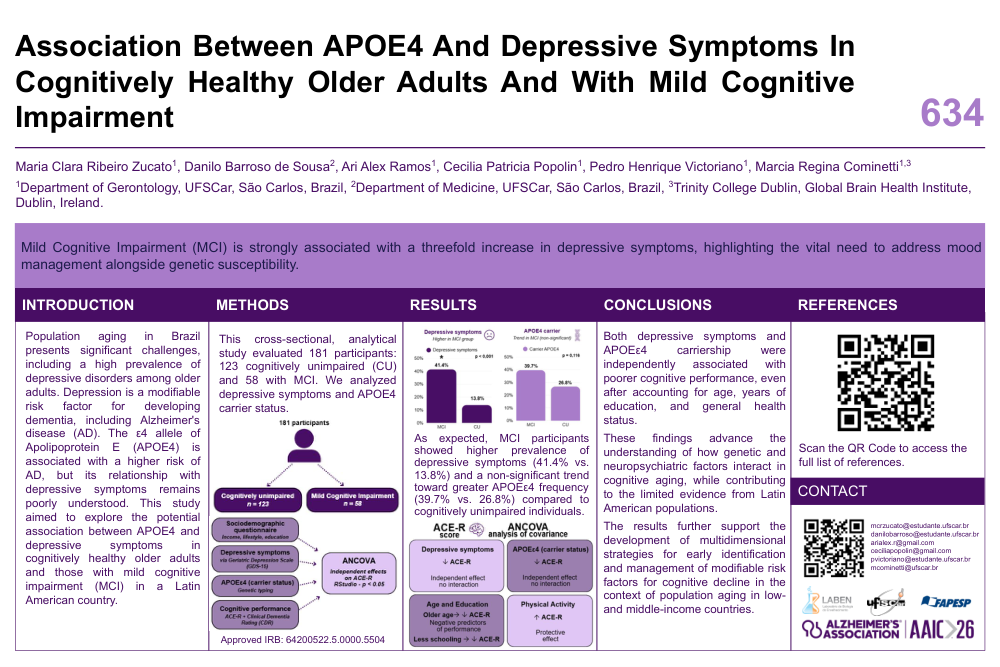
Background: Population aging in Brazil presents significant challenges, including a high prevalence of depressive disorders among older adults. Depression is a modifiable risk factor for developing dementia, including Alzheimer's disease (AD). The E4 allele of Apolipoprotein E (APOE4) is associated with a higher risk of AD, but its relationship with depressive symptoms remains poorly understood. This study aims to explore the potential association between APOE4 and depressive symptoms in cognitively healthy older adults and those with mild cognitive impairment (MCI) in a Latin American country.
Methods: This is a cross-sectional, analytical study with 181 participants, of whom 123 were cognitively unimpaired (CU), and 58 had MCI. Depressive symptoms and E4 allele carrier status were analyzed. A sociodemographic questionnaire, the Addenbrooke's Cognitive Examination Revised (ACE-R), the Clinical Dementia Rating Scale (CDR), and the Geriatric Depression Scale (GDS-15) were used in the evaluation. Statistical analyses were performed using R software. The significance level was set at p<0.05.
Results: The results showed that, as expected, individuals with MCI presented a higher frequency of depressive symptoms (41.4%) compared to CU (13.8%). The APOEε4 allele was more prevalent in the MCI (39.7%) than in the CU group (26.8%). However, the difference was not statistically significant. The analysis of covariance (ANCOVA) showed that both depressive symptoms and APOE4 carrier status were significantly associated with lower scores on the ACE-R test, indicating poorer cognitive performance. However, no interaction was observed between these factors, suggesting that their effects on cognition are independent. Advanced age and lower education were also associated with poorer performance, whereas physical activity was protective for cognition.
Conclusion: These findings contribute to understanding the interactions between genetic factors and depressive symptoms in older people, providing important data for developing strategies to prevent and manage chronic non-communicable diseases in a context of population aging.
Comments
Email is required but is not shown publicly.
Loading comments...