4,068 posters, 219 videos, 101 topics, 69 sessions, 14,365 authors, 6,128 institutions
ePostersLive by SciGen Technologies S.A. All rights reserved.
Alzheimer's Association International Conference 2026
July 12-15, 2026 | London, United Kingdom, and Online

657
Detecting MCI And Dementia Through Passive Sensing Of Lifestyle Behavior With Machine Learning Analysis: A Scoping Review
Poster Presenter
Authors
Affiliations
Part of Topic
Background:
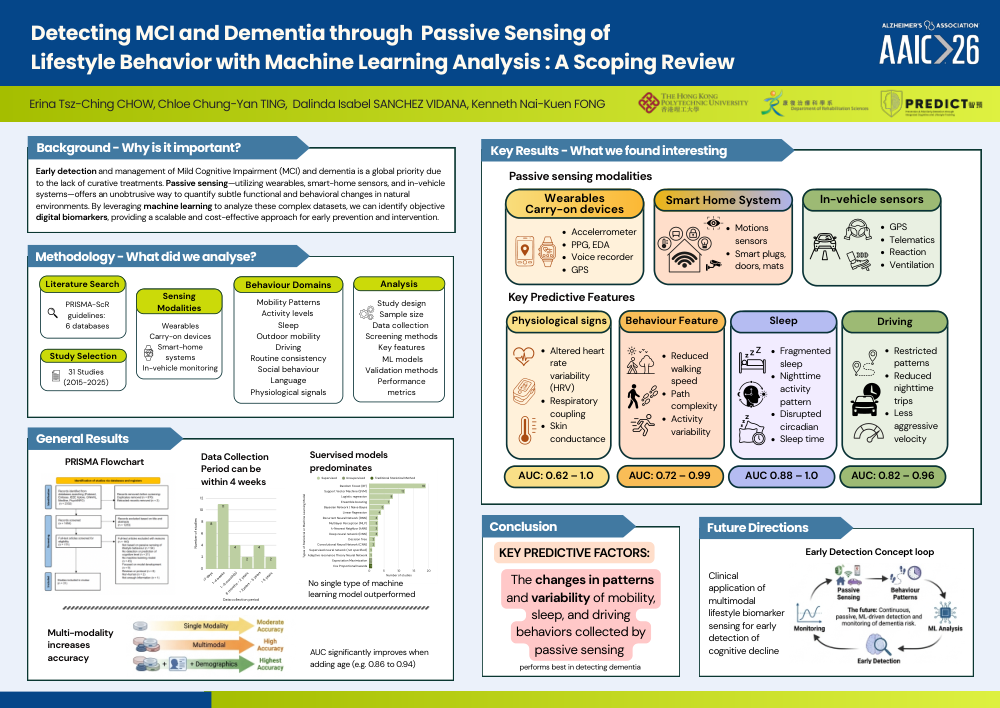
Mild cognitive impairment (MCI) and dementia are increasingly impacting older adults around the globe. Without a curative treatment, early detection is crucial. The rising use of passive sensing technology, such as wearables and sensor systems, enables measurement of subtle functional and behavioral changes associated with cognitive decline. By applying machine learning analysis, quantifying lifestyle changes may provide an alternative method for early detection and subsequent prevention and intervention.
Methods:
This scoping review included studies that compared MCI and dementia patients with healthy controls, employed passive sensing technology for data collection, measured lifestyle behavioral markers in naturalistic or home-like environments, and applied machine learning for classification or prediction of dementia. Following the PRISMA-ScR guidelines, six databases were searched, and 31 studies were included in the review. Data extracted were study design, passive sensing modality used, lifestyle behavioral markers measured, machine learning models, validation procedures, performance metrics, and key predictive features. The purpose of this scoping review is to 1) discover meaningful lifestyle behavioral markers delivering consistent results in detecting cognitive impairment, and 2) explore the performance of machine learning models in the detection of MCI and dementia.
Results:
Major passive sensing modalities include wearables and carry-on devices, smart-home infrastructure, and in-vehicle systems. Five behavioral domains were identified: indoor activity and routines, outdoor mobility and driving, sleep patterns, social/language behavior, and physiological regulation. The most predictive digital biomarkers are reduced complexity and altered regularity of behavior across sleep, mobility, daily activity and physiological domains. (e.g. Altered activity variability, restricted driving patterns, sleep fragmentation). In terms of machine learning analysis, supervised machine learning predominated, particularly random forests, gradient boosting, and support vector machines. However, validation strategies and cognitive reference standards were heterogeneous. The performance of different models across passive sensing modalities resulted in accuracy ranging from 70.4-98.4% and AUC of 0.62-1.0. Models benefit from a hybrid design, a combination of domains, and personalization.
Conclusion:
Passive sensing of lifestyle behavioral biomarker, particularly sleep and mobility, yields promising digital biomarkers for detecting and predicting cognitive impairment, with multimodal and personalized machine learning approaches showing particular potential with complex data. This proves the feasibility of employing unobtrusive, real-world monitoring for early dementia detection.
Comments
Email is required but is not shown publicly.
Loading comments...