4,068 posters, 219 videos, 101 topics, 69 sessions, 14,365 authors, 6,128 institutions
ePostersLive by SciGen Technologies S.A. All rights reserved.
Alzheimer's Association International Conference 2026
July 12-15, 2026 | London, United Kingdom, and Online

5201
Aging-related Plasma Biomarker Changes In Cognitively Normal Adults: Population-based Study In Rural Xi’An, China
Part of Topic
Aging-related Plasma Biomarker Changes In Cognitively Normal Adults: Population-based Study In Rural Xi'An, China
Author
Simeng Cui, Pejie Liu, Chunyu Li, Qiqi Qiang, Yuxuan Weng, Zijian He, Yankun Pan, Lin Wang, Qumin Qu, Ling Gao
Department of Neurology, The First Affiliated Hospital of Xi 'an Jiaotong University, Xi 'an, Shaanxi Province, China
Abstract
Background
Plasma biomarkers have been recommended for Alzheimer's disease (AD) diagnosis. However, the age-dependent trajectories and potential nonlinear associations between age and plasma biomarkers remain incompletely characterized among cognitively normal adults.
Methods
This was a population based cross-sectional study, and 780 cognitively normal adults aged 40 years or older were enrolled. The mean age was 58.14 ± 9.05 years (range: 40-85 years), with 305 men (39.0%). Plasma levels of phosphorylated tau 217 (p-tau217), phosphorylated tau 181 (p-tau181), amyloid-β42/40 ratio (Aβ42/40), glial fibrillary acidic protein (GFAP), and neurofilament light chain (NfL) were quantified using electrochemiluminescence assays. Correlation analyses and multivariable linear regression models were used to investigate the relationship between age and plasma biomarkers.
Results
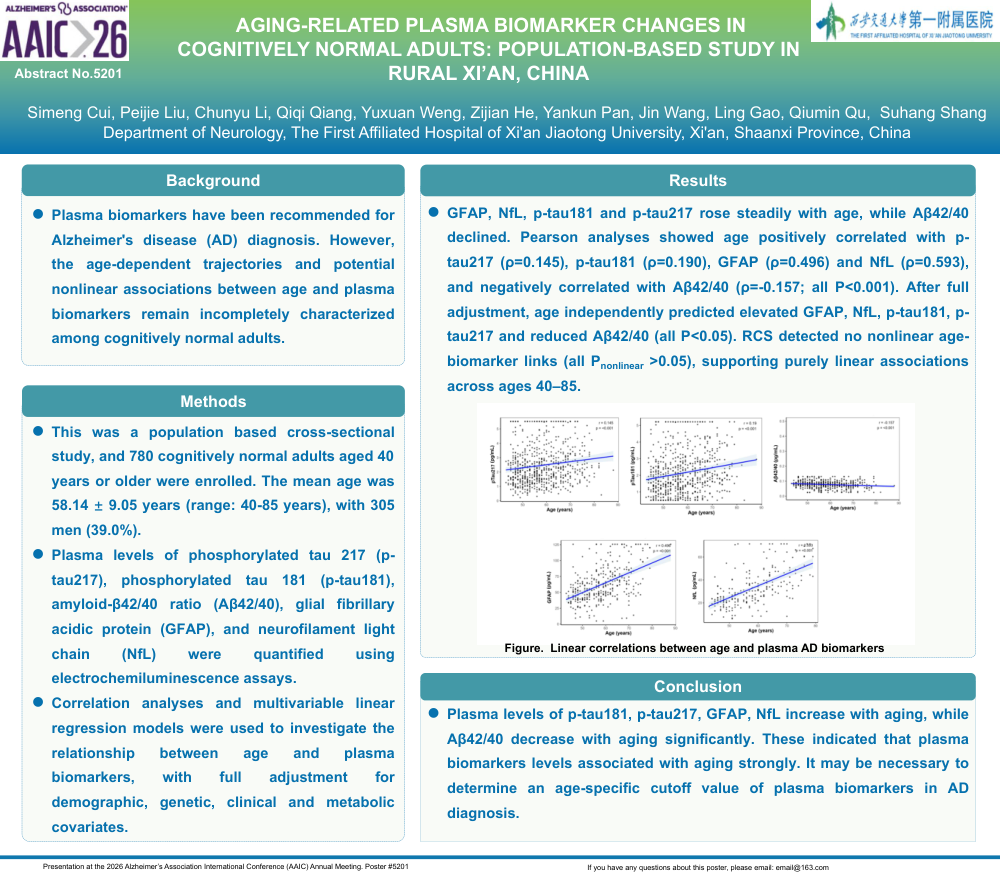
Plasma concentrations of GFAP, NfL, p-tau181, and p-tau217 increased progressively with advancing age, whereas the Aβ42/40 showed a decreasing trend. Pearson correlation analyses demonstrated positive correlations between age and p-tau217 (ρ=0.145), p-tau181 (ρ=0.190), GFAP (ρ=0.496), and NfL (ρ=0.593), while Aβ42/40 was negatively correlated with age (ρ=-0.157) (all P<0.001). In fully adjusted multivariable linear regression models, older age remained independently associated with higher levels of GFAP, NfL, p-tau181, and p-tau217, and with a lower Aβ42/40 (all P<0.05). RCS analyses revealed no statistically significant nonlinear associations for any biomarker (all Pₙₒₙₗᵢₙₑₐᵣ>0.05), indicating predominantly linear relationships between age and plasma biomarker levels across the age spectrum.
Conclusion
Plasma levels of p-tau181, p-tau217, GFAP, NfL increase with aging, while Aβ42/40 decrease with aging significantly. These indicated that plasma biomarkers levels associated with aging strongly. It may be necessary to determine an age-specific cutoff value of plasma biomarkers in AD diagnosis.
Comments
Email is required but is not shown publicly.
Loading comments...