4,068 posters, 219 videos, 101 topics, 69 sessions, 14,365 authors, 6,128 institutions
ePostersLive by SciGen Technologies S.A. All rights reserved.
Alzheimer's Association International Conference 2026
July 12-15, 2026 | London, United Kingdom, and Online

3539
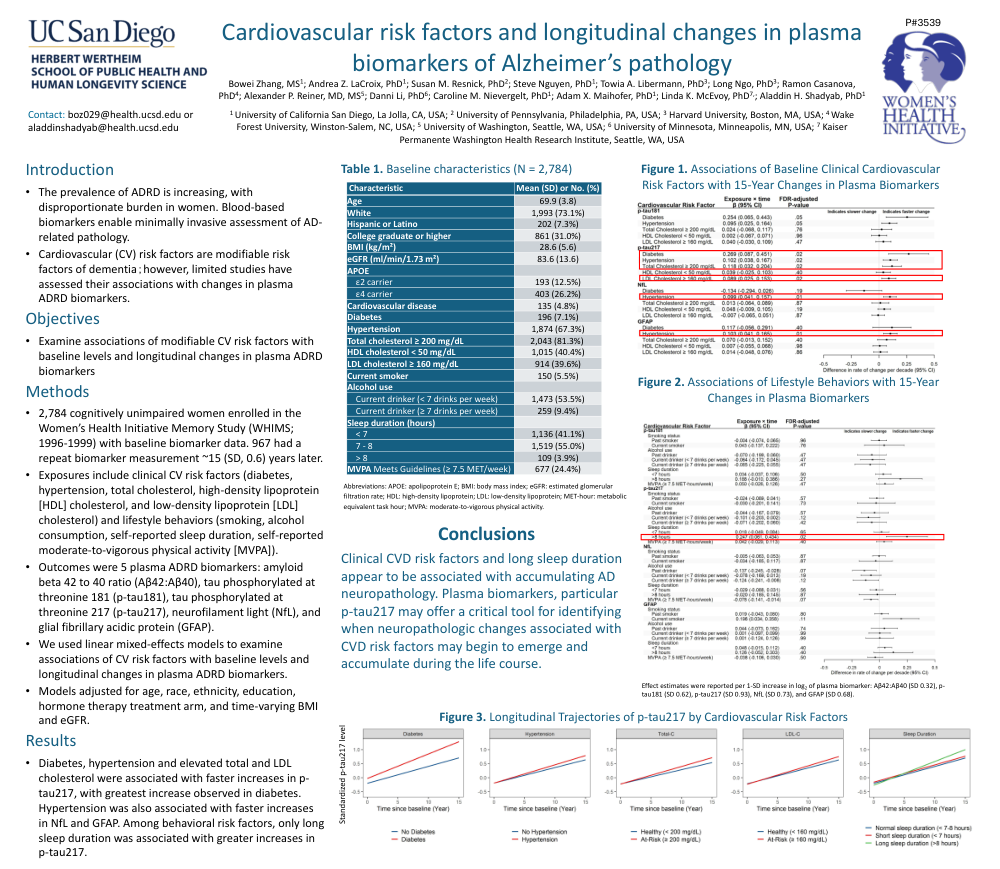
Cardiovascular Risk Factors And Longitudinal Changes In Plasma Biomarkers Of Alzheimer’S Disease Pathology
Poster Presenter
Authors
Affiliations
Part of Topic
Introduction
The prevalence of ADRD is increasing, with disproportionate burden in women. Blood-based biomarkers enable minimally invasive assessment of AD-related pathology.
Cardiovascular (CV) risk factors are modifiable risk factors of dementia;however, limited studies have assessed their associations with changes in plasma ADRD biomarkers.
Objectives
Examine associations of modifiable CV risk factors with baseline levels and longitudinal changes in plasma ADRD biomarkers
Methods
2,784 cognitively unimpaired women enrolled in the Women’s Health Initiative Memory Study (WHIMS; 1996-1999) with baseline biomarker data. 967 had a repeat biomarker measurement ~15 (SD, 0.6) years later.
Exposures include clinical CV risk factors (diabetes, hypertension, total cholesterol, high-density lipoprotein [HDL] cholesterol, and low-density lipoprotein [LDL] cholesterol) and lifestyle behaviors (smoking, alcohol consumption, self-reported sleep duration, self-reported moderate-to-vigorous physical activity [MVPA]).
Outcomes were 5 plasma ADRD biomarkers: amyloid beta 42 to 40 ratio (Aβ42:Aβ40), tau phosphorylated at threonine 181 (p-tau181), tau phosphorylated at threonine 217 (p-tau217), neurofilament light (NfL), and glial fibrillary acidic protein (GFAP).
We used linear mixed-effects models to examine associations of CV risk factors with baseline levels and longitudinal changes in plasma ADRD biomarkers.
Models adjusted for age, race, ethnicity, education, hormone therapy treatment arm, and time-varying BMI and eGFR.
Results
Diabetes, hypertension and elevated total and LDL cholesterol were associated with faster increases in p-tau217, with greatest increase observed in diabetes. Hypertension was also associated with faster increases in NfL and GFAP. Among behavioral risk factors, only long sleep duration was associated with greater increases in p-tau217.
Conclusions
Clinical CVD risk factors and long sleep duration appear to be associated with accumulating AD neuropathology. Plasma biomarkers, particular p-tau217 may offer a critical tool for identifying when neuropathologic changes associated with CVD risk factors may begin to emerge and accumulate during the life course.
Comments
Email is required but is not shown publicly.
Loading comments...