4,068 posters, 219 videos, 101 topics, 69 sessions, 14,365 authors, 6,128 institutions
ePostersLive by SciGen Technologies S.A. All rights reserved.
Alzheimer's Association International Conference 2026
July 12-15, 2026 | London, United Kingdom, and Online

7208
Detecting Semantic Variant Primary Progressive Aphasia In Latinos Via Digital Word Property Markers
Poster Presenter
Authors
Lucas Federico Sterpin, Florentina Morello-Garcia, Nicolás Pelella, Jeremías Inchauspe, Franco Ferrante, Gonzalo Pérez, Jet M. J. Vonk, Agustina Birba, Lucia Amoruso, Marilu Gorno-Tempini, Agustín Ibañez, Adolfo M. García
Affiliations
Cognitive Neuroscience Center, Department of Life and Behavioral Sciences, San Andrés University, Buenos Aires, Argentina, Institute of Neurosciences (INEU), Fleni-CONICET, Buenos Aires, Argentina, Memory and Aging Center, Department of Neurology, University of California San Francisco, California, United States, Basque Center on Cognition, Brain and Language (BCBL), San Sebastian, Spain, Global Brain Health Institute, University of California, San Francisco, CA, USA; Trinity College Dublin, Dublin, Ireland
Part of Topic
Video
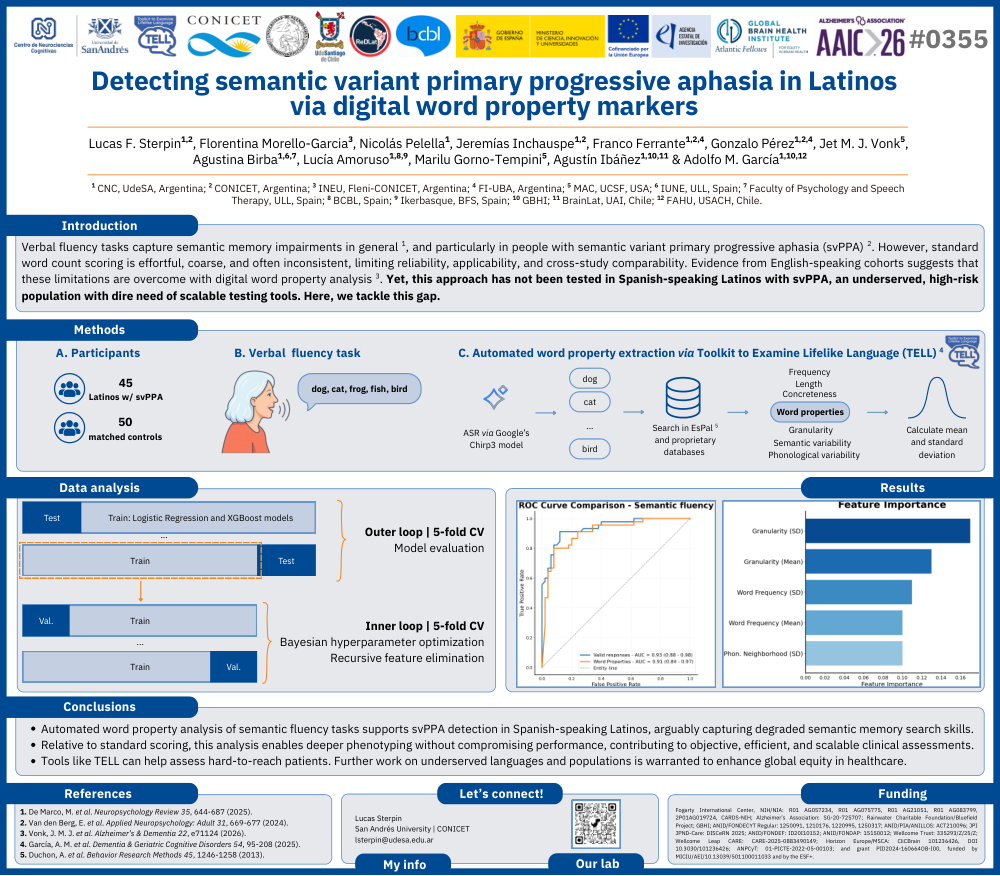
Background: Verbal fluency tasks detect semantic memory deficits in general, and particularly in people with semantic variant primary progressive aphasia (svPPA). However, standard word count scoring is effortful, coarse, and often inconsistent, limiting applicability, reliability, and cross-study comparability. Evidence from English-speaking cohorts suggests that these limitations are overcome by digital word property analysis. Yet, this approach has not been tested in Spanish-speaking Latinos with svPPA, an underserved, high-risk population with dire need of scalable testing tools. Here we tackle this gap.
Methods: Seventy-seven participants from the ReDLat consortium (36 svPPA patients, 41 demographically-matched controls) completed semantic (‘animals’) and phonemic (/p/) fluency tasks. We computed item-level word properties (frequency, phonemic length, phonological neighbors, concreteness, granularity, semantic and phonological variability), alongside whole-task audio features (pitch, voice quality, speech timing). Features were fed to a Logistic Regression classifier to discriminate between groups, with 5-fold nested cross-validation, recursive feature elimination and Bayesian hyperparameter optimization across ten seeds. Scores were bootstrapped to obtain 95% confidence intervals.
Results: For the semantic fluency task, word properties yielded robust classification [Logistic Regression: ROC-AUC = 0.91 (0.81-0.96)], surpassing audio features alone [0.77 (0.66-0.87)] and matching the combination of both features types [0.91 (0.82-0.95)]. Chance-level results were obtained upon shuffling labels [0.49 (0.39-0.57)]. Top features were granularity, number of phonemes, concreteness, and semantic variability. Conversely, analyses of phonemic fluency alone yielded near-chance results [Word properties = 0.57 (0.44-0.67); audio = 0.59 (0.49-0.70); combination = 0.61 (0.50-0.72)]. Combining both tasks did not improve performance [best ROC-AUC = 0.90 (0.81-0.95)].
Conclusions: Digital word property analyses of semantic fluency tasks seems to support svPPA detection in Spanish-speaking Latinos, arguably capturing degraded semantic memory search skills. These tools provide an objective, automated resource for scalable clinical testing in this underserved population.
Comments
Email is required but is not shown publicly.
Loading comments...