4,068 posters, 219 videos, 101 topics, 69 sessions, 14,365 authors, 6,128 institutions
ePostersLive by SciGen Technologies S.A. All rights reserved.
Alzheimer's Association International Conference 2026
July 12-15, 2026 | London, United Kingdom, and Online

9197
Social Determinants Of Health Are Associated With Plasma Proteomic Signatures Of Neurodegeneration In Latin America
Part of Topic
Social Determinants Of Health Are Associated With Plasma Proteomic Signatures Of Neurodegeneration In Latin America
Matías Nicolás Pizarro, Ziyi Li, Ariel Caviedes, Joaquin Migeot, Federica Anastasi, Natalia Vilor-Tejedor, Paulina Orellana, Nickole Marin, Carolina Ochoa-Rosales, Felipe Cabral-Miranda, Hernando Santamaría-García, Paola Murgas, Andrea Slachevsky, David Aguillón, Diana L. Matallana, José Alberto Avila-Funes, Leonel T. Takada, Juliana Acosta-Uribe, Maria Isabel Behrens, J. Nicholas Cochran, Martin Bruno, Nilton Custodio, Rosa Montesinos, Shireen Javandel, Stefanie D. Pina-Escudero, Sid E. O’Bryant, Mike A. Nalls, Mark R. Cookson, Enzo Tagliazucchi, Jennifer S. Yokoyama, Agustin Ibáñez, Yue Andy Qi, Claudia Duran-Aniotz, and the Multi-Partner Consortium to Expand Dementia Research in Latin America (ReDLat).
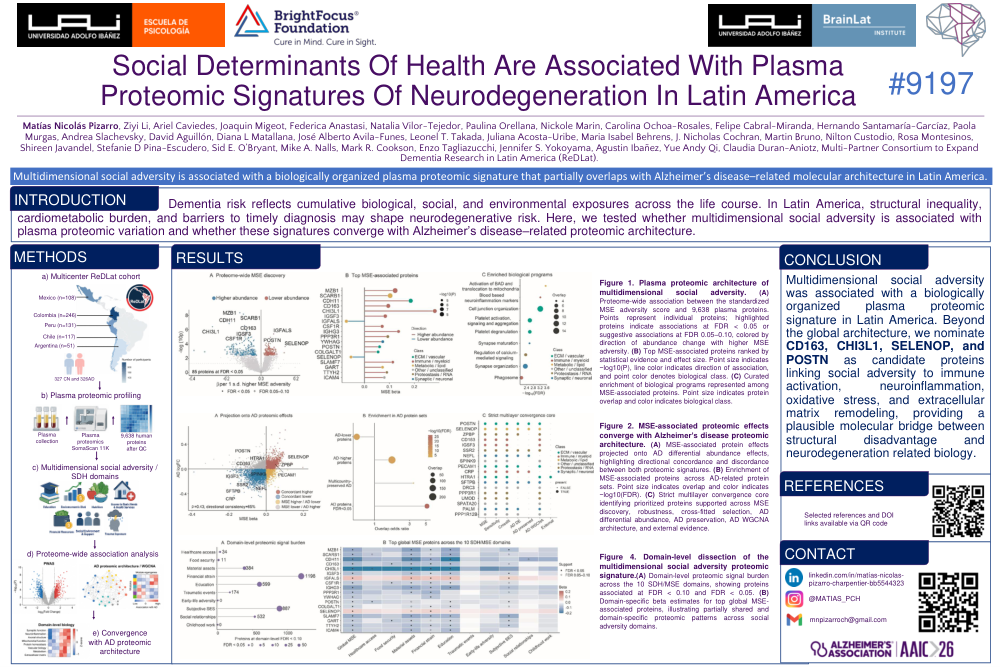
Multidimensional social adversity is associated with a biologically organized plasma proteomic signature that partially overlaps with Alzheimer’s disease-related molecular architecture in Latin America.
Introduction: Dementia risk reflects cumulative biological, social, and environmental exposures across the life course. In Latin America, structural inequality, cardiometabolic burden, and barriers to timely diagnosis may shape neurodegenerative risk. Here, we tested whether multidimensional social adversity is associated with plasma proteomic variation and whether these signatures converge with Alzheimer’s disease-related proteomic architecture.
Methods: We analyzed a multicenter ReDLat cohort including 327 cognitively normal individuals and 326 Alzheimer’s disease patients from Mexico, Colombia, Peru, Chile, and Argentina. Plasma proteomic profiling was performed using SomaScan 11K, yielding 9,638 human proteins after quality control. Multidimensional social adversity was assessed using social determinants of health domains. Proteome-wide association analyses tested associations between MSE adversity and plasma protein abundance. We further evaluated convergence with Alzheimer’s disease proteomic architecture.
Results: Multidimensional social adversity was associated with a biologically organized plasma proteomic signature. MSE-associated proteins were enriched in biological programs related to immune activation, vascular biology, extracellular matrix remodeling, oxidative stress, metabolism, and neurodegeneration-related processes. MSE-associated proteomic effects partially overlapped with Alzheimer’s disease proteomic architecture. Domain-level analyses showed both shared and domain-specific proteomic patterns across social determinants of health domains.
Conclusion: Multidimensional social adversity was associated with a biologically organized plasma proteomic signature in Latin America. Beyond the global architecture, we nominate CD163, CHI3L1, SELENOP, and POSTN as candidate proteins linking social adversity to immune activation, neuroinflammation, oxidative stress, and extracellular matrix remodeling, providing a plausible molecular bridge between structural disadvantage and neurodegeneration-related biology.
Keywords: social determinants of health; plasma proteomics; Alzheimer’s disease; neurodegeneration; Latin America.
Comments
Email is required but is not shown publicly.
Loading comments...