4,068 posters, 219 videos, 101 topics, 69 sessions, 14,365 authors, 6,128 institutions
ePostersLive by SciGen Technologies S.A. All rights reserved.
Alzheimer's Association International Conference 2026
July 12-15, 2026 | London, United Kingdom, and Online

10305
Reliability And Agreement Of The Cognitive Domains And Functional Assessment Questionnaire - Informant Version (CDFAQ-IV)
Poster Presenter
Authors
Iara Souza Santos, João Vitor da Silva Viana, Aline Siqueira de Souza, Giovanna Correia Pereira Moro, Caio Peixoto Tavares, Isabelle de Aguiar Maia, Guilherme Vieira Rodrigues da Costa, Alberto Fonseca Lopes Rodrigues, Joice Coutinho de Alvarenga, Gabriela Tomé Oliveira Engelmann, Marco Aurélio Fagundes Angelo, Débora Marques de Miranda, Marco Aurélio Romano-silva, Jonas Jardim de Paula, Luiz Armando Cunha de Marco, Maria Aparecida Camargos Bicalho, Bernardo de Mattos Viana
Affiliations
Undergraduate Medicine, Federal University of Minas Gerais, Belo Horizonte, Minas Gerais, Brazil; Cog-Aging Research Group, Universidade Federal de Minas Gerais (UFMG), Belo Horizonte, Minas Gerais, Brazil, Cog-Aging Research Group, Universidade Federal de Minas Gerais (UFMG), Belo Horizonte, Minas Gerais, Brazil, Molecular Medicine Postgraduate Program, School of Medicine, Universidade Federal de Minas Gerais (UFMG), Belo Horizonte, Minas Gerais, Brazil; Department of Internal Medicine, School of Medicine, Federal University of Minas gerais, Belo Horizonte, Minas Gerais, Brazil, Older Adult’s Psychiatry and Psychology Extension Program (PROEPSI), School of Medicine, Universidade Federal de Minas Gerais (UFMG), Belo Horizonte, Minas Gerais, Brazil, Federal University of Minas Gerais, Belo Horizonte, Minas Gerais, Brazil, Neurotec R National Institute of Science and Technology (INCT-Neurotec R), Faculty of Medicine, Universidade Federal de Minas Gerais (UFMG), Belo Horizonte, Minas Gerais, Brazil, Molecular Medicine Postgraduate Program, School of Medicine, Universidade Federal de Minas Gerais (UFMG), Belo Horizonte, Minas Gerais, Brazil
Part of Topic
Video
Reliability And Agreement Of The Cognitive Domains And Functional Assessment Questionnaire - Informant Version (CDFAQ-IV)
Iara Souza Santos1,2, João Vitor da Silva Viana1,2, Aline Siqueira de Souza2, Giovanna Correia Pereira Moro1,2, Caio Peixoto Tavares2, Isabelle de Aguiar Maia3, Guilherme Vieira Rodrigues da Costa3, Alberto Fonseca Lopes Rodrigues3, Joice Coutinho de Alvarenga2, Gabriela Tomé Oliveira Engelmann2, Marco Aurélio Fagundes Angelo4, Débora Marques de Miranda5, Marco Aurélio Romano-silva5, Jonas Jardim de Paula6, Luiz Armando Cunha de Marco5, Maria Aparecida Camargos Bicalho6,7, Bernardo de Mattos Viana6.
1Undergraduate Medicine, Federal University of Minas Gerais, Belo Horizonte, Minas Gerais, Brazil, 2Cog-Aging Research Group, Universidade Federal de Minas Gerais (UFMG), Belo Horizonte, Minas Gerais, Brazil, 3Older Adult’s Psychiatry and Psychology Extension Program (PROEPSI), School of Medicine, Universidade Federal de Minas Gerais (UFMG), Belo Horizonte, Minas Gerais, Brazil, 4Federal University of Minas Gerais, Belo Horizonte, Minas Gerais, Brazil, 5Neurotec R National Institute of Science and Technology (INCT-Neurotec R), Faculty of Medicine, Universidade Federal de Minas Gerais (UFMG), Belo Horizonte, Minas Gerais, Brazil, 6Molecular Medicine Postgraduate Program, School of Medicine, Universidade Federal de Minas Gerais (UFMG), Belo Horizonte, Minas Gerais, Brazil, 7Department of Internal Medicine, School of Medicine, Federal University of Minas Gerais, Belo Horizonte, Minas Gerais, Brazil.
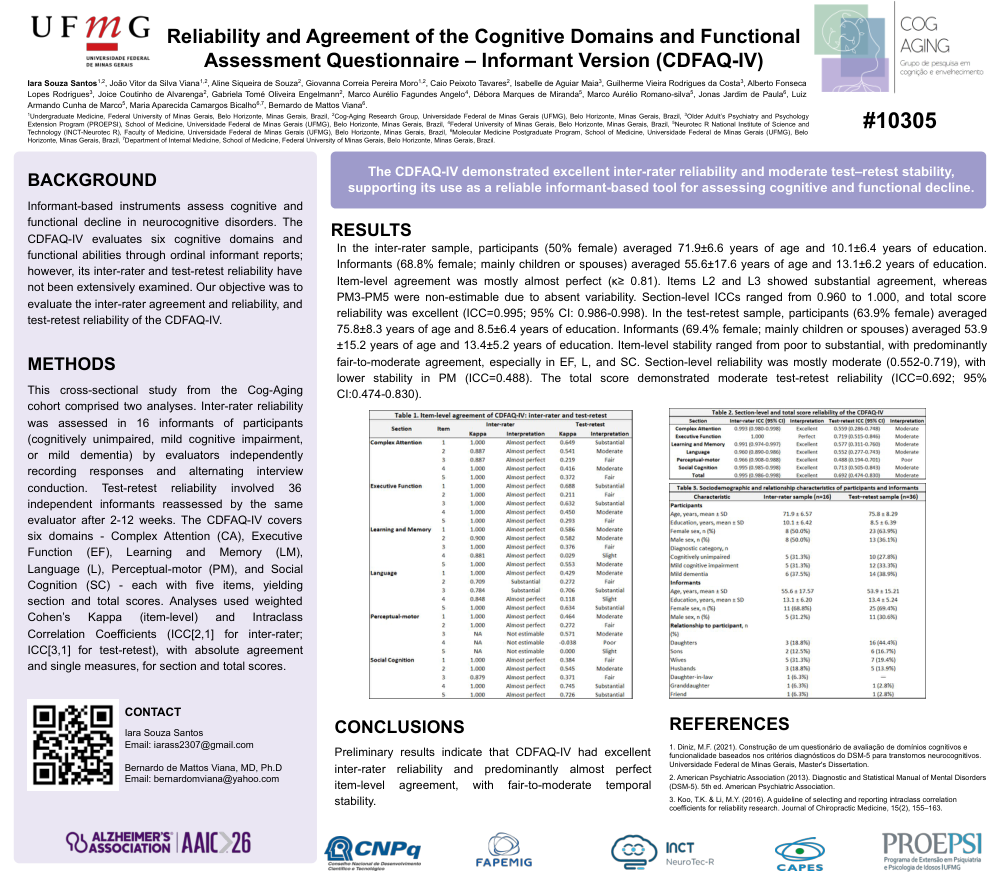
The CDFAQ-IV demonstrated excellent inter-rater reliability and moderate test–retest stability, supporting its use as a reliable informant-based tool for assessing cognitive and functional decline.
BACKGROUND Informant-based instruments assess cognitive and functional decline in neurocognitive disorders. The CDFAQ-IV evaluates six cognitive domains and functional abilities through ordinal informant reports; however, its inter-rater and test-retest reliability have not been extensively examined. Our objective was to evaluate the inter-rater agreement and reliability, and test-retest reliability of the CDFAQ-IV.
METHODS This cross-sectional study from the Cog-Aging cohort comprised two analyses. Inter-rater reliability was assessed in 16 informants of participants (cognitively unimpaired, mild cognitive impairment, or mild dementia) by evaluators independently recording responses and alternating interview conduction. Test-retest reliability involved 36 independent informants reassessed by the same evaluator after 2-12 weeks. The CDFAQ-IV covers six domains - Complex Attention (CA), Executive Function (EF), Learning and Memory (LM), Language (L), Perceptual-motor (PM), and Social Cognition (SC) - each with five items, yielding section and total scores. Analyses used weighted Cohen’s Kappa (item-level) and Intraclass Correlation Coefficients (ICC[2,1] for inter-rater; ICC[3,1] for test-retest), with absolute agreement and single measures, for section and total scores.
RESULTS In the inter-rater sample, participants (50% female) averaged 71.9±6.6 years of age and 10.1±6.4 years of education. Informants (68.8% female; mainly children or spouses) averaged 55.6±17.6 years of age and 13.1±6.2 years of education. Item-level agreement was mostly almost perfect (κ≥ 0.81). Items L2 and L3 showed substantial agreement, whereas PM3-PM5 were non-estimable due to absent variability. Section-level ICCs ranged from 0.960 to 1.000, and total score reliability was excellent (ICC=0.995; 95% CI: 0.986-0.998). In the test-retest sample, participants (63.9% female) averaged 75.8±8.3 years of age and 8.5±6.4 years of education. Informants (69.4% female; mainly children or spouses) averaged 53.9±15.2 years of age and 13.4±5.2 years of education. Item-level stability ranged from poor to substantial, with predominantly fair-to-moderate agreement, especially in EF, L, and SC. Section-level reliability was mostly moderate (0.552-0.719), with lower stability in PM (ICC=0.488). The total score demonstrated moderate test-retest reliability (ICC=0.692; 95% CI:0.474-0.830).
CONCLUSION Preliminary results indicate that CDFAQ-IV had excellent inter-rater reliability and predominantly almost perfect item-level agreement, with fair-to-moderate temporal stability.
REFERENCES 1. Diniz, M.F. (2021). Construção de um questionário de avaliação de domínios cognitivos e funcionalidade baseados nos critérios diagnósticos do DSM-5 para transtornos neurocognitivos. Universidade Federal de Minas Gerais, Master's Dissertation. 2. American Psychiatric Association (2013). Diagnostic and Statistical Manual of Mental Disorders (DSM-5). 5th ed. American Psychiatric Association. 3. Koo, T.K. & Li, M.Y. (2016). A guideline of selecting and reporting intraclass correlation coefficients for reliability research. Journal of Chiropractic Medicine, 15(2), 155–163.
CONTACT Iara Souza Santos Email: iarass2307@gmail.com Bernardo de Mattos Viana, MD, Ph.D Email: bernardomviana@yahoo.com
Comments
Email is required but is not shown publicly.
Loading comments...