4,068 posters, 219 videos, 101 topics, 69 sessions, 14,365 authors, 6,128 institutions
ePostersLive by SciGen Technologies S.A. All rights reserved.
Alzheimer's Association International Conference 2026
July 12-15, 2026 | London, United Kingdom, and Online

1794
Effect Of Polygenic Risk Scores For Alzheimer's Disease On Longitudinal Cerebrospinal Fluid Biomarkers
Part of Topic
INTRODUCTION
Investigating polygenic risk scores (PRSs) may increase understanding of the concurrent effect of multiple genes on sporadic Alzheimer's disease (AD) and prediction of change in disease mechanisms over time. Research regarding associations between PRSs and AD specific longitudinal cerebrospinal fluid (CSF) biomarkers is limited. Although some research exists, findings are inconsistent, and the effect of different PRSs have not been examined within the same cohort nor has their effect been assessed longitudinally following patient stratification by clinical diagnosis and Apolipoprotein E (APOE) status.
OBJECTIVE
To investigate the effect of PRSs for AD on CSF biomarkers, longitudinally, in those along the clinical continuum of sporadic AD.
METHODOLOGY
Data from 171 individuals participating in the Alzheimer’s Disease Neuroimaging Initiative were examined, (mean age in years: 73.30 ± 7.58).
CSF measures of amyloid beta (Aβ42) and phosphorylated tau (p-tau181) were examined over 24 months.
Three sets of PRSs* were constructed using three thresholds: APOEonlyPRS Threshold 1 = 51 single nucleotide polymorphisms (SNPs); APOEonlyPRS Threshold 2 = 96 SNPs; APOEonlyPRS Threshold 3 = 390 SNPs; PRSwithAPOE Threshold 1 = 172 SNPs; PRSwithAPOE Threshold 2 = 1561 SNPs; PRSwithAPOE Threshold 3 = 455028SNPs; PRSwithoutAPOE Threshold 1 = 121 SNPs; PRSwithoutAPOE Threshold 2 = 1465 SNPs; PRSwithoutAPOE Threshold 3 = 454638 SNPs. *SNPs within the entire APOE region were considered, rather than ɛ2 and ɛ4 only.
Binomial hierarchical logistic regression and multiple hierarchical linear regression models were used to account for the effect of demographic and clinical confounding variables, as follows: • Model 1: Age, sex, education, first degree family history of AD, MMSE, and x10 genetic principal components** • Model 2: All variablesused in Model 1, plus PRS. **the alternate CSF biomarker was also added.
Before constructing PRSs: • Select discovery/training sample that has AD genome-wide association study (GWAS) summary statistics. • Select independent / target sample on which GWAS has also been conducted. • Note common variants between both samples. • Limit SNPs to those that are closely associated by using the optimal p threshold.
Constructing PRSs: • Take the sum of all risk alleles in the independent GWAS. • These alleles are weighted by each risk allele’s effect size, that has been estimated from the discovery GWAS. • Calculate for each individual.
RESULTS
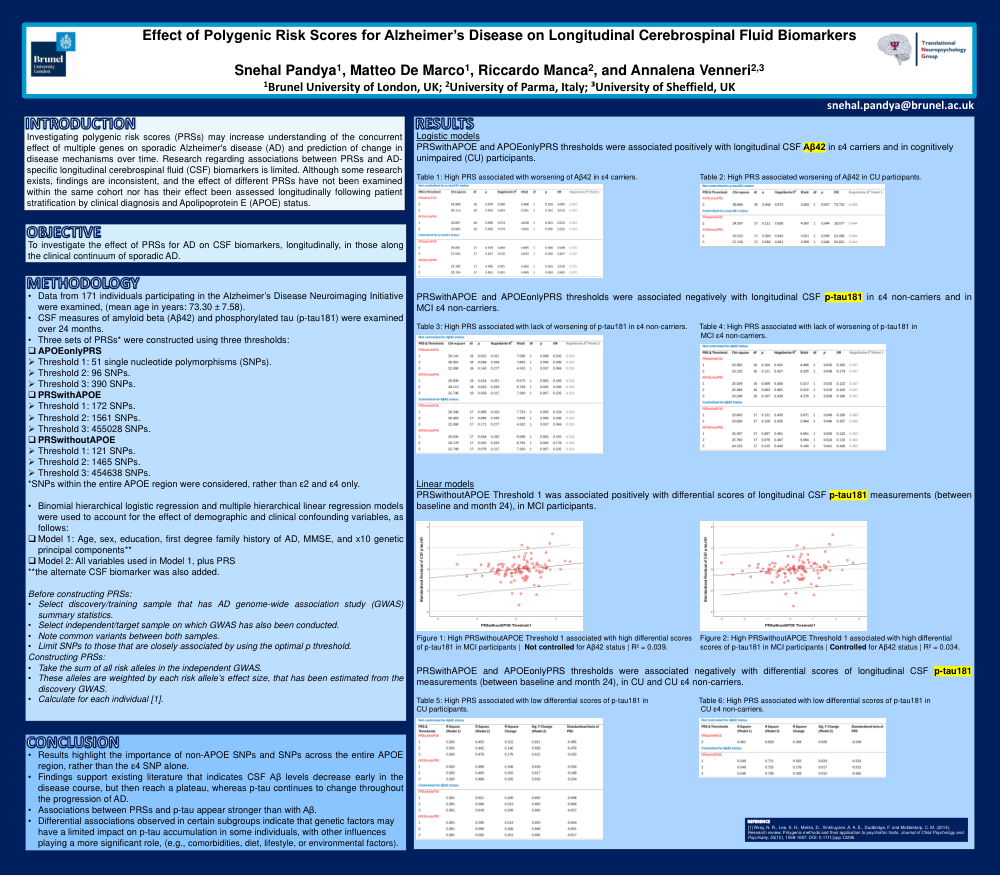
Logistic Models: PRSwithAPOE and APOEonlyPRS thresholds were associated positively with longitudinal CSF Aβ42 in ɛ4 carriers and in cognitively unimpaired (CU) participants. PRSwithAPOE and APOEonlyPRS thresholds were associated negatively with longitudinal CSF p-tau181 in ɛ4 non-carriers and in MCI ɛ4 non-carriers.
Linear Models: PRSwithoutAPOE Threshold 1 was associated positively with differential scores of longitudinal CSF p-tau181 measurements (between baseline and month 24), in MCI participants. PRSwithAPOE and APOEonlyPRS thresholds were associated negatively with differential scores of longitudinal CSF p-tau181 measurements (between baseline and month 24), in CU and CU ɛ4 non-carriers.
CONCLUSION
Results highlight the importance of non-APOE SNPs and SNPs across the entire APOE region, rather than the ɛ4 SNP alone.
Findings support existing literature that indicates CSF Aβ levels decrease early in the disease course, but then reach a plateau, whereas p-tau continues to change throughout the progression of AD.
Associations between PRSs and p-tau appear stronger than with Aβ.
Differential associations observed in certain subgroups indicate that genetic factors may have a limited impact on p-tau accumulation in some individuals, with other influences playing a more significant role, (e.g., comorbidities, diet, lifestyle, or environmental factors).
Comments
Email is required but is not shown publicly.
Loading comments...