4,068 posters, 219 videos, 101 topics, 69 sessions, 14,365 authors, 6,128 institutions
ePostersLive by SciGen Technologies S.A. All rights reserved.
Alzheimer's Association International Conference 2026
July 12-15, 2026 | London, United Kingdom, and Online

717
Kolaviron Ameliorates Cognitive Deficits And Neuronal Degeneration Induced By D-galactose In Mice.
Poster Presenter
Part of Topic
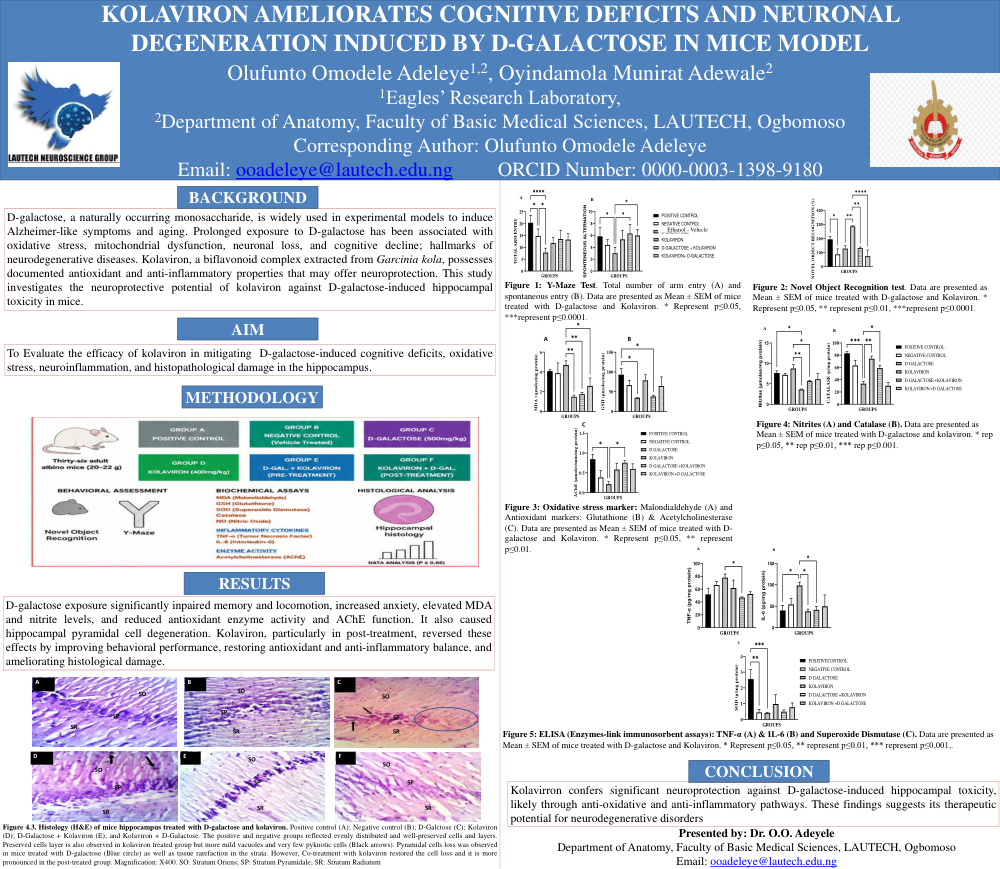
KOLAVIRON AMELIORATES COGNITIVE DEFICITS AND NEURONAL DEGENERATION INDUCED-BY D-GALACTOSE IN MICE MODEL
Olufunto Omodele, ADELEYE1,2,Munirat Oyindamola, ADEWALE1,2
1Department of Anatomy, Ladoke Akintola University of Technology, Ogbomosho, Nigeria
2Eagles’ Research Laboratory, Ladoke Akintola University of Technology, Ogbomosho, Oyo State, Nigeria
*Corresponding Author: Olufunto Omodele Adeleye, (Email: ooadeleye@lautech.edu.ng, ORCID ID: 0000-0003-1398-9180)
ABSTRACT
Background: D-galactose, a naturally occurring monosaccharide, is widely used in experimental models to induce aging. Prolonged exposure to D-galactose has been associated with oxidative stress, mitochondrial dysfunction, neuronal loss, and cognitive decline hallmarks of neurodegenerative diseases such as Alzheimer’s disease. Kolaviron, a biflavonoid complex extracted from Garcinia kola, possesses documented antioxidant and anti-inflammatory properties that may offer neuroprotection. This study investigates the neuroprotective potential of kolaviron against D-galactose-induced hippocampal toxicity in mice.
Aim: To evaluate the efficacy of kolaviron in mitigating D-galactose-induced cognitive deficits, oxidative stress, neuroinflammation, and histopathological damage in the hippocampus.
Method: Thirty-six adult albino mice (20–22 g) were assigned to six groups including control, D-galactose (50 mg/kg), kolaviron (400 mg/kg), and co-treatment groups. Neurobehavioral tests Open Field Test, Y-Maze, and Novel Object Recognition assessed anxiety, locomotor activity, and memory. Biochemical assays measured oxidative stress markers (MDA, GSH, SOD, catalase), inflammatory cytokines (TNF-α, IL-6), and acetylcholinesterase activity. Hippocampal histology was evaluated via H&E staining. Data were analyzed using ANOVA with significance at p ≤ 0.05.
Results: D-galactose exposure significantly impaired memory and locomotion, increased anxiety, elevated MDA and nitrite levels, and reduced antioxidant enzyme activity and AChE function. It also caused hippocampal pyramidal cell degeneration. Kolaviron, particularly in post-treatment, reversed these effects by improving behavioral performance, restoring antioxidant and anti-inflammatory balance, and ameliorating histological damage.
Conclusion: Kolaviron confers significant neuroprotection against D-galactose-induced hippocampal toxicity, likely through antioxidative and anti-inflammatory pathways. These findings suggest its therapeutic potential for neurodegenerative disorders such as Alzheimer’s disease.
Keywords: Kolaviron, D-galactose, Neuroprotection, Oxidative stress, Inflammation, Cognitive impairment, Hippocampus
Comments
Email is required but is not shown publicly.
Loading comments...