4,068 posters, 219 videos, 101 topics, 69 sessions, 14,365 authors, 6,128 institutions
ePostersLive by SciGen Technologies S.A. All rights reserved.
Alzheimer's Association International Conference 2026
July 12-15, 2026 | London, United Kingdom, and Online

4044
Amyloid ί40-stimulated Endothelial Exosomes Induce Lysosomal Failure In Disease-associated Microglia To Exacerbate CAA
Poster Presenter
Part of Topic
Title
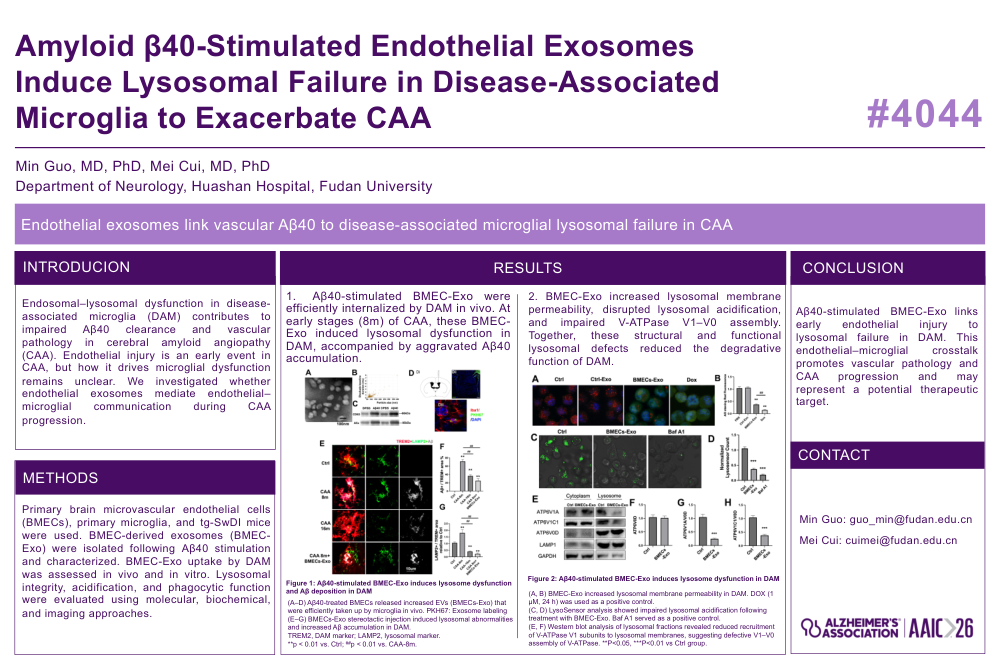
Amyloid β40-Stimulated Endothelial Exosomes Induce Lysosomal Failure in Disease-Associated Microglia to Exacerbate CAA
Abstract
Background:
Endosomal–lysosomal dysfunction in disease-associated microglia (DAM) is increasingly recognized as a central driver of impaired amyloid β40 (Aβ40) clearance and vascular pathology in cerebral amyloid angiopathy (CAA). Endothelial cell injury represents one of the earliest pathological events in CAA, yet how vascular injury is translated into microglial lysosomal dysfunction remains poorly understood. Extracellular vesicles (EVs) are key mediators of intercellular communication, prompting us to investigate whether injured endothelial cells propagate pathogenic signals to DAM via an EV-dependent mechanism.
Methods:
In vivo and in vitro approaches were employed, including tg-SwDI mice, primary brain microvascular endothelial cells (BMECs), and primary microglia. BMECs-derived EVs (BEEVs) were isolated and characterized following Aβ40 exposure. EEVs’ uptake by DAM was assessed both in vivo and in vitro. Lysosomal structure, acidification, and phagocytic capacity of DAM were evaluated using molecular, biochemical, and imaging approaches. Associations between DAM lysosomal dysfunction, vascular Aβ deposition, and vascular injury were examined.
Results:
Aβ40-stimulated BEEVs were efficiently internalized by DAM both in vivo and in vitro. At early stages of CAA, these BEEVs induced convergent lysosomal dysfunction in DAM through two coordinated mechanisms. First, EV uptake activated the TLR4–TBK1/IKKε–Peli1 signaling pathway, leading to degradation of the lysosomal structural protein LAMP2 and increased lysosomal membrane permeability. Second, EVs promoted upregulation of the glycosyltransferase NDST3 in DAM, impairing V-ATPase V1–V0 assembly and disrupting lysosomal acidification. Together, these structural and functional lysosomal defects reduced degradative capacity, compromised DAM phagocytic function, and enhanced the release of pro-inflammatory factors. Functionally, DAM dysfunction was associated with aggravated vascular Aβ40 pathology and accelerated progression of vascular injury.
Conclusions:
These findings identify BEEVs as an endothelial-microglia communication axis that links early endothelial injury to lysosomal failure in DAM during CAA progression. This endothelial–microglial interaction represents a previously underappreciated mechanism contributing to CAA progression and highlights endothelial exosome signaling as a potential therapeutic target in vascular contributions to CAA.
Comments
Email is required but is not shown publicly.
Loading comments...