4,068 posters, 219 videos, 101 topics, 69 sessions, 14,365 authors, 6,128 institutions
ePostersLive by SciGen Technologies S.A. All rights reserved.
Alzheimer's Association International Conference 2026
July 12-15, 2026 | London, United Kingdom, and Online

4954
Metallic Dysfunction Across Huntington's Heart And Brain In Mice And Humans
Part of Topic
Metallic Dysfunction Across Huntington's Heart And Brain In Mice And Humans
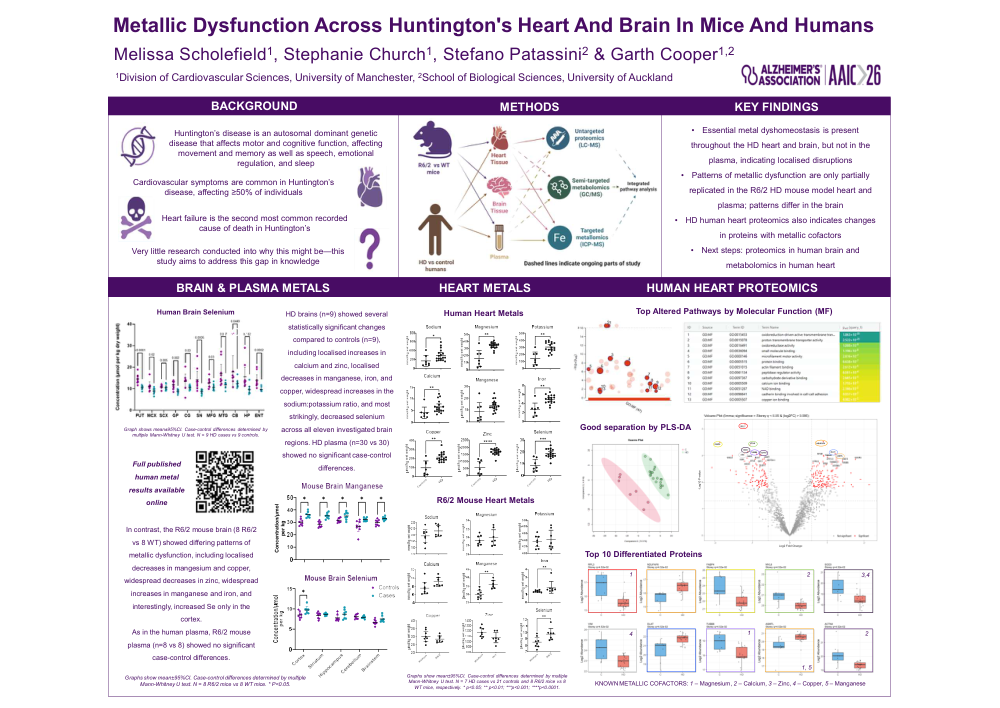
Huntington’s disease is an autosomal dominant genetic disease that affects motor and cognitive function, affecting movement and memory as well as speech, emotional regulation, and sleep
Cardiovascular symptoms are common in Huntington’s disease, affecting ≥50% of individuals
Heart failure is the second most common recorded cause of death in Huntington’s
Very little research conducted into why this might be—this study aims to address this gap in knowledge
Brain Metals
HD brains (n=9) showed several statistically significant changes compared to controls (n=9), including localised increases in calcium and zinc, localised decreases in manganese, iron, and copper, widespread increases in the sodium:potassium ratio, and most strikingly, decreased selenium across all eleven investigated brain regions. HD plasma (n=30 vs 30) showed no significant case-control differences.
In contrast, the R6/2 mouse brain (8 R6/2 vs 8 WT) showed differing patterns of metallic dysfunction, including localised decreases in mangesium and copper, widespread decreases in zinc, widespread increases in manganese and iron, and interestingly, increased Se only in the cortex.
As in the human plasma, R6/2 mouse plasma (n=8 vs 8) showed no significant case-control differences.
Key Findings
Comments
Email is required but is not shown publicly.
Loading comments...